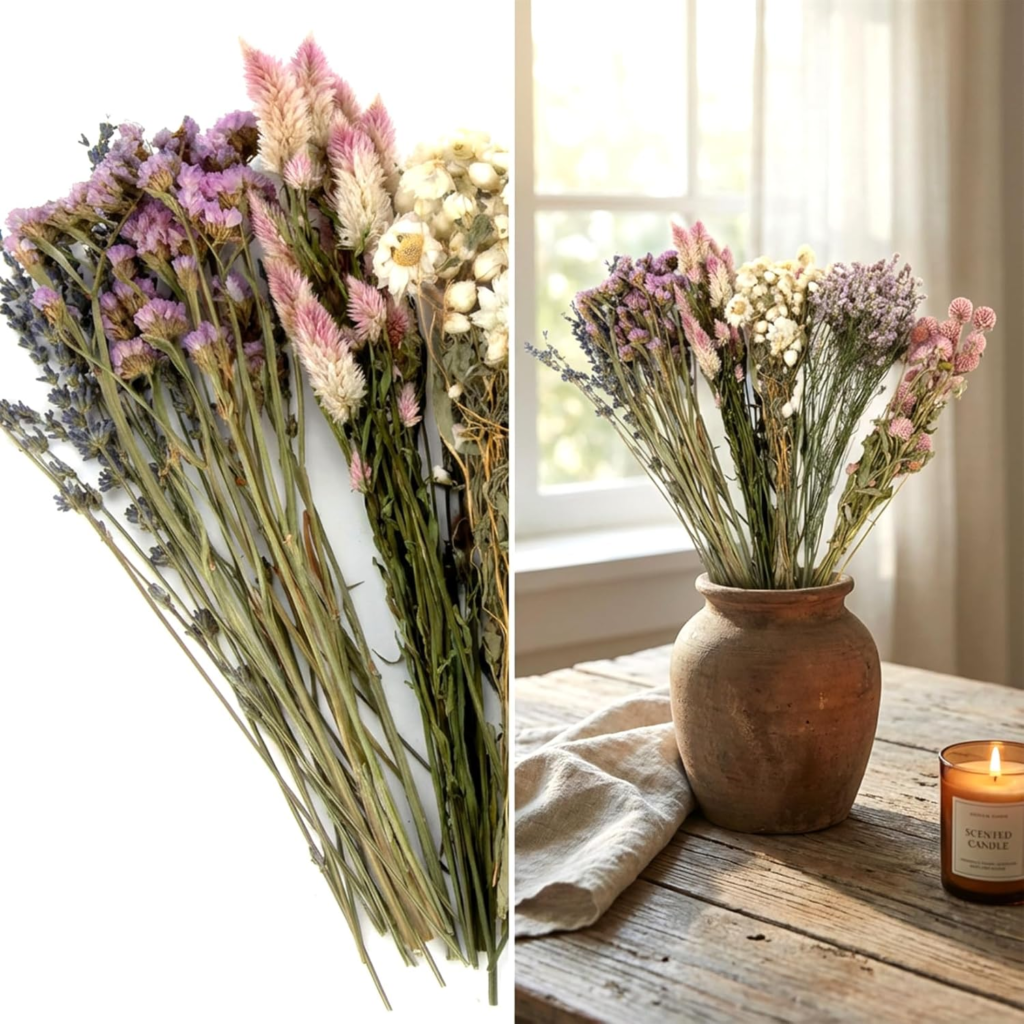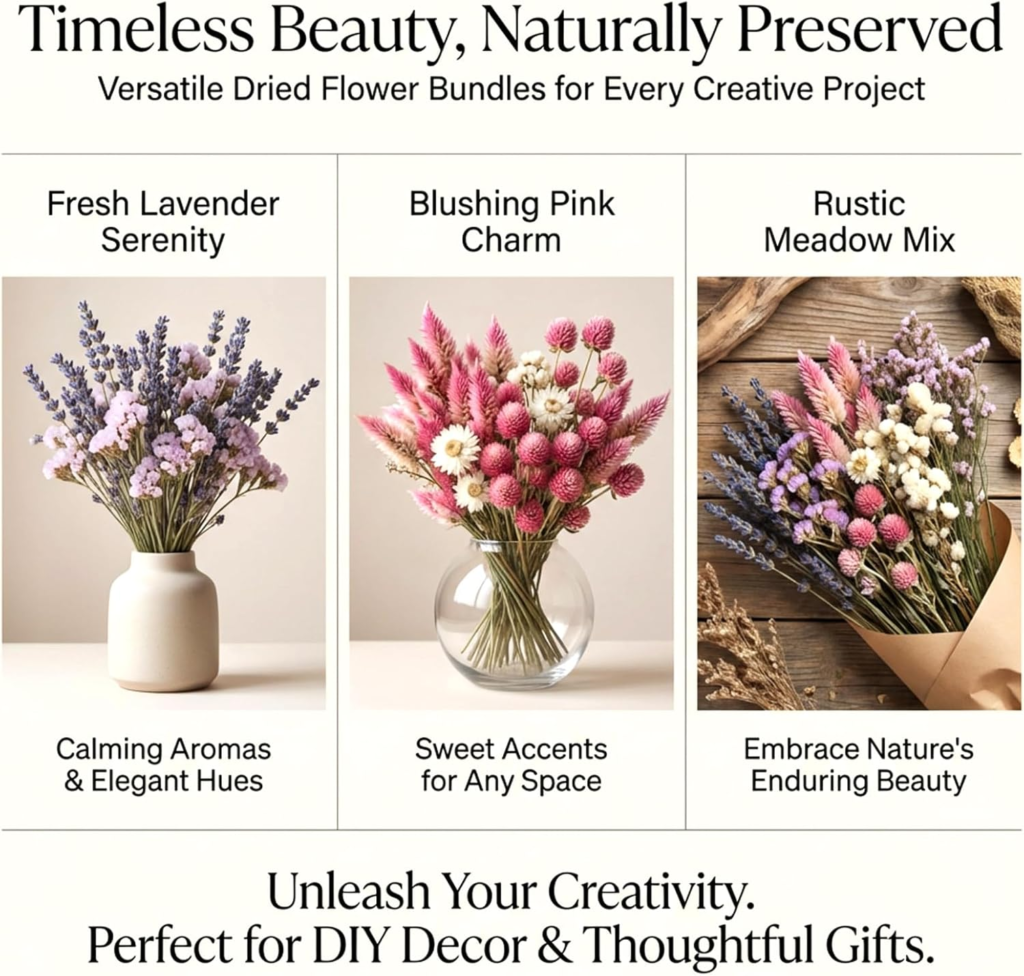
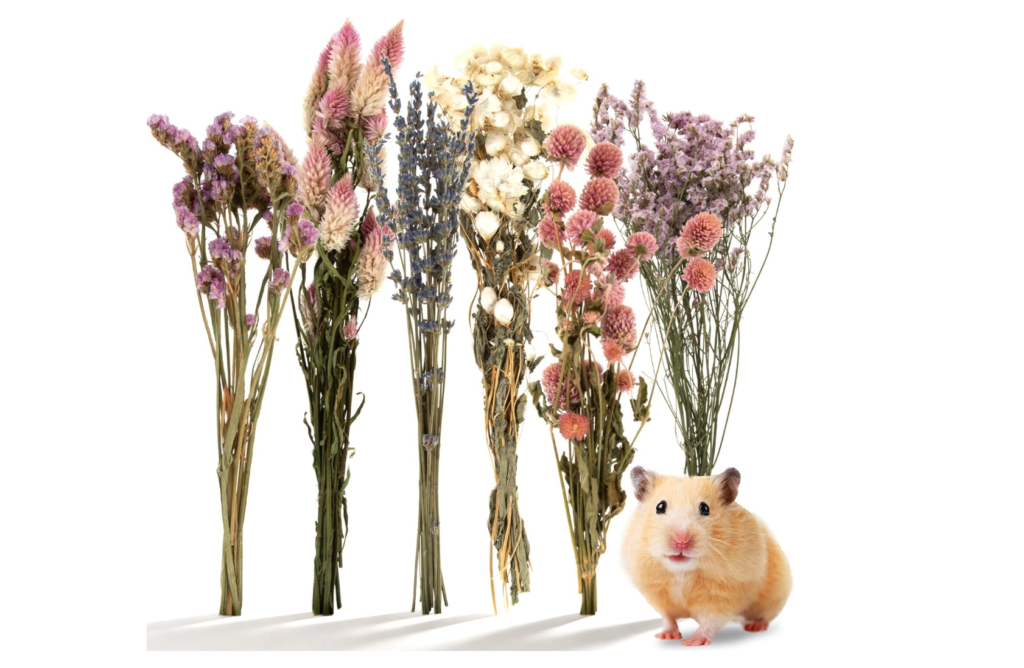
Sukh Natural Hamster Sprays look great in a naturalistic enclosure, and customer feedback suggests many hamsters investigate and nibble them. My hesitation is not the appearance or even the fragility. It is ingredient verification.
The 42-piece set does identify some of the dried plants in available listings, including forget-me-not-type flowers, oat stems and other dried flower or grass sprays. However, the naming varies between listings and some plant descriptions are too vague for me to independently verify every component against reliable hamster-specific feeding guidance.
Because these sprays are accessible to an animal that may chew them, that matters.
I would consider this primarily a decorative enrichment product with uncertain edible-forage credentials, rather than automatically treating every stem in the pack as a hamster-safe food.
Affiliate disclosure: As an Amazon Associate, Hamster Corner may earn from qualifying purchases. This review is based on available product information, customer feedback and hamster welfare guidance. It does not claim hands-on testing unless specifically stated.
Sukh Natural Hamster Sprays at a glance
| Product | Sukh 42-piece dried flower and herb spray set |
| Main use | Naturalistic enclosure decor and exploratory enrichment |
| Materials | Mixed dried flowers, grasses and stems |
| Ingredient disclosure | Some plants are named, but descriptions vary across current listings |
| Main advantage | Attractive natural look and varied textures |
| Main concern | I cannot confidently verify every plant in the mix as hamster-safe forage |
| Durability | Naturally fragile, with mixed feedback on breakage and flattening |
| Best for | Owners prioritizing natural-looking enclosure enrichment who can inspect and monitor the product |
| I would skip it if | You specifically want edible seed sprays with clearly identified ingredients |
My verdict
Visually, I get why this product is popular.
The mixed dried stems add height, texture and color to an enclosure, and customer feedback repeatedly describes hamsters exploring, moving or nibbling the sprays.
That is useful enrichment behavior.
But I would separate “my hamster interacted with it” from “every plant in the package has been independently established as safe to eat.”
The seller markets the sprays for chewing and small-animal use. That is useful product information, but a seller claim is not the same thing as hamster-specific veterinary or animal-welfare evidence for each botanical ingredient.
For me, that prevents this from being an automatic recommendation as edible forage.
What I like
It adds real structure to a natural enclosure
Unlike flat decorative bedding, upright sprays can change how the enclosure feels and how the hamster moves through it.
They can create visual cover around:
- hides
- cork logs
- tunnels
- platforms
- deeper bedding areas
Customer feedback also suggests that hamsters frequently investigate and move through the stems rather than treating them as completely irrelevant decoration.
That is a better reason to use dried plants than simply wanting an enclosure that looks good in photos.
There is genuine variety
The product is not just one bundle of identical millet stems.
Available listings describe a mixture including yellow and purple forget-me-not-type flowers, oat material, reeds and additional dried flower stems.
That gives the enclosure more variation in shape and texture.
The downside is that this same variety makes safety verification more complicated.
The fragility is disclosed
Some reviewers praise the stems as sturdy enough to arrange upright, while others report flattened or broken pieces.
Both can be true.
Dried flowers are naturally brittle, and the seller itself says the material may shed or break when squeezed and should be handled carefully.
So I would not classify some breakage as an unexpected defect.
If you want perfectly rigid, identical enrichment pieces, dried botanical sprays are probably the wrong category.
The ingredient issue matters more than the broken stems
This is the main reason my rating is not higher.
The original draft said Sukh does not disclose the plants at all. That is not quite correct.
Available listings do name several components.
The problem is that the ingredient descriptions are inconsistent between marketplaces, and some translated names are unclear enough that I would not confidently identify the exact botanical species from the product page alone.
That matters because a hamster may not simply walk around the plants.
They may eat them.
A hamster product being labelled “natural” or “chewable” does not remove the need to know what the plant actually is.
Are these sprays safe for hamsters to eat?
I would not give the entire mixed pack an unconditional yes.
Some ingredients are easier to assess than others.
Oats, for example, have good hamster-specific support. Woodgreen also specifically recommends several identifiable seed sprays, including:
- millet
- sorghum
- flax
- amaranth
- pagima
- delicia
Those are much easier choices when your goal is edible foraging enrichment because you know exactly what you are offering.
This Sukh mixed-flower set is different.
The seller markets the components as suitable for chewing, but I could not independently verify every plant represented in the pack from high-quality hamster-specific sources.
That does not prove the mix is dangerous.
It means I would not write “safe for hamsters to eat” as though every botanical ingredient had been checked.
Natural does not automatically mean edible
This is worth emphasizing because dried floral decor can look harmless.
A hamster enclosure can contain many natural-looking materials, but whether something is safe to touch, safe to chew, and appropriate to eat repeatedly are separate questions.
If your hamster mostly walks through the sprays, digs around them or rearranges them, the exposure is different from a hamster that systematically consumes the flower heads and stems.
If your hamster actively eats an ingredient you cannot confidently identify, I would remove that piece rather than assume the seller’s broad “natural” label is enough.
How useful is it for foraging?
As physical enrichment, it can certainly encourage exploration.
But I would be careful with the word forage.
Woodgreen supports scatter-feeding a hamster’s normal complete food and specifically recommends known seed sprays such as millet, sorghum and flax as suitable treats.
That provides a clearer, evidence-backed foraging activity because the edible material is identifiable.
With the Sukh flower pack, I would use the stems more as environmental complexity and exploratory enrichment unless the specific plants in your current pack can be confidently verified.
If your goal is mainly food-based foraging, I would buy clearly labelled seed sprays instead.
Durability and shape
Expect variation.
Some customers describe nicely preserved, relatively sturdy stems. Others report that the material arrived:
- flattened
- brittle
- partially broken
- less full than the listing photos
The seller itself warns that dried flowers are fragile.
I therefore would not judge the product using the same standard as a wooden bridge or ceramic hide.
You are buying dried plant material.
Some shedding and breakage are inherent to the format.
What would concern me more is visible moisture, mould, unusual contamination or a strong sign that the material has deteriorated during storage.
Freshness on arrival
Several available reviews describe dry material in good condition, while others focus more on flattening or breakage than spoilage.
That is encouraging, but review reports cannot guarantee the condition of the pack you receive.
Inspect dried plant enrichment before it goes into the enclosure.
I would reject or discard material that arrives:
- damp
- visibly mouldy
- contaminated with unknown debris
- carrying an unusual musty or rotten smell
Store unused sprays somewhere dry.
The seller also recommends keeping the dried material away from moisture.
Should you freeze hamster sprays before using them?
I would not present a 24 to 48-hour freezer routine as a proven safety step.
Some customer reviews say they freeze dried sprays before placing them in hamster enclosures. That is an owner practice, not evidence that a specific freezer duration reliably eliminates every possible mite, insect or egg associated with dried plants.
The original article turned that anecdotal practice into a recommendation.
I would remove it.
Instead, buy dried enrichment from a source you trust, inspect the package carefully and follow any legitimate storage or pest-control instructions supplied for that product.
If there is visible infestation, I would not solve that by guessing at a freezer schedule and then putting the material into the enclosure.
How often should you replace the sprays?
There is no need for a universal weekly replacement rule.
I could not verify the original claim that Sukh requires replacing this pack every week.
Woodgreen’s broader hamster cleaning guidance says seed sprays can be replaced during an enclosure refresh, while soiled enrichment should be removed when needed.
That is a better practical approach.
Replace individual pieces when they are:
- heavily chewed
- damp
- contaminated with urine
- mouldy
- badly deteriorated
Clean, dry decorative stems do not need to be thrown away simply because seven days have passed.
Is it suitable for Syrian and dwarf hamsters?
The product is marketed for Syrian and dwarf hamsters as well as several other small animals.
There is no obvious size problem comparable with a hide entrance or wheel because these are loose dried stems.
The bigger question is how the individual hamster interacts with them.
A hamster that ignores most flowers and explores around the stems presents a different use case from one that immediately eats every plant in the enclosure.
Species labels do not resolve the ingredient question.
Value for money
This depends heavily on what you are buying it for.
If your goal is visual impact, one mixed pack can add far more variety than buying several single-species sprays separately.
If your goal is verified edible forage, I think the value proposition is weaker.
I would rather spend that money on clearly identified millet, sorghum, flax, amaranth or another hamster-supported seed spray where I know what the hamster is eating.
That makes Sukh’s mixed set more of a decor-and-enrichment purchase than a food purchase for me.
Better alternatives for edible spray enrichment
If you specifically want your hamster to harvest seeds from the stems, choose products that clearly identify the plant.
Woodgreen specifically lists options such as:
- millet seed spray
- sorghum
- flax
- amaranth
- pagima
- delicia
Those give you the same general idea of natural foraging without requiring you to decode a mixed dried-flower bundle.
If you want a more durable non-food enrichment piece instead, see our AccEncyc Hamster Tunnel Hideout review or Haosie Wooden Bridge review.
What to check when the package arrives
Before adding any dried botanical product to a hamster enclosure:
- Check that the package is dry.
- Look for mould or obvious contamination.
- Remove badly broken or sharp stems.
- Compare what arrived with the current ingredient description.
- Place only a few pieces initially so you can see how your hamster interacts with them.
- Remove an unfamiliar plant if your hamster begins consuming it heavily and you cannot verify what it is.
You do not need to panic because a hamster takes one curious nibble.
The point is to avoid assuming that an incompletely identified mixed botanical product is automatically unlimited edible forage.
Frequently asked questions
Are Sukh hamster sprays safe?
They are sold specifically for small-animal habitat use, and many buyers report using them successfully.
However, I could not independently verify every plant in the mixed pack from authoritative hamster-specific feeding guidance.
I would therefore use them cautiously as naturalistic enrichment rather than give the whole mixture a blanket “safe to eat” label.
Does Sukh disclose the ingredients?
Partly.
Current listings name several dried plants, including forget-me-not-type flowers, oats/reeds and other flower stems.
The issue is that the names and descriptions vary between listings and are not consistently presented as a precise botanical ingredient list.
That makes independent safety checking harder than it should be.
Will the sprays arrive broken?
Possibly.
Feedback ranges from sturdy and attractive to flat or brittle. The seller itself notes that dried flowers are fragile and can shed when squeezed.
A little breakage is therefore expected with this type of product.
Should I freeze the sprays first?
I did not find reliable hamster-care guidance establishing a 24 to 48-hour freezing rule.
Some owners do it, but I would not present that practice as proven pest control.
Inspect the product carefully and follow verified manufacturer guidance instead.
How often should I replace them?
When they become wet, dirty, mouldy or heavily deteriorated.
There is no evidence-based reason to discard clean dried sprays exactly once a week.
Final verdict
Sukh Natural Hamster Sprays are visually excellent enclosure enrichment, but I am less convinced by them as edible forage.
The product has a substantial amount of positive customer feedback, and the mix can make a hamster setup look more varied and natural. The fragility does not bother me much because the seller openly describes dried flowers as delicate.
The ingredient labeling bothers me more.
Some plants are named, so it is inaccurate to say there is no disclosure at all. But the naming varies between listings and is not clear enough for me to independently verify every stem as something a hamster should eat.
That changes my recommendation.
If you want decorative dried plants and your hamster mostly explores around them, I can see the appeal. If you specifically want food-based foraging, I would choose clearly identified millet, sorghum, flax, amaranth or another supported seed spray instead.
For me, this is a good-looking secondary enrichment product, not a first-choice edible forage mix.
As an Amazon Associate, Hamster Corner may earn from qualifying purchases. Prices, ratings, product contents and availability can change, so verify the current listing and ingredient information before ordering.