
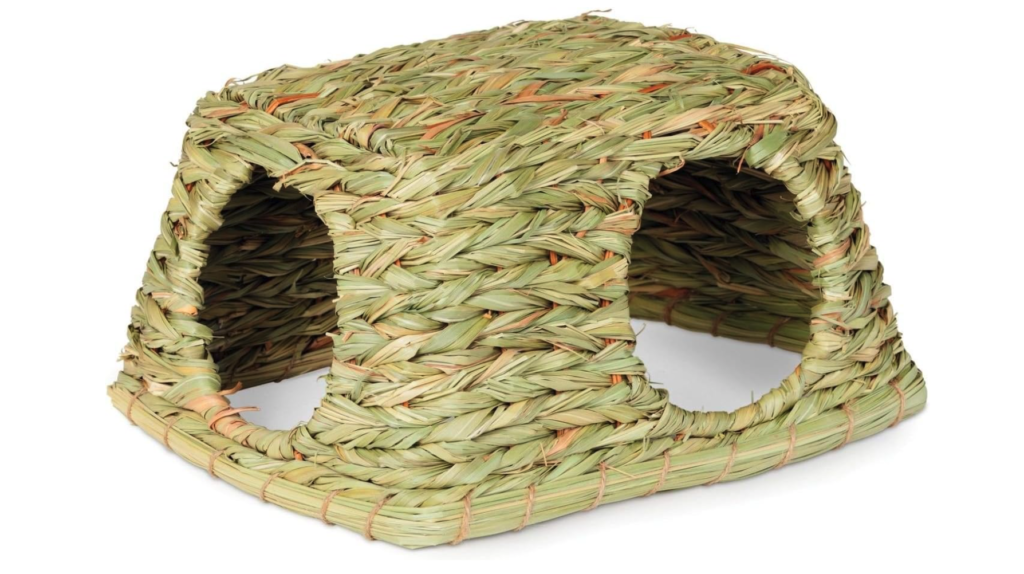
The Prevue Nature’s Hideaway Small Grass Hut is one of the more convincing natural hideouts for hamsters because Prevue actually lists the Small #1096 model for hamsters, mice and gerbils. At about 7 × 4 × 3.5 inches, it is far more proportionate for a hamster enclosure than the larger Medium and Large versions sold in the same range.
What I would change from a lot of online descriptions is the word “edible.” Prevue calls this a natural grass activity center, not hamster food, and specifically tells owners to inspect it regularly and remove it when it becomes worn or damaged. Chewing is something I would expect from a woven natural accessory, but I would not treat the entire hut as unlimited forage.
Affiliate disclosure: As an Amazon Associate, Hamster Corner may earn from qualifying purchases. This review is based on current manufacturer information, available customer feedback and hamster welfare guidance. It is not presented as a hands-on test unless specifically stated.
Prevue Nature’s Hideaway Grass Hut at a glance
| Product | Prevue Nature’s Hideaway Small Grass Hut #1096 |
| Best for | Hamsters, mice and gerbils |
| Size | Approximately 7 × 4 × 3.5 inches |
| Material | 98% sisal tassel, 0.75% plant cane, 0.75% bamboo and 0.5% sisal rope |
| Design | Hand-woven natural grass hide |
| Cleaning | Prevue recommends removing debris and wiping with a dry soft cloth |
| Main advantage | One of the few versions in this product family actually sized and marketed for hamsters |
| Main limitation | Natural woven construction is consumable and should be replaced when worn or damaged |
| Our rating | 4.3/5 |
My verdict
I like the Small #1096 version considerably more for hamsters than the Medium grass hut that appears in many larger marketplace listings.
Prevue itself says the Small is ideal for:
- hamsters
- mice
- gerbils
That removes a lot of the uncertainty we had with products such as oversized rabbit grass houses that merely include “hamster” somewhere in a long species list.
The dimensions also make sense.
At roughly 7 inches long and 4 inches wide, the Small can provide another covered area without taking over a large portion of a modern hamster enclosure.
My main qualification is that I would treat it as natural secondary cover and chewable enrichment, not as an edible food item and not necessarily as the hamster’s only sleeping house.
The Small version is actually made for hamsters
This is the biggest factual correction to the original review.
Prevue sells several Nature’s Hideaway grass products that look similar but are aimed at different animal sizes.
The current lineup includes:
- Small Grass Hut #1096: about 7 × 4 × 3.5 inches, for mouse, hamster and gerbil
- Medium Grass Hut #1097: about 11 × 9 × 6 inches, for chinchilla and guinea pig
- Large Grass Hut #1100: about 12 × 9 × 8 inches, for guinea pig, dwarf rabbit and ferret
So there is no reason to buy the Medium version for a hamster simply because it has more customer reviews.
The Small is the hamster-specific product.
That is the version I would start with unless your individual Syrian clearly needs a larger entrance or more internal room.
What is the hut actually made from?
Prevue provides a much more useful material breakdown than the vague “hay hut” description found on some marketplaces.
For Small #1096, the company lists:
- 98% sisal tassel
- 0.75% plant cane
- 0.75% bamboo
- 0.5% sisal rope
That means I would stop calling this a hay hideout.
I would also stop calling it fully edible.
Prevue describes it as 100% natural grass material and an activity center for burrowing, exploring and nesting. It does not describe the hut as a food product or say hamsters should consume the entire structure.
The manufacturer’s own safety instruction is to inspect it periodically and remove it once it becomes worn or damaged.
That is the recommendation I would follow.
Can a hamster chew it?
Chewing a woven natural accessory would not surprise me.
In fact, customer feedback across the Nature’s Hideaway range repeatedly describes small pets chewing and dismantling the grass structures.
But chewable and intended to be eaten as food are not the same thing.
I would let normal investigative gnawing happen while checking the structure regularly.
If your hamster begins consuming large amounts of material, if long strands come loose, or if chewing exposes sharp structural pieces, remove the hut.
Do not wait until it completely collapses simply because the material started out natural.
The open bottom is a genuine advantage
One feature I particularly like for hamster use is the floorless design.
Available product Q&A for the Nature’s Hideaway hut confirms that it has no bottom.
That fits surprisingly well with good hamster housing.
RSPCA recommends a nesting box without a floor where possible so owners can lift the shelter to check it, while the hamster can connect the hide directly with the substrate below.
In deep bedding, that means you can partially nestle the grass hut into the substrate and let the hamster extend burrows beneath or around it.
It also avoids creating a hard floor between the hamster and its digging bedding.
I would not claim that urine simply “passes through” and therefore the hut stays hygienic, though. A hamster can still urinate against or soak the woven walls.
Is the Small size large enough for a Syrian hamster?
This is the part I would assess individually.
Prevue officially includes hamsters in the Small model’s intended species, but “hamster” covers a substantial size range.
A dwarf hamster and a large adult Syrian are very different animals.
The Small hut’s overall dimensions are approximately 7 × 4 × 3.5 inches. That is nicely proportioned for dwarf hamsters and may work for many Syrians, but I would check the actual openings and internal room when the unit arrives.
Natural woven products can vary slightly in shape.
Your hamster should be able to:
- enter without forcing its body through
- turn around normally
- leave easily
- use the shelter without becoming wedged
If a large Syrian clearly does not fit comfortably, I would choose a different hide rather than relying on the hamster to chew the entrance wider.
I would not automatically move up to the Medium
This is important.
The Medium Nature’s Hideaway is not simply “the Syrian version.”
Prevue officially lists Medium #1097 for chinchillas and guinea pigs.
It measures around 11 × 9 × 6 inches, substantially larger than the Small.
Customer feedback on that version actually includes repeated complaints from guinea pig owners that the approximately 2.5 to 3-inch entrances are tighter than expected.
That tells us something useful about the Medium, but it does not establish a universal hamster entrance requirement.
If the Small does not suit your Syrian, I would compare other hamster-specific hides rather than assuming the Medium is automatically the best upgrade.
Does it work as a primary sleeping hide?
It can provide cover, but I would still offer a more enclosed nesting option.
Blue Cross recommends an enclosed sleeping hide and says a multi-chamber hide is ideal because hamsters prefer sleeping farther from the entrance.
RSPCA similarly recommends a dark nesting shelter large enough for a hamster to sleep, move comfortably and keep a food store.
The Prevue grass hut has a useful enclosed shape, but woven grass allows more light through than a solid multi-chamber house.
For that reason, I see its strongest role as:
secondary hide + texture + exploratory enrichment
rather than replacing the main nesting house.
If your hamster decides to sleep in it sometimes, that is fine. They should simply have other secure options available.
How durable is it?
There is no reliable “lasts several weeks” answer.
The lifespan depends heavily on what the individual hamster does.
A hamster that mainly walks through or rests inside it may keep the hut intact much longer than one that immediately starts dismantling the weave.
Prevue itself does not give an expected lifespan.
Instead, its instruction is more useful:
inspect periodically and remove the product if it becomes worn or damaged.
That is exactly how I would treat it.
Do not judge the accessory as defective merely because a hamster gradually chews it. But do replace it once deterioration creates loose strands, exposed hard components or an unstable structure.
Could the woven material create sharp pieces?
This is worth checking.
Recent customer feedback for the larger Medium hut includes at least one report of chewing exposing hard pieces that the owner considered an eye-injury concern.
That report involved guinea pigs and does not prove the same thing will happen to every Small hamster hut.
Still, it reinforces Prevue’s own instruction to inspect the product as it wears.
Natural does not mean maintenance-free.
Run your fingers carefully over damaged areas during routine enclosure checks and remove the hut if chewing exposes anything sharp.
What about the sisal rope?
The official material breakdown includes 0.5% sisal rope.
That is more useful information than vaguely describing the hut as only grass.
I would not automatically label that tiny rope component dangerous.
I would, however, watch what happens as the structure is dismantled.
RSPCA warns about thin fibrous nesting materials that can form strands and become wrapped around hamster limbs. That warning is directed at cotton-wool-style nesting materials, not specifically at this Prevue hut.
So I would not claim Prevue’s sisal rope has a documented entanglement problem.
The practical rule is simply to remove long, loose strands if the weave starts coming apart significantly.
How do you clean it?
Prevue’s official cleaning direction is straightforward:
remove debris and wipe clean with a dry soft cloth.
That tells you something important about the product.
This is not a washable ceramic hide that you can scrub repeatedly.
If your hamster mainly explores or sleeps inside it and keeps it dry, maintenance should be simple.
If the woven material becomes deeply soaked with urine, mouldy or otherwise impossible to keep clean through dry cleaning, I would replace it.
Trying to preserve a cheap natural hide indefinitely is not worth creating a hygiene problem.
Is it really a forage toy?
I would not use that description.
A hamster may chew it, shred it and use pieces during normal interaction.
But forage usually implies searching for or harvesting something edible.
Prevue markets the grass hut for burrowing, exploring and nesting, not as a nutritional forage product.
If you want actual food-based foraging, identifiable seed sprays and scatter-feeding the hamster’s normal dry food are better-supported options.
The grass hut belongs in the enrichment category.
What I like
The Small #1096 gets several things right for hamster use.
The scale makes sense. It does not consume the huge footprint of rabbit-oriented grass houses.
The open bottom works with deep bedding. You can integrate the hut into a burrowing setup rather than placing a sealed box on top of the substrate.
The manufacturer actually names hamsters as an intended species. That sounds basic, but it distinguishes this model from many generic small-animal accessories.
It adds another texture. A woven grass structure gives the hamster something very different from ceramic, paper bedding and wooden hides.
And because the product is relatively simple, there are fewer complicated moving parts or plastic components to evaluate.
What I do not like
It is still a woven natural accessory with a limited service life.
You need to inspect it as it deteriorates.
It is not easy to sanitize if badly soiled.
The Small’s size also deserves checking with a large Syrian rather than assuming every hamster fits simply because the manufacturer uses the word “hamster.”
And most importantly, I would not market it as a snack.
The whole value of this product survives perfectly well without claiming that the hamster is supposed to eat the house.
Who I think it is best for
I like the Small #1096 for:
- dwarf hamster enclosures
- Syrians that fit the actual openings comfortably
- naturalistic setups
- owners wanting an additional floorless hide
- hamsters that enjoy manipulating natural materials
- setups that already contain a secure primary sleeping hide
Who should skip it
I would choose something else if:
- your large Syrian does not fit comfortably
- you need a hide that can be thoroughly washed
- your hamster rapidly turns woven accessories into long loose strands
- you want a permanent primary sleeping house
- you specifically want an edible forage product
For a more durable option, see our AccEncyc Hamster Tunnel Hideout review.
For the broader housing decision, see our hamster hideout guide.
What I would check when it arrives
Because the hut is hand-woven, inspect the actual unit rather than relying solely on published dimensions.
Check:
- The openings are large enough for your hamster.
- The structure is dry and free from mould.
- Nothing sharp protrudes from the weave.
- There are no long loose fibers.
- It sits securely in the bedding.
- Your hamster can enter and turn comfortably.
Then keep checking it as your hamster uses it.
The manufacturer itself tells owners to remove the hut once it becomes worn or damaged, so gradual inspection should be part of owning this type of accessory.
Frequently asked questions
Is the Prevue Nature’s Hideaway Grass Hut made for hamsters?
The Small #1096 is.
Prevue specifically lists it for mice, hamsters and gerbils.
The Medium and Large models are aimed at larger small pets, so make sure you are looking at the correct version.
Is it safe for a hamster to eat?
I would not describe the whole hut as hamster food.
Prevue calls it a natural grass activity center and lists its materials as sisal tassel, plant cane, bamboo and a small amount of sisal rope.
Normal chewing may happen, but the manufacturer tells owners to remove the product when it becomes worn or damaged.
Is the Small big enough for a Syrian?
Potentially, but check your individual hamster.
The Small measures approximately 7 × 4 × 3.5 inches. A dwarf should have much less difficulty with the scale, while a large Syrian deserves a closer check of the entrances and internal space.
Do not force a poor fit.
Does it have a floor?
The Nature’s Hideaway hut design is open-bottomed.
That can work particularly well over deep hamster bedding because the hamster remains directly connected to its digging substrate.
How long does it last?
There is no reliable fixed lifespan.
Some hamsters may barely chew it while others may dismantle it quickly.
Replace it when wear creates instability, loose strands, sharp exposed material or hygiene problems.
Can it replace a multi-chamber hide?
I would still provide an enclosed primary sleeping hide.
Blue Cross considers a multi-chamber hide ideal for sleeping, while the Prevue grass hut works very well as an additional covered space and enrichment item.
Final verdict
The Prevue Nature’s Hideaway Small Grass Hut #1096 is one of the better grass-hide options for a hamster, mainly because this specific version really is designed for hamster-sized animals.
The original review made the product sound like a guinea-pig hut that happened to fit hamsters better because its holes ran small. That is true of the larger Medium version, but not of the Small.
Prevue deliberately markets Small #1096 for hamsters, mice and gerbils and sizes it at approximately 7 × 4 × 3.5 inches.
My main correction goes the other way: do not call it fully edible.
It is a natural woven enrichment accessory that a hamster may chew, but Prevue does not market the structure as food and explicitly says to inspect it and remove it once worn or damaged.
For me, that leaves a pretty clear recommendation:
Buy the Small if you want an affordable natural secondary hide, check the fit if you have a large Syrian, and replace it as the woven structure deteriorates.
As an Amazon Associate, Hamster Corner may earn from qualifying purchases. Prices, specifications and availability can change, so make sure you are buying the Small #1096 version if you want the hamster-sized model.
[…] For a smaller natural alternative, see our Prevue Nature’s Hideaway Grass Hut review. […]