
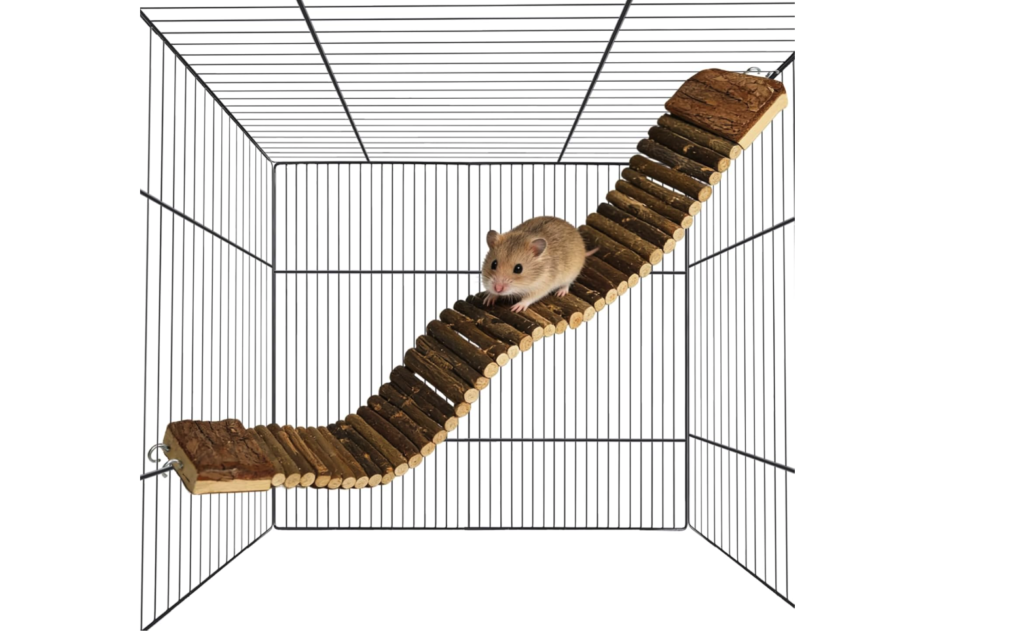
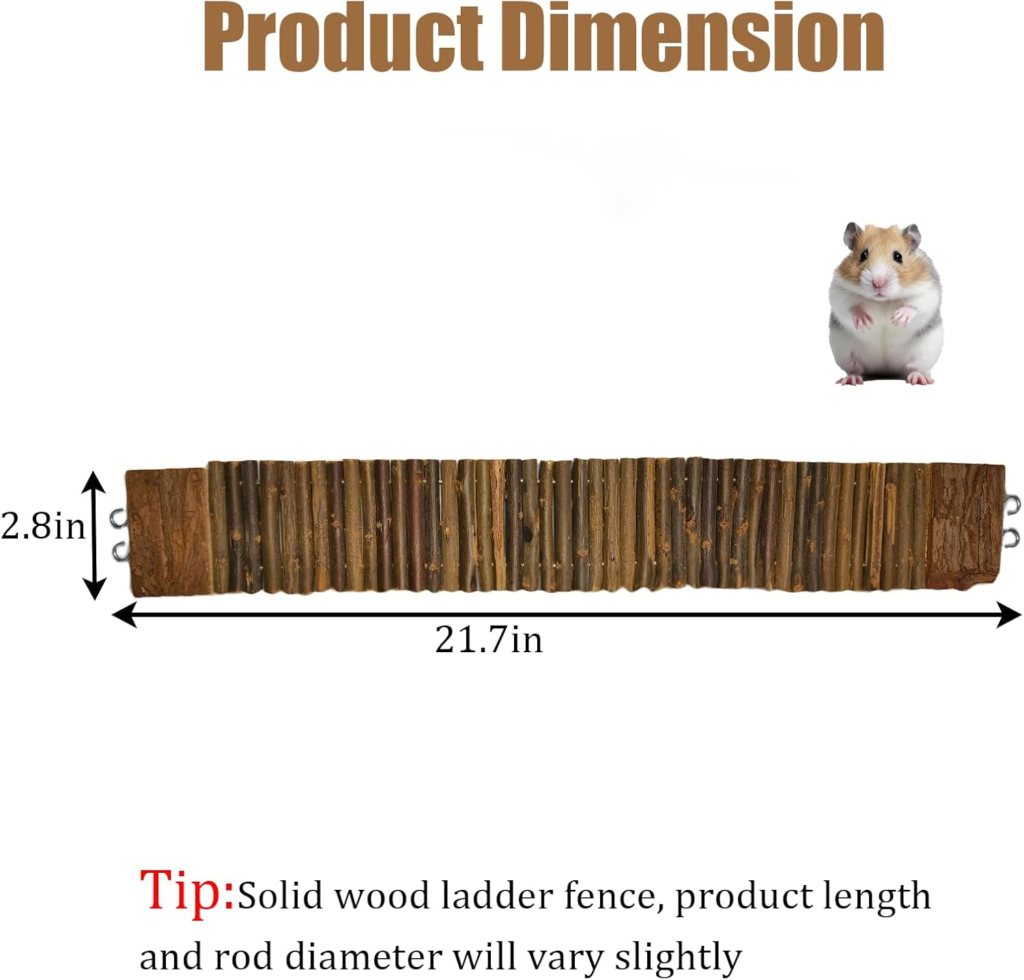
The Hamiledyi Hamster Suspension Bridge is a genuinely versatile bendable bridge, but I would use it low in the enclosure and inspect it more carefully than a solid wooden accessory. The current product listing describes a bridge about 21.6 inches long with wooden pieces held together by two flexible metal wires and metal hooks for hanging.
That construction is what makes the bridge useful, but it also creates its main limitations. Gaps between the wooden pieces deserve checking before use, and the bridge should be retired if chewing or wear exposes the internal wire.
For me, this is a good low climbing and layout accessory, not something I would hang high above the bedding as a dramatic suspension bridge.
Affiliate disclosure: As an Amazon Associate, Hamster Corner may earn from qualifying purchases. This review is based on current product information, available customer feedback and hamster welfare guidance. It is not presented as a hands-on product test unless specifically stated.
Hamiledyi Hamster Suspension Bridge at a glance
| Product | Hamiledyi Hamster Suspension Bridge |
| Approximate size | 21.6 × 2.7 inches |
| Construction | Wooden pieces connected by two flexible metal wires |
| Attachment | Current listing shows metal hooks at both ends |
| Main uses | Low bridge, ramp, curved barrier or enclosure divider |
| Main advantage | Long and highly shapeable |
| Main concerns | Gaps between pieces, internal wire and metal hardware as the bridge wears |
| Best placement | Low over bedding or another forgiving surface |
| Our rating | 4.0/5 |
My verdict
I like the flexibility much more than I like the idea of using this as a high suspension bridge.
The internal wire lets you bend the Hamiledyi into shapes that a fixed wooden bridge cannot manage. It can span a low gap, create a curved route through bedding or act as a divider between substrate areas.
At roughly 21.6 inches long, it also gives you plenty of material to work with.
But the same construction creates extra things to inspect.
The wooden sections are threaded onto metal wire, and current customer feedback includes concern about gaps between those sections. If chewing or wear eventually reveals the wire, I would remove the bridge rather than continue using it.
So my recommendation is straightforward:
Use it low, check the gaps before use and retire it before the internal hardware becomes exposed.
What the bridge is actually made from
Current Hamiledyi product information describes the bridge as pine wood connected by two flexible metal wires.
The listing also describes metal hooks used to attach it to a cage.
That explains why it can be shaped repeatedly without immediately springing back into a straight line.
What I would not repeat from the original draft is:
“Natural pine gives a safe surface for chewing and dental wear.”
That is too confident.
PetMD’s hamster-toy guidance is more nuanced about pine. It allows some untreated kiln-dried pine in wooden chew products while also warning that pine softwood can splinter when chewed.
The Hamiledyi listing I found says pine, but does not give me enough information about processing to independently establish that this exact wood is an ideal hamster chew material.
So I would treat chewing as expected wear, not as the reason to buy this product.
If dedicated gnawing material is needed, clearly identified hamster-safe chew wood is a better choice.
The biggest overlooked issue is the gaps
The original article concentrated heavily on exposed wire.
I think the spaces between the wooden pieces deserve equal attention.
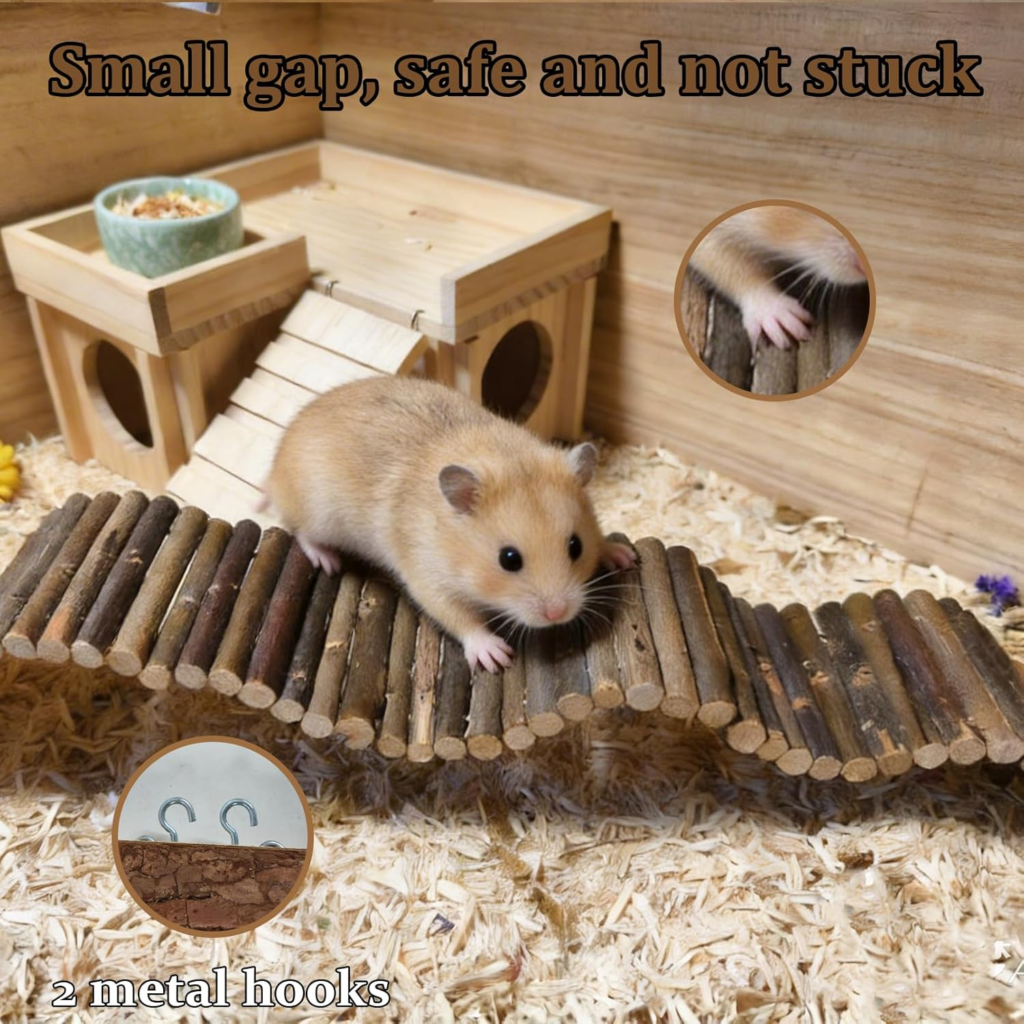
PetMD specifically warns that ladders with large gaps between rungs can cause injuries if a hamster’s feet slip or become caught.
That matters here because available customer feedback on this Hamiledyi-style bridge includes an owner who felt the spaces between the wooden sections were too wide for their hamster.
I would therefore check the actual unit before installing it.
Bend the bridge into the shape you intend to use and look at how the gaps change.
A gap that looks small while the bridge is flat may open wider when you form a steep curve.
If your hamster’s foot could easily slip between the wooden pieces, I would not use that configuration.
I also would not recommend stuffing unsafe fibrous material into the gaps as a permanent fix.
A different bridge is the better solution if the construction does not suit your hamster.
Keep it low rather than hanging it high
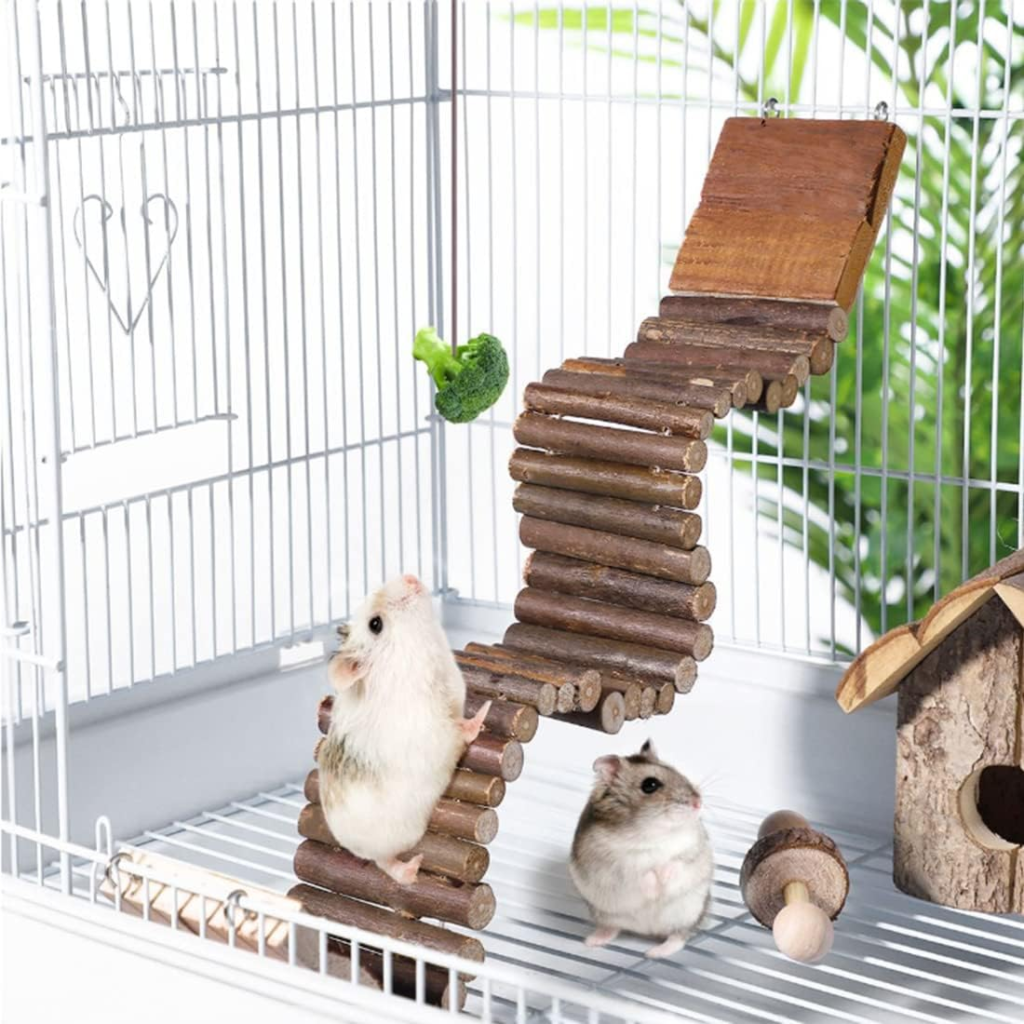
The metal hooks make it tempting to hang the bridge high across the enclosure.
I would resist that.
Blue Cross recommends enrichment such as low wooden items, cork logs and branches for hamsters. It also notes that hamsters are fragile and can be injured by falls.
Dwarf hamsters in particular are not especially agile climbers.
That does not mean hamsters should never climb.
It means a bridge should be arranged so a slip has a forgiving outcome.
I would use this Hamiledyi:
- close to the bedding
- as a shallow ramp
- as a low curved bridge
- against deep substrate
- between low platforms
I would not suspend it high above a hard sand bath, ceramic hide, wheel or bare platform.
Deep bedding underneath provides much more sensible fall protection.
The internal wire needs regular inspection
This is still the most important long-term maintenance issue.
The wooden sections are supported by metal wire.
While the wood remains intact and the wire remains enclosed, your hamster is mainly interacting with the wooden exterior.
Once chewing, breakage or shifting pieces expose the wire, that changes.
Sharp or projecting metal can create an injury risk, and PetMD’s hamster toy guidance is conservative about toys where metal parts become accessible.
I would retire the bridge if you see:
- exposed internal wire
- wire ends sticking out
- missing wooden sections
- loose or broken hooks
- sharp metal edges
- sections that no longer sit securely on the wire
Do not try to extend its life simply because most of the bridge still looks fine.
Check the hooks before first use
Current product information describes hooks at the ends for attaching the bridge.
Inspect them before putting the bridge into the enclosure.
They should not have:
- sharp exposed ends
- loose connections
- openings that can trap a foot
- damaged wire
- positions where the hamster can become wedged between the hook and cage furniture
If you use the hooks against cage bars, make sure the bridge cannot suddenly detach when the hamster walks across it.
In a tank-style enclosure without bars, you may find the bridge more useful sitting directly in the substrate than hanging at all.
It is longer than a lot of hamster bridges
At about 21.6 inches or 55 cm, this is a genuinely long accessory.
That can be a strength.
In a 100 × 50 cm enclosure, you have enough space to curve it rather than forcing it into a straight line.
It can also create separation between:
- deep bedding
- sand
- different substrates
- feeding and digging areas
But measure your intended placement before ordering.
A long bridge can become awkward when the enclosure already contains a large wheel, multi-chamber hide, sand bath, platforms and other enrichment.
The question is not whether 21.6 inches is objectively “too long.”
It is whether you have a useful place for that length.
The flexibility is genuinely useful
This is the main reason I would choose the Hamiledyi over a fixed ladder.
The two internal wires let the accessory maintain different shapes.
I think its best configurations for hamsters are relatively conservative:
Low bridge
Use it across a shallow gap or over bedding.
This gives the hamster another route without creating a large fall.
Gentle ramp
A shallow incline can help connect different levels or platforms.
Avoid turning it into a steep ladder, particularly for dwarf hamsters.
Curved divider
Placed vertically or partly buried, it can help separate different enclosure textures.
This may be more useful than hanging it.
Low arch
You can curve part of it over bedding to create another structure to walk around or underneath, provided the resulting gaps and stability remain safe.
I would be less interested in turning it into a tight enclosed tunnel. A proper wide tunnel or cork structure is simpler and avoids forcing the bridge into an extreme curve that opens the gaps between its wooden sections.
Is pine a problem?
I would not classify this product as unsafe solely because the listing says pine.
But I also would not use “pine is safe” as a selling point.
Hamster guidance around pine depends on how the wood has been processed and how it is being used.
PetMD specifically allows some untreated kiln-dried pine among possible wooden chew products, while also warning about pine softwood that can splinter.
Because I could not verify how the Hamiledyi wood is processed beyond the seller’s general pine description, the safest editorial position is:
The bridge is sold as a pine accessory, but Hamster Corner has not independently verified the wood treatment or evaluated it as a dedicated chew toy.
If your hamster starts aggressively destroying the wood rather than occasionally gnawing it, inspect the bridge more frequently because that also brings the internal wire closer to exposure.
Does it help wear down hamster teeth?
I would remove that claim.
Hamsters do need appropriate materials to gnaw because their incisors grow continuously.
But buying a wire-core bridge is not necessary for dental care, and we do not need to invent an additional health benefit to justify the product.
Its useful job is environmental enrichment.
Provide suitable dedicated chew materials separately.
Is it safe for a Roborovski or other dwarf hamster?
Potentially, but I would pay even more attention to the gaps and incline.
Blue Cross notes that dwarf hamsters can struggle with steep climbing.
A small hamster also has smaller feet, so spaces between wooden pieces deserve careful inspection.
For a dwarf hamster, I would position the bridge:
- almost flat
- on a shallow incline
- close to deep bedding
There is no benefit to creating a difficult obstacle simply because the product can be suspended.
Is it safe for a Syrian hamster?
A Syrian’s larger body may make the width feel more restrictive than it does for a dwarf, but the listed width is about 2.7 inches.
Rather than declaring it suitable based on a species label, look at your hamster using it.
The hamster should be able to walk naturally without constantly placing feet into the spaces between sections or struggling to balance on the narrow surface.
If the bridge is clearly awkward for your individual Syrian, use it as a low divider instead of a walkway.
How often should you inspect it?
There is no evidence-based schedule such as every three days or once a week.
Inspect it during your normal enclosure checks and more frequently if your hamster actively chews it.
The amount of wear matters more than the calendar.
A hamster that barely touches the bridge may leave it unchanged for a long time.
A determined chewer can alter the structure much faster.
Who I think it is best for
The Hamiledyi bridge makes the most sense if you have a large enclosure and want a long accessory that can be reshaped as the layout changes.
I particularly like it for:
- low ramps
- low bridges
- substrate dividers
- gentle curved routes
- layouts where a fixed bridge would be awkward
Its versatility is the reason to buy it.
Who should skip it
I would choose something simpler if:
- you want a bridge without internal metal hardware
- your hamster destroys wooden accessories aggressively
- the gaps on your unit are large enough to concern you
- you plan to hang it high above hard objects
- your enclosure is too crowded for a 21.6-inch accessory
If you want a shorter alternative, see our Haosie Flexible Hamster Wooden Bridge review.
For simpler enrichment options, see our hamster chew toys guide.
What I would check when it arrives
Before installing the Hamiledyi bridge:
- Check every hook and attachment point.
- Look for exposed wire.
- Feel the wood for unusually sharp or splintered areas.
- Bend the bridge into the shape you intend to use.
- Check how wide the spaces become between individual wooden sections.
- Make sure the finished incline is not unnecessarily steep.
- Position it over deep bedding or another safe surface.
Then continue checking it as your hamster chews and rearranges the enclosure.
Frequently asked questions
How long is the Hamiledyi suspension bridge?
Current product information gives a length of approximately 21.6 inches or 55 cm and a width of around 2.7 inches or 7 cm.
Measure the space where you intend to put it before ordering.
Can you bend it into different shapes?
Yes.
The wooden pieces are held together by two flexible internal wires, allowing the bridge to hold curved shapes.
For hamster use, I prefer low bridges, gentle ramps and dividers rather than steep ladders.
Is it safe for hamsters to chew?
I would not market this as a dedicated chew toy.
The seller describes the wood as pine, but I could not independently verify its processing. More importantly, aggressive chewing can eventually expose the bridge’s internal metal wire.
Provide dedicated hamster-safe gnawing materials separately.
What happens if the wire becomes exposed?
Remove the bridge.
Exposed or projecting metal is not wear I would accept in an accessory the hamster walks over and chews.
Are the gaps between the wooden pieces safe?
Check your individual bridge.
PetMD warns that large spaces in ladders can trap hamster feet, and customer feedback for this type of bridge includes concern about the gaps.
The spaces can also change when the bridge is bent.
Should I hang it high in the cage?
I would not.
Hamsters can be injured in falls, and dwarf hamsters in particular are not strong climbers.
Keep bridges and ramps relatively low and provide deep bedding underneath.
Final verdict
The Hamiledyi Hamster Suspension Bridge is versatile enough to earn a place in a good enclosure, but I would use it differently from the dramatic hanging bridge shown in product marketing.
Its 21.6-inch length and flexible wire core make it useful as a low bridge, gentle ramp or divider. That flexibility is a legitimate advantage.
The trade-off is maintenance.
Check the gaps between the wooden sections, keep the structure low enough that a fall is not dangerous and retire it immediately if chewing exposes the internal wire or damages the metal attachments.
I also would not buy it specifically as a pine chew toy or claim it provides a dental benefit. There are simpler materials for that job.
My recommendation: good as low, flexible enclosure enrichment, provided you are comfortable inspecting a wire-core accessory as it wears.
As an Amazon Associate, Hamster Corner may earn from qualifying purchases. Prices, specifications, ratings and availability can change, so check the current product listing before ordering.
Sources
Hamster climbing, ladder-gap and chew-toy safety: PetMD hamster toys
Hamster climbing and fall-safety guidance: Blue Cross hamster care



[…] If you need a longer flexible bridge, see our Hamiledyi Hamster Suspension Bridge review. […]