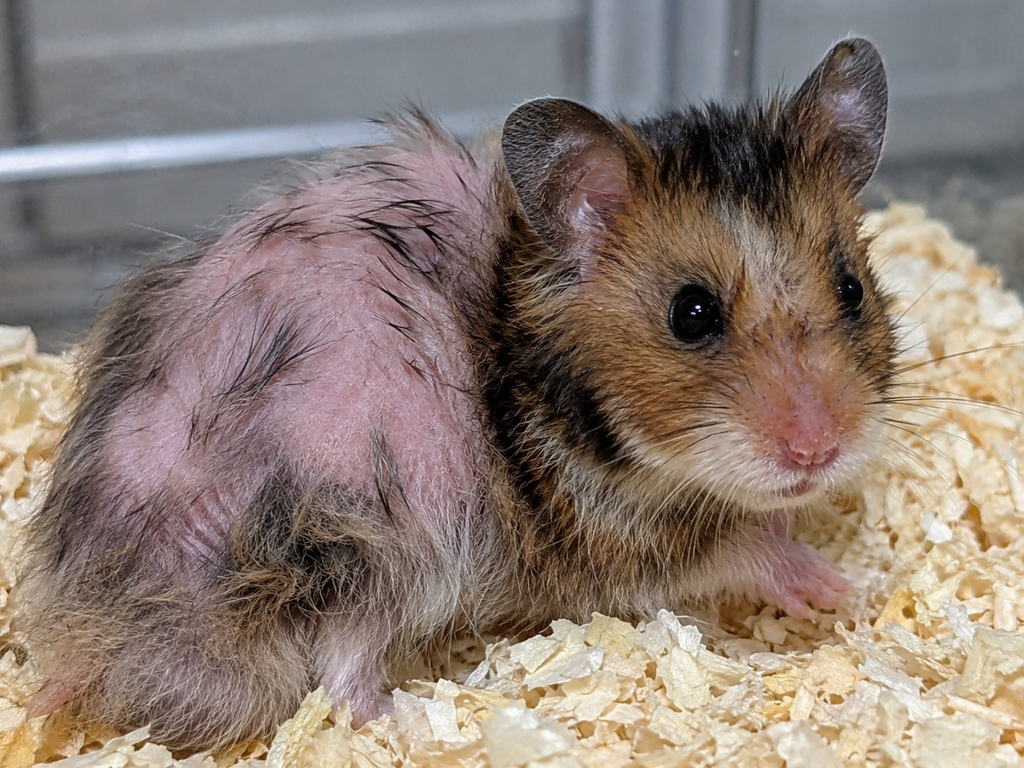
Hair loss in a hamster can come from mites, fungal infection, rubbing, nutritional problems, age-related changes or underlying disease, so the pattern alone usually cannot tell you the cause. Even apparently mild thinning deserves attention because several very different conditions can look similar at first.
Mites and ringworm are possibilities, but they are not the only ones. Adrenal tumors can also be associated with hair loss in Syrian hamsters, although hormonal adrenal disease is much less established than many hamster guides make it sound.
What can cause hair loss in hamsters?
Veterinary sources describe a fairly broad list of causes.
PetMD includes:
- age-related changes
- rubbing or other environmental trauma
- barbering or hair chewing
- nutritional problems
- mites and other skin parasites
- ringworm
- thyroid abnormalities
- kidney or other organ disease
- certain cancers
The Merck Veterinary Manual similarly lists rubbing, inadequate nutrition, barbering, mites, adrenal tumors, thyroid abnormalities, kidney problems and cutaneous lymphoma among possible causes.
That is why I would not try to diagnose hamster hair loss from one photograph or one characteristic such as symmetry.
Hair-loss patterns can give clues, not diagnoses
Different causes can produce somewhat different appearances, but there is considerable overlap.
| Possible cause | Clues you might notice | Important limitation |
|---|---|---|
| Mites | Hair loss, scaling, dandruff or scabbing, sometimes scratching | Some mite infestations cause little or no itching |
| Ringworm | Bald areas with dry, flaky, scaly or crusty skin, sometimes circular redness | The lesions are not always perfect rings and testing may be needed |
| Rubbing | Localized hair loss where part of the body repeatedly contacts an enclosure surface | Check the environment, but do not assume every isolated patch is friction |
| Age-related change | Gradual thinning in an older hamster | Aging is only one possible explanation and should not automatically rule out disease |
| Internal disease | Hair thinning or patches, sometimes with weight, appetite or other health changes | Multiple endocrine, kidney and neoplastic conditions can look similar |
| Cutaneous lymphoma | Patchy alopecia, sometimes with pigmentation, weight loss or reduced appetite | Requires veterinary diagnosis |
The useful question is not simply “what shape is the bald patch?” but what else is happening at the same time?
Are mites the most common cause?
I would not make that claim.
PetMD’s hamster mite guide describes mites as a common hamster problem, particularly Demodex species.
However, the Merck Veterinary Manual lists mites as one of several possible causes of alopecia and describes mite infestation, adrenal tumors, thyroid abnormalities and kidney problems as rarer causes in its hair-loss section.
There is not enough support for turning mites into the default diagnosis whenever a hamster develops a bald patch.
Another misconception is that mites always cause intense itching. PetMD specifically notes that hair loss from mites can occur with or without itching, depending on the mite involved.
A veterinarian may use a skin scraping or other tests to look for parasites rather than treating based on appearance alone.
See our hamster mites guide for more detail.
What does ringworm look like in a hamster?
Ringworm is a fungal infection, not a worm.
PetMD’s veterinarian-reviewed ringworm guide says affected hamsters can develop:
- bald patches
- dry or flaky skin
- scaling or crusting
- thickened skin
- red lesions that may appear circular
Some infected hamsters have very mild signs or none at all.
So the classic circular bald patch can be a clue, but it is not a reliable home diagnostic test.
A veterinarian may use fungal culture, PCR, microscopy or other testing to distinguish ringworm from mites and other skin conditions.
Can hamster ringworm spread to people?
Yes.
Ringworm can spread between animals and humans. PetMD specifically notes transmission between hamsters and people, and the CDC confirms that ringworm fungi can spread through contact with infected pets and contaminated objects or surfaces.
If ringworm is suspected, minimize unnecessary direct contact until you have veterinary advice and wash your hands thoroughly after handling the hamster or enclosure items.
PetMD recommends gloves while handling a hamster known to have ringworm or contaminated cage furnishings.
If you develop a suspicious skin rash yourself, contact a healthcare professional rather than trying to treat both yourself and the hamster with the same product.
Does symmetrical hair loss mean adrenal disease?
Not necessarily.
There is evidence that adrenal disease can be associated with alopecia in Syrian hamsters.
A 2026 veterinary case report described a two-year-old female Syrian hamster with progressive, non-itchy hair loss affecting the hindquarters and an adrenal mass that was later confirmed as an adrenocortical adenocarcinoma.
But one case report does not establish a universal diagnostic pattern.
The Merck Veterinary Manual notes that adrenal adenomas commonly occur in Syrian hamsters, while confirmed Cushing disease producing clinical signs has only rarely been reported.
Merck also warns that cutaneous lymphoma can produce patchy alopecia and pigmentation and may be mistaken for hyperadrenocorticism.
So I would not tell an owner that an older female Syrian losing hair from the rear forward probably has adrenal disease.
It is one possibility that a veterinarian may investigate.
Can old age cause a hamster to lose hair?
Age-related alopecia is recognized in hamsters.
PetMD includes aging among potential causes of hair loss, so some older hamsters may develop thinner coats without a contagious skin disease.
The mistake would be assuming that hair loss is harmless simply because the hamster is old.
An older hamster can also develop mites, organ disease, tumors and other conditions associated with coat changes.
If you notice new or progressive hair loss, especially alongside changes in appetite, weight, activity or skin condition, veterinary assessment is the safer approach.
Can bedding cause hair loss?
Bedding can matter, but “bedding allergy” should not be used as a catch-all diagnosis.
PetMD advises against cedar and unprocessed pine bedding because their aromatic oils can irritate a hamster’s skin and respiratory tract. Merck likewise recommends avoiding cedar chips and fresh pine materials because of possible toxicity.
If your hamster is currently housed on one of those materials, switching to an appropriate dust-free hamster bedding is sensible regardless of whether it ultimately explains the hair loss.
Rubbing can also cause localized alopecia. PetMD and Merck both list repeated contact with enclosure surfaces as a possible cause.
Check for rough edges, narrow openings or other places where the hamster repeatedly rubs the same area.
But if the hair loss persists, do not assume changing the bedding has ruled out a medical problem.
What can you safely do at home?
Home care should focus on observation and removing obvious environmental problems, not treating an undiagnosed skin disease.
You can:
- photograph the affected area so you can see whether it spreads
- note whether your hamster is scratching
- check for redness, flakes, crusts, wounds or swelling
- monitor appetite, activity and body weight
- remove sharp or rough surfaces that are clearly rubbing the same area
- switch away from cedar or fresh pine bedding if you are using it
- keep the enclosure appropriately clean and dry
Do not apply human antifungal cream, flea medication, mite treatment, essential oils or medicated shampoos unless a veterinarian has specifically told you what to use.
The RSPCA warns that hamsters should only receive medicines recommended for them by a veterinarian. Human and other-animal medications can be dangerous.
Should you deep-clean the cage immediately?
Not automatically.
If a veterinarian diagnoses a contagious parasite or fungal infection, environmental cleaning may become an important part of treatment. PetMD includes enclosure cleaning and disinfection in the management of some diagnosed skin conditions.
But before diagnosis, repeatedly stripping the enclosure is not a substitute for finding the cause of the hair loss.
Remove wet or spoiled material and maintain normal hygiene. If mites, ringworm or another contagious problem is confirmed, follow the veterinarian’s specific instructions for bedding replacement, cleaning and disinfection.
When should a hamster with hair loss see a vet?
I would arrange veterinary assessment for new or unexplained hair loss, rather than waiting until the hamster becomes obviously ill.
Contact a hamster-experienced veterinarian more urgently if the hair loss is accompanied by:
- significant scratching or self-trauma
- red, crusty, bleeding or painful skin
- rapidly spreading bald areas
- swelling or a new lump
- reduced appetite
- unexpected weight loss
- significant lethargy
- another notable behavioral or health change
The RSPCA points out that hamsters have high metabolic rates and can lose condition quickly when they become ill.
See signs of a sick hamster for other changes worth watching.
Frequently asked questions
Can hamster mites cause hair loss without itching?
Yes.
PetMD specifically notes that mite-related hair loss may occur with or without itching, depending on the type of mite. Scratching therefore cannot reliably confirm or rule out mites.
Is a circular bald patch definitely ringworm?
No.
Ringworm lesions can be circular, but hamster ringworm can also cause more general baldness, flakes, crusts or skin thickening. Other skin diseases can look similar.
A veterinarian may need fungal testing to confirm the diagnosis.
Will my hamster’s fur grow back?
It depends on why the hair was lost.
Hair can regrow after some treatable causes are corrected, but regrowth varies with the underlying condition and the health of the hair follicles. Endocrine disease, cancer, chronic skin damage and age-related changes may behave differently from a successfully treated parasite problem.
Do not use fur regrowth alone to decide whether an underlying condition has resolved.
Is hair thinning normal in an old hamster?
It can happen with age, but age should not be used to diagnose hair loss at home.
Older hamsters can also develop parasites, kidney disease, endocrine problems and tumors. New or progressive alopecia is worth discussing with a hamster-experienced veterinarian even if the skin does not appear irritated.
The bottom line
Hamster hair loss has many possible causes, and the pattern alone usually cannot identify which one is responsible.
Mites and ringworm are important possibilities, but mites do not always itch and ringworm does not always produce a perfect circular patch. Rubbing, nutritional problems, aging, organ disease and cancer can also cause alopecia.
Adrenal disease deserves particular caution. It can cause alopecia in Syrian hamsters, but the evidence does not support treating symmetrical rear-to-front thinning in an older female as a reliable adrenal diagnosis.
Check the skin and enclosure, avoid inappropriate home medications, and arrange veterinary assessment for unexplained hair loss. If the hamster also has skin wounds, reduced appetite, weight loss, marked lethargy or rapidly worsening signs, seek veterinary help promptly.
Keep reading: Hamster mites | Signs of a sick hamster
Hamster Corner provides general educational information about hamster care. It is not a substitute for diagnosis or treatment from a hamster-experienced veterinarian.