
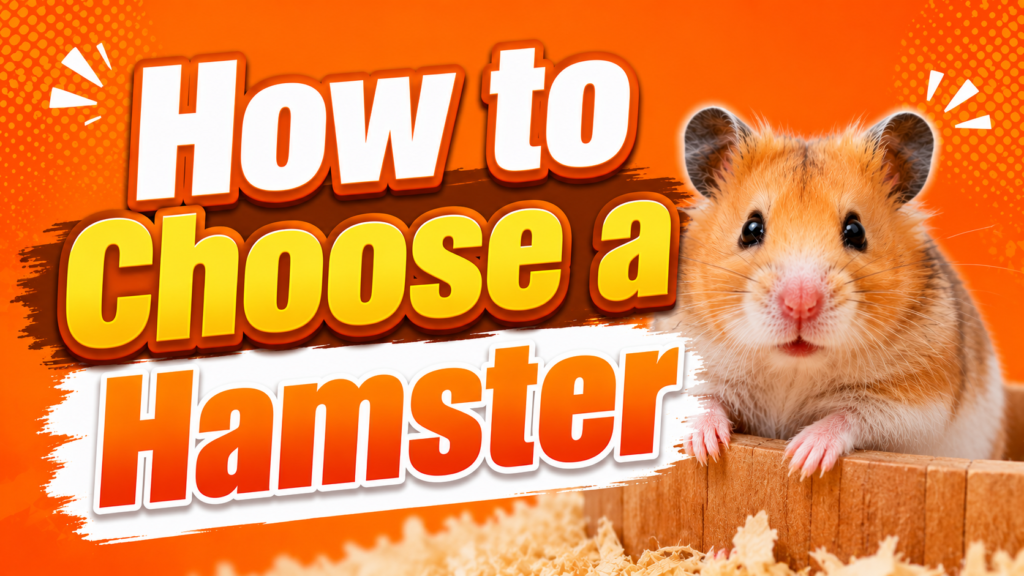
Choose a hamster by matching the animal to what you actually want from the relationship, then look at the individual hamster’s health, behavior and history. Syrian hamsters can be easier to handle because they are larger, while Roborovskis are usually much more difficult to hold because they are tiny and extremely fast. But species does not guarantee personality, and there is no good basis for assuming every Campbell’s is nippy or every Winter White is friendlier.
A good choice is not simply “the cutest hamster in the cage.”
Before bringing one home, ask yourself whether you mainly want to watch natural behavior, hope to build up to regular handling, are choosing a pet for a family, or simply want a hamster whose needs fit the setup you can provide.
Then look at the individual animal.
For the practical side of finding one, see our where to buy a hamster and adopting a hamster guides.
Step 1: Decide what you want from a hamster
The biggest mistake is choosing from a species stereotype without thinking about what you expect from the pet.
All commonly kept hamster species need substantial space, deep bedding, a suitable wheel, places to hide and burrow, enrichment, appropriate food and veterinary care when necessary.
What differs more noticeably is body size and how easy the animal may be to handle.
| Hamster | What matters when choosing |
|---|---|
| Syrian | Largest common pet hamster. Their larger body can make handling easier, but individual temperament still varies. |
| Winter White | Small and quick. Pet-shop animals labelled Winter White may actually have Campbell’s ancestry. |
| Campbell’s dwarf | Small and active. Do not assume the species is inherently more likely to bite. |
| Roborovski | The smallest common pet hamster and exceptionally fast. Usually the least practical choice if frequent handling is important to you. |
| Chinese | Longer-bodied with a more noticeable tail. Can become comfortable with handling when well socialized. Check local laws carefully. |
Woodgreen specifically notes that Syrian hamsters can be easier to handle because of their size, while Roborovskis are exceptionally fast and can be difficult to pick up. It also points out that many pet dwarf hamsters are Campbell’s and Winter White hybrids unless they come from a known pedigree.
So use species as a starting point, not a personality test.
For a closer comparison, see our types of hamsters and dwarf vs Syrian hamster guides.
Step 2: If handling matters, say so before choosing
A hamster does not have to enjoy being held to be a good pet.
Some owners are happiest watching a hamster dig tunnels, build a nest, forage and run. Others specifically want to work toward hand-feeding and handling.
If regular handling matters to you, a Syrian can be a practical starting point because its larger body is generally easier to support securely.
That still does not mean:
- every Syrian is calm
- every Syrian enjoys being held
- Syrian hamsters never bite
- dwarf hamsters cannot become hand-tame
- a hamster that is nervous today will always be nervous
Roborovskis are the clearer exception. Woodgreen describes them as exceptionally fast and difficult to handle regularly, particularly for young children.
Do not buy a Robo expecting enough taming sessions to turn it into a slow, cuddly hamster.
Step 3: Look at the individual hamster’s health
Species comes second to health.
When the hamster is naturally awake, look for:
- clear, bright eyes
- a clean nose
- a clean coat without obvious unexplained hair loss
- a clean, dry rear
- normal movement
- normal breathing without obvious effort
- an appropriate body condition
- interest in the surroundings when awake
Veterinary guidance from PetMD lists clear eyes, a clean coat, clean nose and ears, and a clean rear among normal healthy signs. Weight loss, fecal staining around the rear, wounds, respiratory difficulty, diarrhea and loss of appetite are reasons for veterinary attention.
Do not judge a hamster for sleeping during the day. Hamsters naturally spend much of the daytime asleep and may react defensively if suddenly woken.
Observing an animal during its normal active period tells you much more.
Step 4: A dirty rear is a warning sign, but do not diagnose it yourself
Pay particular attention to the fur around the rear.
Fecal staining, obvious diarrhea or persistent wetness can indicate illness and should not be dismissed as a hamster being messy. PetMD and the RSPCA both list diarrhea or a fecal-stained rear among important health warning signs.
Do not automatically label every dirty rear as “wet tail,” though.
Wet tail is commonly used to describe significant diarrhea in hamsters, while specific diseases such as proliferative ileitis require veterinary diagnosis.
If an animal appears ill, ask what veterinary assessment it has received rather than relying on a shop or seller’s informal diagnosis.
Step 5: Do not search for a perfect personality in five minutes
A hamster’s behavior in a shop, rescue center or unfamiliar environment is not a reliable preview of its entire personality.
A hamster may be:
- newly arrived
- asleep
- stressed by unfamiliar smells
- surrounded by noise
- unused to handling
- frightened by being picked up by a stranger
A hamster trying to escape your hand does not automatically have a “bad temperament.”
Likewise, one that freezes during handling is not necessarily relaxed. Freezing can also be a response to fear.
If possible, ask the person caring for the hamster how it normally behaves when awake:
- Does it approach people?
- Does it take food from a hand?
- How does it respond to routine enclosure maintenance?
- Has it been handled voluntarily?
- Is there any known history of biting or extreme fear?
A rescue or foster home may sometimes have a useful advantage here because the hamster may have been observed in a home-like environment for longer.
Step 6: Do not choose by age alone
There is no good evidence for the rule that the “ideal” hamster must be exactly 4 to 8 weeks old.
The previous version of this guide also suggested that hamsters older than 10 to 12 weeks are inherently harder to tame. That is too rigid.
Young animals can learn to become comfortable with handling, but older hamsters can also build trust with people.
An adult rescue hamster may actually give you something a very young hamster cannot: a clearer idea of its established behavior and handling preferences.
Rather than chasing a narrow age window, check that:
- the hamster is fully weaned
- its age or approximate age is known where possible
- its health history is disclosed
- you understand any previous handling history
- males and females have been managed responsibly
Do not reject a healthy adult simply because an online guide says younger always means easier.
Step 7: Look at the source, not just the hamster
The conditions around the animal can tell you important things.
Look for a seller, breeder or rescue that can answer basic questions about:
- where the hamster came from
- approximate age
- sex
- current food
- recent health concerns
- previous treatment
- handling history
- whether males and females have been housed together
- whether cage mates have recently been sick or injured
Visible illness affecting multiple animals is a serious concern.
So are unexplained injuries, persistent diarrhea, respiratory symptoms, no access to clean water, or a seller who refuses to discuss obvious health problems.
This does not mean every temporary pet-store enclosure needs to look like a permanent 100 × 50 cm home. What matters here is whether the animals appear to be managed responsibly and whether important health information is being hidden.
Step 8: Confirm the sex when it matters
Sexing small hamsters is not always easy for an inexperienced owner.
If an accurate sex matters because of pregnancy risk, previous mixed housing or another reason, ask an experienced rescue, breeder or veterinarian to confirm it rather than relying entirely on a label attached to a cage.
If you know a female hamster has recently been housed with males, mention that history when arranging veterinary care.
Do not introduce unfamiliar hamsters simply to “see if they get along.”
Step 9: Plan for one hamster per enclosure
For someone choosing a new hamster, planning one hamster per enclosure is the simplest conservative choice.
This is one area where reputable welfare organizations differ slightly.
Woodgreen recommends housing pet hamsters individually because fights among captive dwarf hamsters can become severe.
The RSPCA says some established same-sex dwarf sibling pairs or trios can sometimes live together, while also emphasizing that they do not need hamster companionship to be happy and that apparently stable groups can fall out later.
Syrian and Chinese hamsters should live alone.
If you are starting from scratch, there is no welfare advantage that requires you to buy two dwarf hamsters together. One hamster with a properly enriched enclosure avoids the risk of suddenly needing a second complete setup after fighting begins.
If you want two hamsters, the easiest plan is two separate enclosures.
Step 10: Have the full enclosure ready first
Do not buy the hamster and then start researching cages.
Woodgreen currently recommends at least 100 × 50 cm of continuous floor space for all commonly kept pet hamster species, including dwarfs and Roborovskis.
Before bringing the hamster home, have ready:
- the enclosure
- deep suitable bedding
- an appropriately sized solid wheel
- enclosed hides
- nesting material
- a sand area
- food
- water
- safe enrichment
- a secure carrier
The smallest hamster does not need the smallest cage.
A Robo may weigh far less than a Syrian, but it still needs room to forage, burrow, run and explore.
See our hamster cage setup guide before bringing the animal home.
Which hamster is best for a beginner?
There is no universally best beginner hamster.
If handling is important, a Syrian is often the easiest species to physically handle because of its larger size. That is a useful practical difference.
It should not be turned into a promise that Syrians are calmer, friendlier or easier to tame in every case.
A beginner can also care successfully for a dwarf hamster if they understand the animal’s needs and are comfortable handling a smaller, faster pet.
A Roborovski is less suitable when frequent handling is a priority because its speed and tiny size genuinely make handling more difficult.
The best beginner hamster is therefore the healthy individual whose normal behavior fits what the owner actually wants.
What if the hamster is for a child?
Do not choose a hamster on the assumption that a small animal automatically makes an easy children’s pet.
The RSPCA notes that hamsters have fairly complex needs, can be easily injured by rough handling, and should remain the responsibility of an adult.
They are also mainly active later in the day and at night, which can conflict with a young child’s schedule.
For a family that hopes to handle the hamster, a larger Syrian may be physically easier to manage than a tiny Robo.
But an adult still needs to be responsible for:
- enclosure setup
- feeding
- health monitoring
- cleaning
- veterinary care
- safe handling
A hamster should not be purchased with the expectation that a child will independently manage all of its care.
Should you choose a male or female hamster?
Sex is usually less useful for predicting personality than people think.
Individual behavior varies, and broad claims that one sex is automatically friendlier or easier to tame are not reliable enough to use as the main selection rule.
There can be practical differences within particular species. For example, Woodgreen notes that female Syrian hamsters can be especially active and may benefit from even more space.
But when choosing an individual hamster, health, temperament and the quality of the planned environment matter more than trying to choose a guaranteed personality by sex.
Does coat color affect temperament?
Do not choose by color expecting it to predict personality.
A black Syrian is not automatically calmer than a golden Syrian, and a particular dwarf color does not tell you whether the hamster will enjoy handling.
Coat type can affect care, though. Long-haired Syrian hamsters may need additional grooming attention, so coat should not be dismissed as completely cosmetic.
Choose the animal first for health and suitability. Choose your favorite appearance second.
Should you handle a hamster before choosing it?
You do not need to force a handling test.
If the hamster is awake and the organization allows interaction, you can observe how it responds to a hand, a tunnel or gentle handling.
But treat the result as one observation, not a pass-fail exam.
A hamster that is nervous in an unfamiliar environment may settle considerably once it has had time to adjust to a quiet home. Woodgreen recommends allowing a newly arrived hamster time to settle before beginning regular handling.
Never wake a sleeping hamster just to test whether it is friendly.
Check the law before choosing a species
Pet laws are not identical everywhere.
California
California’s current restricted-species rules exempt domesticated golden hamsters (Mesocricetus auratus) and domesticated dwarf hamsters in the genus Phodopus from the state’s rodent restrictions.
Chinese hamsters, Cricetulus griseus, are not included in those hamster exemptions. California Department of Fish and Wildlife guidance also says restricted-species permits are issued only for limited purposes such as research, exhibition, education or shelter, not ordinary pet ownership.
So if you live in California, do not assume that keeping a Chinese hamster simply requires an ordinary pet permit.
Hawaii
The Hawaii Department of Agriculture explicitly lists hamsters among animals prohibited from entry or possession by private individuals.
Rules can change and cities or counties may add their own restrictions, so check current government guidance before obtaining an unusual species.
A simple way to make the final decision
Before saying yes to a hamster, ask five questions:
- Does this species fit the kind of interaction I want?
- Does this individual appear healthy?
- Do I know enough about its history and current care?
- Is my complete enclosure already ready?
- Can I provide proper care even if this hamster never becomes cuddly?
If the answer to all five is yes, you are making a much better decision than someone choosing solely by color, age or a “best hamster” ranking.
The bottom line
Choose the individual hamster first for health, then use species to match realistic handling expectations.
Syrians can be easier to physically handle because they are larger. Roborovskis are genuinely harder to handle because they are exceptionally small and fast. Beyond those useful differences, avoid stereotypes such as “Campbell’s are nippy” or “Winter Whites are friendlier.”
There is also no evidence-based reason to insist on buying a hamster between exactly 4 and 8 weeks old. Healthy adult and rescue hamsters can make excellent pets and may come with a better-known personality.
Look for clear eyes, a clean coat and rear, normal breathing and movement, and a source willing to discuss the animal’s history. Have at least 100 × 50 cm of continuous floor space ready before bringing the hamster home.
For a new setup, one hamster per enclosure is the simplest conservative choice. And always check current local laws, particularly if you are considering a Chinese hamster in California or any hamster in Hawaii.
Keep reading: Where to buy a hamster | Adopting a hamster | Types of hamsters | Best hamster for beginners
Sources: Woodgreen hamster care guide | RSPCA hamster companionship guidance | PetMD hamster care sheet | California restricted species regulations | California Department of Fish and Wildlife exotic pet guidance | Hawaii Department of Agriculture animal guidelines
Hamster Corner provides general educational information about hamster care. If a hamster appears unwell or develops changes in appetite, stool, breathing, movement or normal behavior, contact a veterinarian experienced with hamsters.