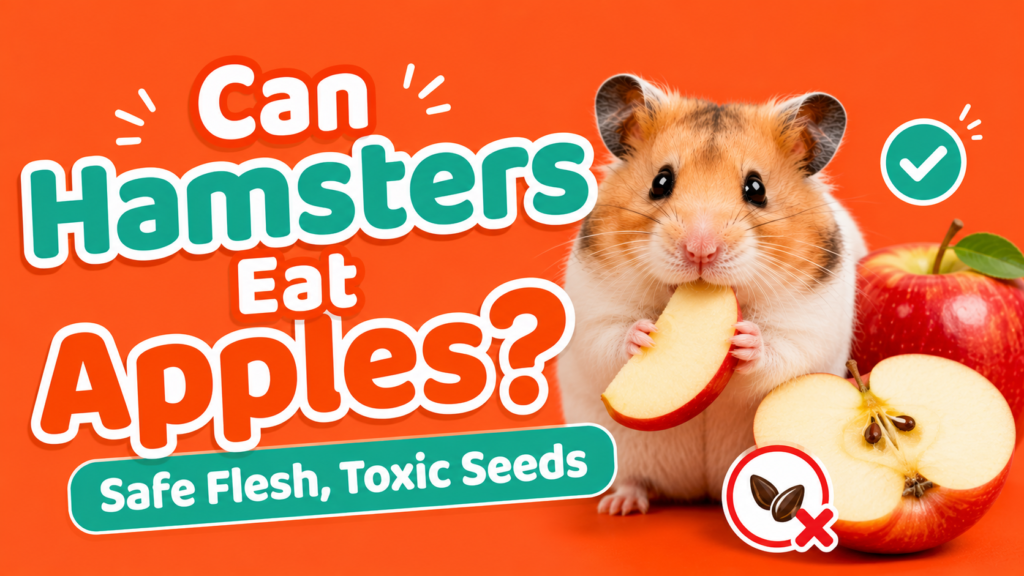
Yes, hamsters can eat apple, but only the flesh, in very small amounts, and never the seeds. Apple flesh is a safe occasional treat. Apple seeds are toxic because they release cyanide when chewed. Offer about a teaspoon of diced flesh for a Syrian, and half that for a dwarf, once or twice a week.
Apple is a good now-and-then snack as long as you follow two rules: feed only the flesh, and remove every seed. Get those right and most hamsters enjoy it. Here is how much is safe and how to serve it.
Most important rule: remove the entire core and every seed before feeding apple. Never let your hamster near apple seeds.
Is apple good for hamsters?
Apple flesh offers a little fiber, some vitamin C, and antioxidants, plus a soft texture most hamsters enjoy. As an occasional treat it is a nice bit of variety. Like all fruit, though, apple is fairly high in natural sugar, so it belongs in the rare-treat category, not the everyday bowl. For dwarf hamsters, which are prone to diabetes, that caution matters even more.
Why apple seeds are toxic
Apple seeds contain amygdalin, which breaks down into cyanide when chewed or digested. In a human, the few seeds in one apple are trivial. In a hamster weighing as little as 1 ounce, the safety margin is tiny, so you should never let a hamster eat even part of an apple seed. This is the same reason cherry pits and apricot, peach, and plum stones are off limits. See our full guide to foods toxic to hamsters for the complete list.
How much apple can a hamster eat?
Keep portions tiny and occasional.
| Hamster type | Safe portion | How often |
|---|---|---|
| Syrian (larger) | About 1 teaspoon of diced flesh | Once or twice a week |
| Dwarf (Robo, Winter White, Campbell’s, Chinese) | About half a teaspoon, finely diced | Sparingly, a rare treat |
| Diabetes-prone or overweight dwarf | Best avoided. Choose a low-sugar vegetable instead | Not recommended |
How to feed apple safely, step by step
Five quick steps:
- Wash the apple to remove pesticide residue from the skin.
- Cut it open and remove the entire core and all seeds. Do not leave a single seed behind.
- Dice the flesh into tiny pieces, pea-sized or smaller, especially for dwarfs.
- Offer one small piece during supervised time, ideally by hand.
- Remove leftovers within a few hours and check nesting corners, since hamsters hoard fresh food that then spoils.
Can hamsters eat apple skin?
Yes, the skin is safe as long as the apple is washed well. Some hamsters enjoy the extra texture. If you cannot wash it thoroughly, peeling is a fine option.
Can hamsters eat dried apple?
It is best avoided. Dried fruit has concentrated sugar and is stickier, which is not ideal for a small animal prone to weight gain and cheek-pouch problems. Fresh, properly portioned apple is better.
Can hamsters eat applesauce or apple juice?
No. Applesauce and juice are high in sugar, often with added sugar, and do not suit a hamster’s digestive system. Stick to small pieces of fresh flesh.
Does the apple variety matter?
Not much. Red, green, and yellow apples are all safe in the flesh, and the small portion size keeps the difference in sugar minimal. Some people choose slightly tart green apples like Granny Smith for a touch less sugar, but any fresh, washed, seed-free apple works fine. What matters far more than the variety is the portion and removing the seeds.
Can dwarf hamsters eat apples?
Sparingly. Dwarf species are prone to diabetes, so apple should be a rare treat of about half a teaspoon of finely diced flesh. If your dwarf is overweight or showing signs of diabetes, skip fruit entirely and offer a low-sugar vegetable instead.
What if my hamster ate part of the core?
The core itself is not toxic, but it often contains seeds, which are. If your hamster got into the core, remove it, check that no seeds were eaten, and watch closely for the next 12 to 24 hours. Contact an exotic vet if you notice labored breathing, lethargy, or loss of coordination.
How often can hamsters have apple?
Once or twice a week at most, and less for dwarfs. Apple is a treat that sits inside your hamster’s small weekly sugar budget, so it should not be a daily food. If you have already given another sugary fruit that week, skip the apple and offer a low-sugar vegetable instead. Spacing treats out keeps the diet balanced and the calories in check.
Is apple better than other fruits for hamsters?
It is one of several safe options, not a clear winner. Apple, pear, blueberry, and a little banana are all fine in tiny amounts, and rotating between them adds variety. The same rules apply to each: small portion, no seeds or pits, washed first, and only occasionally.
How to introduce apple for the first time
Start with a piece even smaller than the normal treat portion. Offer it during your hamster’s active evening hours, ideally by hand, then wait a day or two and check the droppings. Firm, normal stools mean apple agrees with your hamster, and you can move to the regular treat-sized amount. Soft stools mean you should pause and try a smaller piece later, or choose a lower-sugar food. Because you are introducing just one new food at a time, anything that disagrees is easy to identify.
What to watch for after feeding apple
Introduce apple slowly and watch for soft stools, which can happen if any fruit is overdone. If your hamster ever does eat a seed, monitor closely for 12 to 24 hours for labored breathing, lethargy, or loss of coordination, and contact an exotic vet if you see any of these signs.
The bottom line
Apple is a safe treat when you stick to two rules: feed only the flesh, and remove every seed. Keep portions tiny, about a teaspoon for a Syrian and half that for a dwarf, and offer it just once or twice a week. For diabetes-prone dwarfs, make it a rare treat or skip it in favor of low-sugar vegetables.
Keep reading: What Can Hamsters Eat?, Foods Toxic to Hamsters, Can Hamsters Eat Carrots?
Hamster Corner provides general educational information about hamster care. It is not a substitute for professional veterinary advice. If your hamster shows signs of illness, contact an exotic vet promptly.