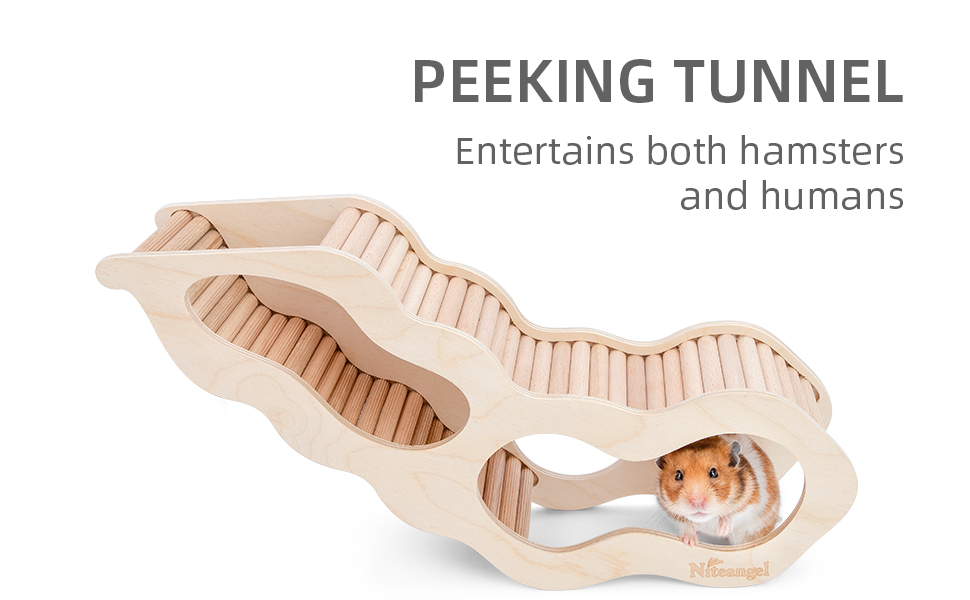
The Niteangel Secret Peep Tunnel Hamster Hut is a well-designed wooden hide-and-ramp combination for dwarf hamsters, with a bottomless shelter underneath and a built-in climbing surface above. Niteangel itself recommends this model for dwarf hamsters and similarly sized small pets, and its approximately 2.1-inch entrance is the main reason I would not automatically recommend it for a Syrian.
The design is clever, though. It gives a dwarf hamster another covered retreat without using a separate hide and ramp, and the floorless base integrates nicely with deep bedding.
Affiliate disclosure: As an Amazon Associate, Hamster Corner may earn from qualifying purchases. This review is based on current manufacturer information, available customer feedback and hamster welfare guidance. It is not presented as a hands-on product test unless specifically stated.
Niteangel Secret Peep Tunnel Hamster Hut at a glance
| Product | Niteangel Hiding Ladder / Secret Peep Tunnel Hamster Hut |
| Listed dimensions | Approximately 14.1 × 3.3 × 7.6 inches on current marketplace listings |
| Entrance | Approximately 2.1 inches |
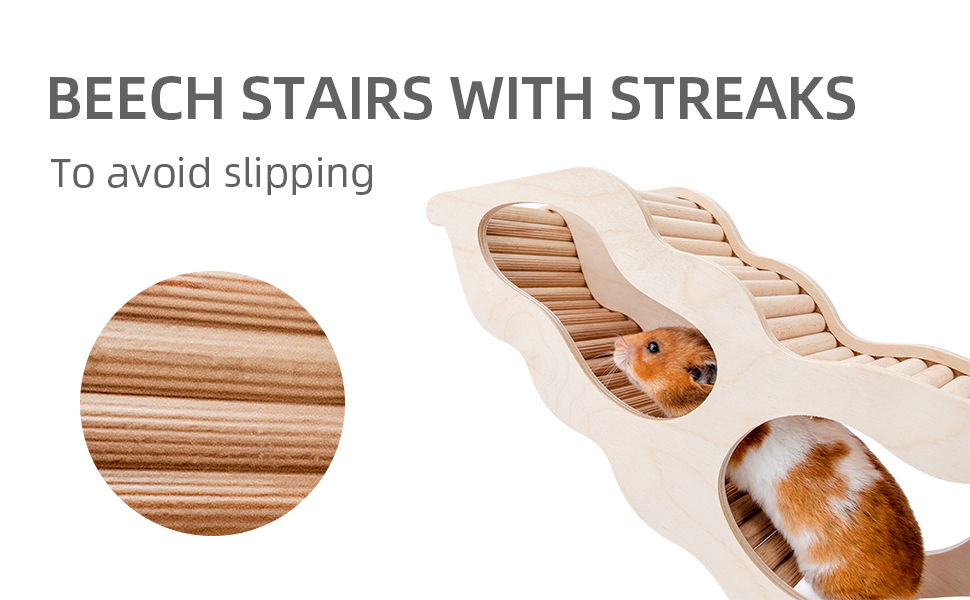
| Materials | Birch plywood and beech sticks |
| Construction | Manufacturer says it is built without nails |
| Base | Open / bottomless |
| Officially recommended for | Dwarf hamsters, tiny gerbils, mice and similarly sized pets |
| Main advantage | Combines a covered hide with a low climbing surface |
| Main concern | I would not assume the 2.1-inch entrance comfortably fits every Syrian |
| Our rating | 4.4/5 |
My verdict
For a dwarf hamster, I think this is one of the more useful Niteangel accessories.
It is not simply a decorative house.
The lower section provides cover, while the sloped wooden roof acts as another surface to explore or use as a low route through the enclosure.
More importantly, the house has no solid bottom.
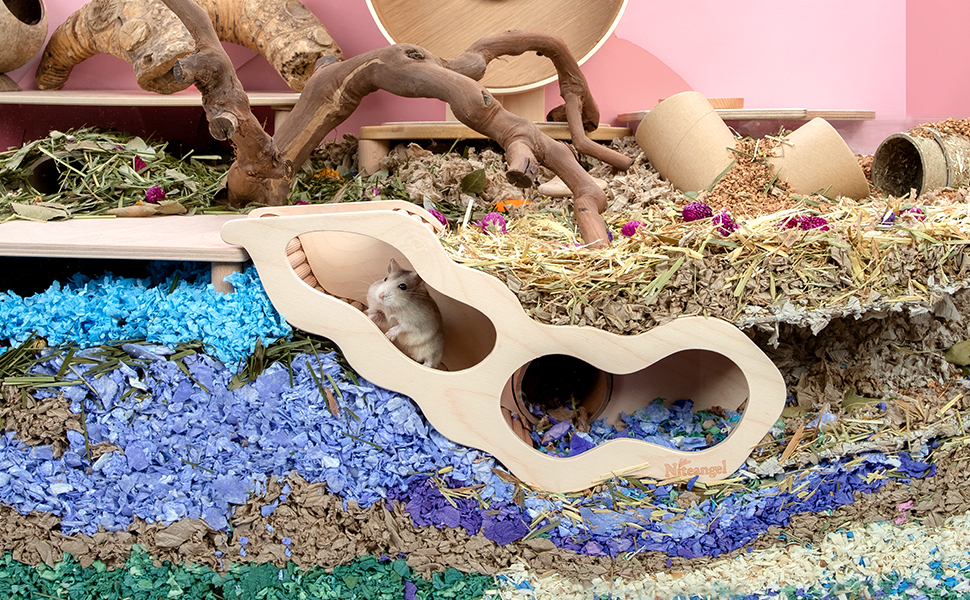
That fits well with deep hamster bedding because the hide can sit directly over substrate rather than separating the hamster from its digging area.
What I would change from the original review is the Syrian recommendation.
Some Syrian owners do report successful use. That is interesting customer feedback, but Niteangel itself describes the approximately 2.1-inch entrance as intended for dwarf hamsters and similar-sized pets.
For a Syrian, I would choose a hide with clearly larger openings rather than relying on anecdotal fit.
What is it actually made from?
The original draft called this a solid-wood hide.
That is not quite accurate.
According to Niteangel’s current product page, the house is made from:
- birch plywood
- beech sticks
Niteangel says it is assembled without nails and that the corners are sanded smooth.
Those are useful construction details.
I would still inspect the individual product before use. Natural and assembled wooden products can vary, and a manufacturer’s “sanded smooth” claim does not replace checking the actual piece that arrives.
Run your fingers around:
- the entrance
- roof edges
- ladder sections
- joints
- accessible corners
If you find an obviously rough or damaged area, deal with that before putting the hut into the enclosure.
The entrance is designed for dwarf hamsters
Niteangel lists the entrance at approximately 2.1 inches, or around 5.3 cm.
More importantly, the manufacturer explicitly recommends the product for:
- dwarf hamsters
- tiny gerbils
- mice
- similarly sized pets
That is much stronger information than trying to infer suitability from Amazon reviews.
The original article says many Syrian owners find it roomy.
Some may.
But Syrians vary considerably in body size, and a hamster being physically capable of pushing through an opening is not the same as the opening being comfortably proportioned.
Blue Cross also warns that narrow commercial tubes can be uncomfortable for Syrian hamsters.
For that reason, my recommendation is simple:
I would buy this model primarily for dwarf hamsters.
If you have a Syrian, choose a hide specifically sized for Syrians or verify the opening and interior dimensions very carefully before purchase.
Bigger overall does not mean a bigger entrance
One reason this product can be confusing is its overall length.
Current marketplace specifications put it around 14.1 inches long, which sounds substantial for a hamster accessory.
But much of that length comes from the sloped ladder structure.
It does not mean the enclosed sleeping area has a Syrian-sized doorway or Syrian-sized interior.
This is why overall product dimensions should not replace entrance measurements when buying hides.
The bottomless design is one of its best features
This is more than a cleaning convenience.
The RSPCA recommends providing a dark nesting shelter and says it is best if the nesting box does not have a floor.
A floorless hide allows the hamster to remain directly connected to its bedding.
With the Niteangel hut, you can place the covered section over a suitably deep substrate and let the hamster:
- dig beneath it
- pull nesting material inside
- alter the entrance area
- connect the hide with its own tunnels
That makes much more sense for a burrowing animal than treating the hut as a little wooden bedroom sitting on a bare cage floor.
Does it replace a proper sleeping hide?
I would still provide more than one shelter.
RSPCA says the hamster’s nesting shelter should be dark inside and large enough for sleeping, moving around and maintaining a food store.
The Niteangel hut is semi-enclosed rather than a deeply enclosed multi-chamber house.
For a dwarf hamster that chooses to sleep there, that is perfectly reasonable.
But I would also provide another secure hide, especially a more enclosed sleeping option.
The goal is to give the hamster choices rather than decide which single accessory it must use as its bedroom.
The climbing roof is useful, but keep the setup low
Niteangel markets the upper surface as a climbing ramp.
I think that is a reasonable secondary function, provided it is used conservatively.
Hamsters benefit from environmental complexity, but they are not animals that need tall climbing structures.
Blue Cross specifically recommends low wooden enrichment and notes that dwarf hamsters can struggle with steep climbing.
So I would position the Niteangel hut:
- on or partly within bedding
- with deep substrate around it
- away from hard objects beneath possible fall points
I would not use the roof as the beginning of a tall climbing course.
Its usefulness is in giving the hamster another low route through the habitat.
Is the ladder safe?
Niteangel says there are no gaps between the wooden sticks forming the climbing surface.
That is a useful feature because gaps in ladders can allow small feet to slip through.
Still, inspect the actual unit.
Check that:
- no roof stick has separated
- no unusual gap has opened
- nothing moves excessively
- there are no sharp broken sections
This becomes especially important if your hamster starts chewing the accessory.
Can hamsters chew the wood?
Niteangel markets the house as chewable.
I would not go further than that.
The original review says the wood is safe to chew and helps with dental wear. I would remove the dental claim.
Hamsters certainly gnaw, and their incisors continually grow, but a hideout does not need an invented dental benefit to justify its existence.
This product’s main purpose is shelter and environmental enrichment.
If your hamster occasionally gnaws the wooden structure, inspect the resulting wear.
If you want dedicated chewing material, provide clearly identified hamster-appropriate chews separately.
What about the plywood?
The main body is birch plywood rather than one solid block of birch.
That does not automatically make the product unsuitable.
Niteangel specifically manufactures and markets this plywood structure for hamster use.
I did not find independent testing of the adhesive or manufacturing process, so I would not add claims such as “completely non-toxic glue” unless Niteangel publishes evidence supporting them.
The practical approach is to use the product as intended and inspect it if your hamster begins heavily dismantling the plywood itself.
How sturdy is it?
Available customer feedback is broadly positive about construction, and current marketplace summaries commonly describe the hut as sturdy.
That matches Niteangel’s own construction claim.
I would not say the product is proven to last for years or that joints never loosen.
How long wooden hamster furniture survives depends heavily on:
- chewing
- moisture
- the individual unit
- how it is positioned
- how often it is moved
Inspect the structure during normal enclosure maintenance.
If a joint starts separating or a component becomes unstable, remove it rather than waiting for the hut to collapse.
What about rough edges?
Niteangel says each corner is sanded smooth.
I could not establish that rough entrances are a widespread recurring defect, so I would not make that a headline criticism.
A pre-use edge check is still sensible with any wooden accessory.
If you find a genuinely rough area on your individual unit, contact the seller or carefully address it before use rather than assuming all units share the same problem.
Cleaning the Niteangel hut
The bottomless design makes bedding maintenance easier because you can lift the hut instead of emptying a sealed wooden box.
But the wood itself remains porous.
If your hamster urinates repeatedly against the wooden walls, cleaning may be more difficult than with ceramic.
I would:
- Remove loose debris when necessary.
- Keep the structure dry.
- Follow current Niteangel care instructions for the product.
- Replace the hut if it becomes heavily contaminated and cannot be adequately cleaned.
Do not routinely destroy the hamster’s clean nest just because you lift the hide.
RSPCA recommends balancing hygiene with avoiding unnecessary disturbance to established bedding and nesting material.
Does it really save cage space?
Somewhat, but I would not oversell that either.
Combining a hide with a ramp means one accessory performs two physical functions.
That can be useful.
However, the product is around 14 inches long, so it still takes up a meaningful part of the layout.
Measure before ordering and make sure the enclosure still has ample room for:
- deep bedding
- a proper wheel
- sand
- additional hides
- tunnels and cover
- feeding and water areas
The goal is not to cram as many two-in-one accessories as possible into the cage.
Who I think it is best for
I would shortlist the Niteangel Secret Peep Tunnel Hut for:
- dwarf hamster owners
- naturalistic enclosure setups
- owners wanting a floorless secondary hide
- layouts that can make use of a low ramp
- hamsters that like digging around fixed structures
Its combination of shelter and low-level structure is genuinely useful.
Who should skip it
I would choose another product if:
- you have a large Syrian and want guaranteed fit
- you want a spacious primary multi-chamber sleeping house
- you need something fully washable
- your enclosure does not have room for a roughly 14-inch accessory
- the individual unit arrives damaged or unstable
For a buried alternative, see our AccEncyc Hamster Tunnel Hideout review.
For the wider decision, see our hamster hideout guide and hamster cage setup guide.
What I would check when it arrives
Before placing the hut into the enclosure:
- Check the 2.1-inch entrance against your hamster’s actual size.
- Run your fingers around the doorway and edges.
- Check every wooden joint.
- Make sure the roof sticks are secure.
- Look for cracks or damaged plywood.
- Place it securely on or within deep bedding.
- Keep hard objects away from areas where the hamster could fall from the roof.
After that, inspect according to actual wear rather than using a rigid replacement schedule.
Frequently asked questions
Is the Niteangel Secret Peep Tunnel Hut good for Syrian hamsters?
I would not choose it as my default Syrian hide.
Niteangel officially recommends the approximately 2.1-inch entrance for dwarf hamsters and similarly sized animals.
Some Syrian owners report successful use, but anecdotal fit does not guarantee that every adult Syrian can enter and turn comfortably.
Is it made from solid wood?
Not entirely.
Niteangel says it is made from birch plywood and beech sticks.
The construction is nail-free according to the manufacturer.
Is the wood safe to chew?
Niteangel markets the product as chewable, but I would treat it primarily as enclosure furniture rather than a dedicated dental chew.
Inspect it if your hamster begins heavily dismantling the structure.
Does it have a floor?
No.
The bottomless design allows it to sit directly over bedding, which works particularly well in a deep burrowing setup.
Can it be used as the hamster’s main sleeping house?
Possibly if your hamster chooses it, but I would still provide another dark, enclosed sleeping option.
Hamsters benefit from having multiple secure places to hide.
Does the climbing roof replace other enrichment?
No.
It adds one additional low route through the enclosure but does not replace deep bedding, foraging opportunities, tunnels, suitable hides or an appropriately sized wheel.
Final verdict
The Niteangel Secret Peep Tunnel Hamster Hut is a strong dwarf-hamster accessory, but I would stop selling it to readers as a surprisingly roomy Syrian hide.
Niteangel itself gives us the clearest answer: the approximately 2.1-inch entrance is designed for dwarf hamsters and similarly sized small pets.
The product still has several genuine strengths.
Its bottomless design works naturally with deep bedding. The birch-plywood and beech construction avoids exposed nails. And the upper ramp gives a dwarf hamster another low surface to explore without requiring a completely separate bridge.
I would simply keep the use case narrow and accurate.
My recommendation: a very good secondary hide-and-ramp combination for dwarf hamsters. For Syrians, choose a product with clearly larger openings rather than relying on customer anecdotes.
As an Amazon Associate, Hamster Corner may earn from qualifying purchases. Prices, ratings, specifications and availability can change. Check the current dimensions and make sure the entrance comfortably fits your hamster before ordering.
Sources
Niteangel official product page