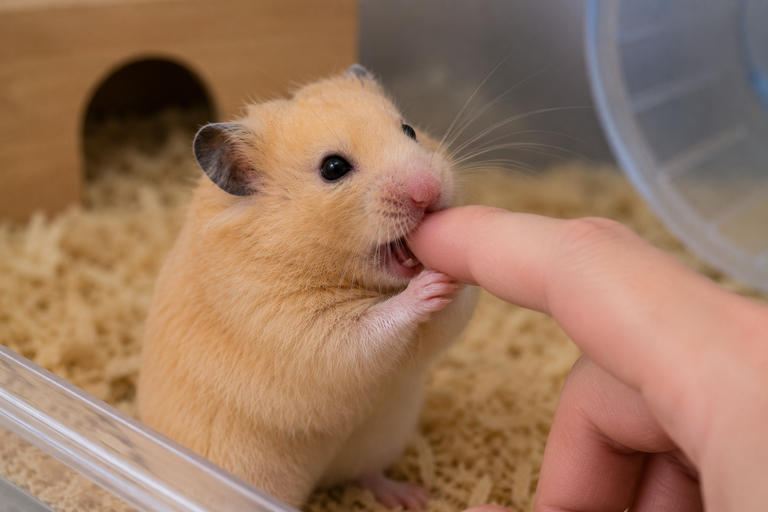

Hamsters can become familiar with their owner’s smell, presence and handling routine, and they may behave differently around a familiar person than around someone new. However, there is no good direct study showing that pet hamsters recognize individual human owners in the same way research has demonstrated recognition of other hamsters. Scent is likely important, but claims about recognizing your voice, remembering you for months or knowing you specifically as “their owner” go beyond the evidence.
The distinction may sound small, but it matters. Hamsters clearly have sophisticated scent-based recognition abilities. What science has demonstrated directly is recognition of other hamsters, while owner recognition remains a reasonable possibility rather than a proven fact.
Can hamsters recognize individual people?
Probably to some extent, but direct evidence is limited.
I could not find a controlled cognition study that tested whether a hamster can distinguish its human owner from another familiar or unfamiliar person.
What we do know is that hamsters are capable of individual recognition in other contexts.
Studies on golden hamsters have shown that they can:
- Distinguish familiar from unfamiliar hamsters
- Discriminate between odors belonging to different individuals
- Remember some familiar individual scents
- Respond differently to familiar individuals depending on previous experiences with them
One study even found that golden hamsters could recognize familiar individuals as more than simply one isolated smell. The animals appeared to form representations connecting different scent signals with the same individual.
That is strong evidence that hamsters have the cognitive machinery for individual recognition.
But those experiments involved hamsters recognizing other hamsters, not hamsters identifying their human owners.
So it is reasonable to say that your hamster can become familiar with you. It is less defensible to say science has proved that it recognizes you as a unique human individual.
Is scent how hamsters become familiar with you?
Scent is probably an important part of it.
The RSPCA describes hamsters as having well-developed senses of smell and hearing and notes that smell is particularly important for social communication.
This matches experimental research.
Golden hamsters can discriminate between individually distinctive odors from other hamsters, and research has identified olfactory brain pathways involved in individual recognition.
There is also practical pet-care evidence supporting familiarity with human scent.
Blue Cross recommends initially placing your hand in the enclosure without touching a nervous hamster so that your presence and smell become familiar. It then recommends gradually progressing toward hand-feeding and gentle handling.
That supports this practical conclusion:
A hamster can learn that your scent and presence are familiar and associated with previous interactions.
What it does not prove is that the hamster builds the same type of social concept of “owner” that people often attribute to dogs.
Can hamsters recognize your voice?
This is much less certain.
Hamsters have good hearing, and the RSPCA notes that sounds are important in their environment. However, I could not find hamster-specific research showing that pet hamsters can reliably distinguish their owner’s voice from another human voice.
Woodgreen Pets Charity recommends quietly talking to a hamster before handling so that it is aware you are there.
That is sensible handling advice.
It is not evidence of voice recognition.
Your hamster may become accustomed to the sounds associated with your normal routine, including your voice, footsteps or the opening of its enclosure. But saying it specifically recognizes your voice needs more evidence than is currently available.
Does a hamster know its owner’s scent?
Again, familiarity is easier to support than true owner identification.
Hamster scent-memory experiments show that golden hamsters can remember individually distinctive odors from other hamsters.
In one study, males could distinguish a familiar individual scent from a novel one after 10 days, although that discrimination was no longer demonstrated at 21 days under that particular experimental setup.
Other experiments have produced different memory durations depending on the relationship and previous social experience between the hamsters.
Those studies tell us something important: hamster odor memory is real, but it is context dependent.
They do not establish that a pet hamster remembers its human owner’s scent for a particular number of weeks or months.
So I would not promise that a hamster returning to its owner after a long absence will immediately recognize that person.
What does it mean when your hamster comes to you?
A hamster approaching you can be a positive sign, but it is not a scientific owner-recognition test.
A hamster that has become comfortable with handling may:
- Approach when you place your hand in the enclosure
- Sniff your hand without immediately retreating
- Take food from your hand
- Climb onto your hands voluntarily
- Remain relatively calm while being handled
- Explore normally while you are nearby
Blue Cross uses these same kinds of gradual interactions when describing how a hamster becomes accustomed to being handled.
But several explanations can produce those behaviors.
Your hamster may recognize familiar cues, anticipate food, have learned that your hands are safe, or simply have become less fearful of human interaction.
You cannot tell from one behavior exactly what the hamster is thinking.
Does my hamster love me?
Science cannot give us a useful yes-or-no answer to that question.
Terms such as love, affection and attachment describe complex emotional experiences that are difficult to demonstrate in a hamster.
What you can observe is trust and learned familiarity.
A hamster that voluntarily approaches, accepts handling and remains relaxed around a familiar caretaker has learned that those interactions are not threatening.
That relationship is meaningful from a welfare perspective without needing to claim that hamster attachment works like human relationships or dog-human bonding.
How long does it take a hamster to get used to you?
There is no evidence-based two-to-four-week recognition deadline.
Individual hamsters vary considerably.
Woodgreen advises giving a new hamster a day or two to settle before beginning handling and describes a gradual process of allowing the hamster to move over your hands and become comfortable with being picked up. It notes that after around one to two weeks of calm, patient handling, many hamsters become comfortable being picked up and hand-fed.
That is a taming guideline, not proof that recognition has formed after a specific number of days.
Some hamsters become comfortable quickly. Others may need substantially longer.
Roborovski hamsters can also be especially difficult to handle because of their speed and small size, so lack of interest in being held should not automatically be interpreted as failure to recognize you.
How to help your hamster become familiar with you
Focus on predictable, low-stress interaction rather than trying to make the hamster “bond” on a timetable.
Let the hamster investigate you
Place your hand inside the enclosure and allow the hamster to approach and sniff in its own time.
Do not immediately chase, grab or corner it.
Interact when your hamster is awake
The RSPCA advises respecting a hamster’s sleeping pattern and avoiding unnecessary handling while it is resting.
Being woken and picked up unexpectedly can be stressful regardless of how familiar the person is.
Build positive associations gradually
Blue Cross recommends offering food from your hand as part of the taming process.
Once the hamster comfortably approaches, you can progress toward gentle handling.
Handle consistently and gently
Use calm movements and let the hamster gain experience with your hands without forcing interaction.
For the full process, see how to tame a hamster and how to bond with your hamster.
Why does my hamster react differently to another person?
It might be because the person looks, smells, sounds or handles the hamster differently.
But do not reduce this automatically to:
My hamster recognizes my scent and knows the other person is a stranger.
That is plausible, but it has not been demonstrated directly in pet hamster-human recognition experiments.
A different reaction could also be caused by:
- Different handling technique
- Faster or more hesitant movements
- Strong perfume or another unfamiliar smell
- Food scents on someone’s hands
- The hamster being disturbed at a different time
- Previous experience with being handled
- Normal variation in the hamster’s mood and activity
Hamsters are prey animals, and the RSPCA notes that unfamiliar sights, sounds and smells can make them nervous.
Why does my hamster bite me but not someone else?
Do not assume this is proof of recognition or favoritism.
First look at what is different about the interaction.
Wash your hands before handling, particularly if they smell of food or another animal. Approach slowly while the hamster is awake and let it investigate your hand rather than reaching directly toward it.
Also consider whether the hamster is being startled, cornered or handled longer than it is comfortable with.
If a normally tame hamster suddenly becomes defensive or unusually reluctant to be touched, consider health as well as behavior.
See signs of a sick hamster if the behavioral change is sudden or accompanied by changes in eating, activity or appearance.
Will my hamster remember me after a vacation?
Possibly, but there is no reliable human-owner memory duration.
Research shows that hamsters can retain memories of familiar individual odors, but experiments involving other hamsters have produced different memory durations depending on the type of experience and relationship.
That means claims such as:
- hamsters remember owners for several months
- they never forget a familiar scent
- two weeks away will not affect recognition
are not supported well enough.
If your hamster seems more cautious after you have been away, simply return to calm, gradual interaction rather than assuming the bond has disappeared.
Can a hamster become familiar with several people?
Probably, especially if several people handle it gently and consistently.
There is no reason to assume a hamster can learn only one person’s cues.
However, I could not find a controlled study testing whether pet hamsters separately identify multiple human caretakers.
So the strongest practical statement is that a hamster can become comfortable and familiar with repeated interactions involving more than one person, rather than claiming that it has scientifically demonstrated individual human recognition of each family member.
Frequently asked questions
Does my hamster recognize me when I walk into the room?
It may respond to familiar cues associated with you, but the behavior alone cannot tell us whether it has identified you as a unique individual. Smell, movement, environmental sounds and learned feeding routines may all contribute.
Does my hamster know its name?
There is no good hamster-specific evidence showing that hamsters recognize their names as individual labels. They may learn that a repeated sound predicts food, attention or another event, but that is different from understanding a name.
Do hamsters recognize people by smell?
Scent is a plausible and probably important cue. Hamsters have a highly developed olfactory system, experimental research shows individual odor recognition between hamsters, and welfare guidance recommends allowing a pet hamster to become familiar with a caretaker’s smell. Direct human-owner recognition experiments are still lacking.
The bottom line
Hamsters can become familiar with their owners, particularly with repeated scent, handling and routine cues. But science has not yet demonstrated human-owner recognition as directly as it has demonstrated recognition between hamsters.
Golden hamsters clearly possess sophisticated scent-based individual recognition. They can distinguish familiar individuals, remember individual odors and respond according to previous social experience.
That makes it entirely plausible that a pet hamster learns that a particular person’s smell and handling are familiar and safe.
What we should not add without evidence are claims that hamsters reliably recognize their owner’s voice, recognize a human stranger on sight, form recognition within exactly two to four weeks or remember an owner’s scent for months.
A familiar, relaxed response to you is still meaningful. It shows that your hamster has learned from repeated interactions and has become comfortable with your presence, even if we cannot precisely label what that recognition feels like to the hamster.