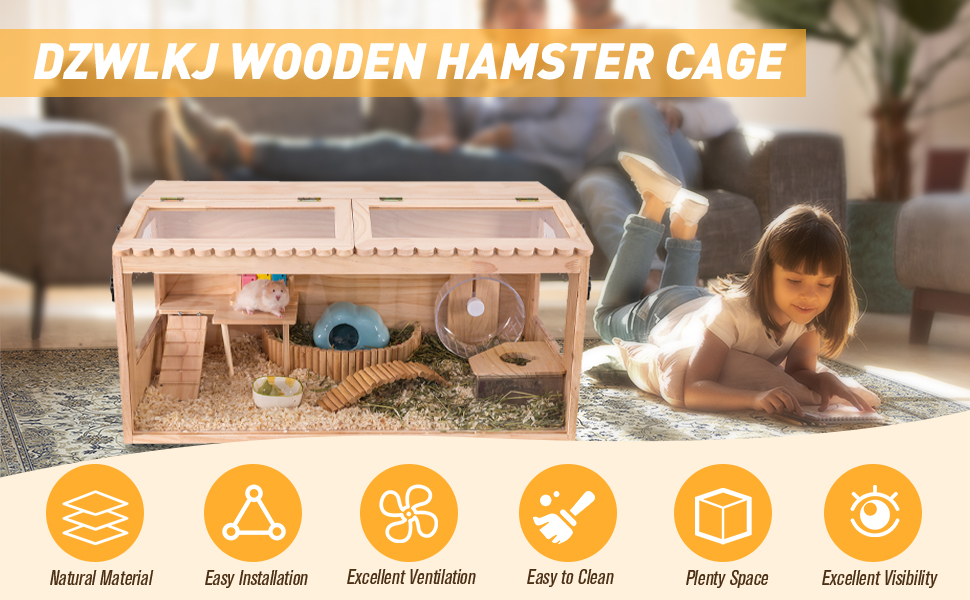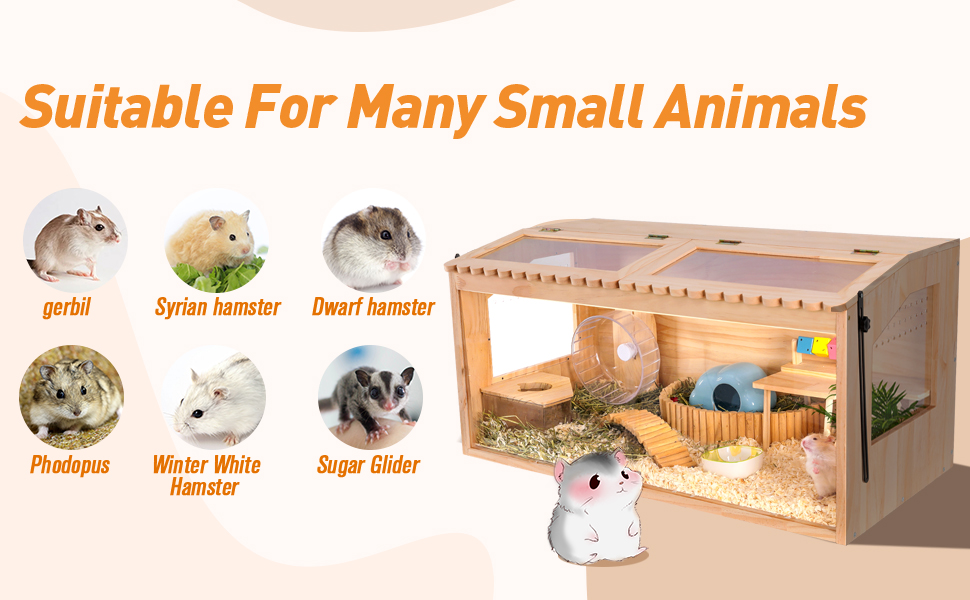
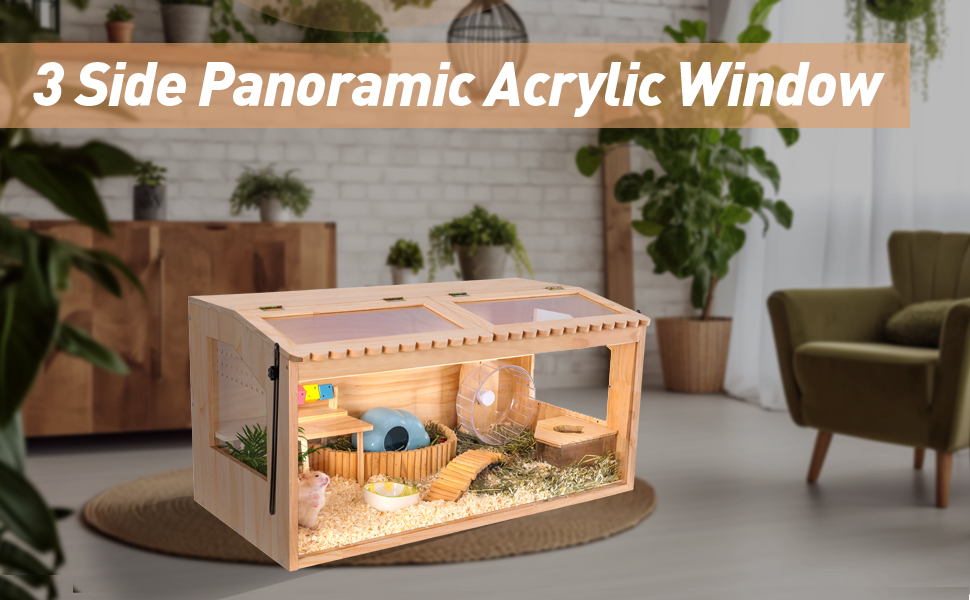
The DZWLKJ Wooden Hamster Cage looks much better than most starter cages, but the size label needs more scrutiny than the original review gave it. The 24-inch and 32-inch versions are clearly too small under current Blue Cross and Woodgreen hamster housing guidance. The 40-inch version looks large enough on paper, but its listed 40 × 20-inch measurement is an external dimension and sits too close to the 100 × 50 cm guideline for me to assume the usable interior actually meets it.
The 48-inch version is the only size I would seriously shortlist, and even then I would confirm the internal base width before ordering.
There is also a broader caveat with the construction. RSPCA currently advises against wooden hamster cages, while Blue Cross and Woodgreen are more accepting of tank-style solid-sided housing. That disagreement deserves to be part of the buying decision.
Affiliate disclosure: As an Amazon Associate, Hamster Corner may earn from qualifying purchases. This review is based on current product specifications, available customer feedback and hamster welfare guidance. It is not presented as a hands-on product test unless specifically stated.
DZWLKJ Wooden Hamster Cage at a glance
| Product | DZWLKJ Wooden Hamster Cage |
| Construction | Seller describes pine wood with acrylic viewing panels |
| Listed sizes | 24 × 16 × 16, 32 × 16 × 16, 40 × 20 × 20 and 48 × 20 × 20 inches across current DZWLKJ listings |
| 24-inch version | Clearly too small for permanent hamster housing |
| 32-inch version | Clearly too small for permanent hamster housing |
| 40-inch version | Borderline because published dimensions appear to be external |
| 48-inch version | Best candidate, but verify usable internal width |
| Main advantage | Attractive furniture-style design with relatively large 40-inch and 48-inch options |
| Main concerns | Internal dimensions are not clearly published, wooden construction has welfare-source disagreement, and customer feedback includes access and panel-security issues |
| Our rating | 3.4/5 |
My verdict
I would not buy the 24-inch or 32-inch DZWLKJ as a hamster’s permanent home.
That part is straightforward.
I would also stop automatically recommending the 40-inch model.
The 40 × 20-inch listing sounds almost perfect because it converts to roughly 101.6 × 50.8 cm. But those are listed overall product dimensions.
Blue Cross and Woodgreen recommend a hamster enclosure with a base around 100 × 50 cm.
When an enclosure is built with a wooden frame around the base, external dimensions do not necessarily equal the continuous usable area inside.
The 40-inch model has almost no spare width to absorb that difference.
The 48-inch version is more convincing because its length is approximately 122 cm, but its listed depth is still only 20 inches, or about 50.8 cm.
For that reason, my recommendation is:
Consider the 48-inch version only after confirming that the internal usable base is approximately 100 × 50 cm or larger.
If the seller cannot provide interior measurements, I would choose an enclosure with clearly published usable dimensions instead.
The four sizes are not equally suitable
Current DZWLKJ listings show several enclosure sizes.
Here is how the published external dimensions compare with current welfare guidance.
| Listed size | Approximate metric size | My verdict |
|---|---|---|
| 24 × 16 × 16 in | 61 × 40.6 × 40.6 cm | Too small |
| 32 × 16 × 16 in | 81.3 × 40.6 × 40.6 cm | Too small |
| 40 × 20 × 20 in | 101.6 × 50.8 × 50.8 cm | Too close to the minimum to approve from exterior dimensions alone |
| 48 × 20 × 20 in | 121.9 × 50.8 × 50.8 cm | Best option, but internal depth still needs checking |
Blue Cross currently recommends housing no smaller than 100 × 50 cm of floor space and 50 cm high.
Woodgreen recommends:
- Syrian and Chinese hamsters: 100 × 50 × 50 cm
- Dwarf and Roborovski hamsters: 100 × 50 cm with at least 40 cm of height
That immediately rules out the 24-inch and 32-inch versions regardless of whether the seller markets them for Syrians, dwarfs or both.
Why external dimensions matter
This is where the original review was too confident.
A 40 × 20-inch product is not automatically the same thing as a 40 × 20-inch usable interior floor.
The listed size may include:
- the wooden frame
- panel thickness
- external trim
- door framing
What matters to the hamster is the uninterrupted space inside those boundaries.
The 40-inch DZWLKJ is only about 1.6 cm longer and 0.8 cm deeper than 100 × 50 cm on its published outer dimensions.
That gives almost no margin.
I could not find reliable current internal measurements for this model.
Because of that, I would not publish:
“The 40-inch size meets the minimum.”
We do not actually know that from the available specifications.
Is the 48-inch version better?
Yes.
If I had to choose one DZWLKJ model, it would be the 48 × 20 × 20-inch version.
The approximately 122 cm external length provides substantially more margin than the 40-inch model.
That extra length gives you more room to arrange:
- deep bedding
- a large wheel
- a multi-chamber hide
- a sand area
- digging substrates
- tunnels
- enrichment
My only dimensional hesitation remains the depth.
Twenty inches equals approximately 50.8 cm externally.
Because I do not have a verified internal width, I would still ask the seller for the inside front-to-back measurement before treating it as a confirmed 100 × 50 cm enclosure.
That may sound overly cautious, but cage dimensions are too important to guess.
The 24-inch and 32-inch versions are not hamster upgrades
The smaller versions may look substantial in product photography.
Their measurements tell a different story.
The 24-inch model is approximately 61 × 41 cm.
The 32-inch version is approximately 81 × 41 cm.
Neither reaches the 100 cm length or 50 cm depth used by current Blue Cross and Woodgreen guidance.
The 32-inch model also has a listed height of only about 40.6 cm.
That technically reaches Woodgreen’s minimum height for dwarf and Roborovski hamsters, but the floor dimensions still fail.
For Syrian and Chinese hamsters, Woodgreen recommends 50 cm of height as well as the larger footprint.
So I would not recommend either smaller size even if an individual Amazon reviewer says their hamster seems happy in it.
A customer review cannot override the actual dimensions.
There is disagreement about wooden hamster cages
This is a caveat I would not hide.
Current RSPCA guidance says that wooden cages should not be used and prefers a cage with stainless-steel bars or mesh sides over one with solid sides.
That is a fairly conservative position.
Blue Cross takes a different approach. Its current hamster guide says tanks or aquariums are ideal because they support deep bedding and reduce escape through bars.
Woodgreen also discusses both cages and tanks and illustrates solid-sided and wooden-style hamster setups in its current care material.
So there is no perfectly unified welfare consensus that says:
“All wooden cages are unsafe.”
Nor is there enough support for me to say:
“Pine-and-acrylic cages are unquestionably ideal.”
For Hamster Corner, I would handle that uncertainty openly.
If you prefer to follow the most conservative RSPCA material guidance, skip the DZWLKJ and choose another enclosure type.
If you are comfortable following Blue Cross/Woodgreen-style solid-sided housing, then dimensions, ventilation, security and resistance to moisture or chewing become the more practical questions.
What about the pine construction?
The seller describes the frame as pine and markets it as non-toxic.
I would treat that as a manufacturer claim, not an independent safety certification.
I also would not confuse a pine structural frame with pine bedding.
The concerns around loose aromatic wood bedding and the practical concerns around a finished enclosure are not automatically identical.
The more relevant questions for this cage are whether:
- exposed wooden areas become heavily chewed
- urine repeatedly soaks into the wood
- joints remain secure
- panels remain intact
Available customer feedback gives us reason to inspect those areas.
Customer reports raise some security concerns
One detailed customer review reported that a Syrian hamster learned to open the front sliding panels and occasionally escaped.
The same owner also reported that a side acrylic panel cracked and that the wooden bottom became stained from urine after several months.
Another review described receiving an acrylic section already damaged.
Those are individual customer experiences, not proof that every DZWLKJ cage will fail.
But escape security and panel integrity are serious enough that I would check them immediately.
When the cage arrives:
- Close every sliding panel.
- Push gently from the inside to see whether it can move.
- Check acrylic edges for cracking.
- Inspect every joint.
- Make sure the lid cannot be pushed open.
- Repeat those checks periodically if your hamster chews or pushes at the structure.
Do not assume a door is hamster-proof merely because it feels secure to a human.
Cleaning access may be awkward
The seller promotes sliding and tilting access as a cleaning benefit.
Customer feedback is more mixed.
One detailed review said the top did not open as widely as expected, making full cleaning difficult, while removing and replacing the front panel was also inconvenient.
I would treat that as a possible design drawback rather than a guaranteed problem.
Daily spot-cleaning probably does not require completely dismantling an enclosure anyway.
But a deep-bedding cage eventually needs access to:
- buried wet bedding
- old fresh-food stores
- heavily soiled equipment
- difficult corners
Wide access becomes much more useful when the enclosure contains 20 to 30 cm of bedding rather than a thin pet-store layer.
If easy full access is one of your highest priorities, a large tank with a fully removable top or another front-opening enclosure may be simpler.
Ventilation looks promising, but it is not independently tested
DZWLKJ advertises large side ventilation openings or adjustable ventilation panels depending on the variant.
Some customer feedback also mentions side ventilation and openings in the top.
That is better than a completely sealed wooden-and-acrylic box.
But I would remove statements such as:
“Good ventilation.”
I did not find independent airflow testing for this enclosure.
The accurate description is:
The cage includes dedicated ventilation openings, but Hamster Corner has not independently measured its airflow.
That distinction becomes particularly important in a mostly solid-sided enclosure.
Can it hold enough bedding?
The 40-inch and 48-inch versions are listed at approximately 20 inches or 50.8 cm high.
In principle, that is much more useful for hamster setup than the 16-inch versions.
Blue Cross recommends at least 20 cm of suitable digging bedding.
Woodgreen recommends at least 15 cm through most of the enclosure, with a deeper 25 to 30 cm digging area.
You then need enough clearance above that bedding for the wheel.
Woodgreen recommends a 12-inch upright wheel for Syrian and Chinese hamsters, while Blue Cross also recommends large species-appropriate wheels that allow a straight-backed run.
A roughly 50 cm-high enclosure can potentially accommodate that combination much better than a 40 cm-high one.
But again, published external height is not the same as clear internal height.
Check the actual available space once the lid, frame and bedding guards are accounted for.
For the fuller setup, see our hamster bedding depth guide and hamster cage setup guide.
What about the washable liners?
Some current DZWLKJ variants are advertised with two washable liners.
That can be useful for protecting the wooden base.
It does not mean you should use a fabric liner instead of loose hamster bedding.
Hamsters need a deep diggable substrate.
If your specific version includes floor liners, I would treat them only as a protective layer underneath the actual bedding, assuming they remain inaccessible to destructive chewing and do not interfere with the setup.
Check what is included with the exact size you order because package contents appear to vary between DZWLKJ listings.
Is the 40-inch size worth buying?
I would pass unless the seller gives you the interior measurements.
This is probably the biggest change from the original review.
The 40-inch enclosure has attractive listed dimensions, but being barely larger than 100 × 50 cm externally makes it too close for a recommendation based on assumptions.
If the seller confirms an internal base of at least approximately 100 × 50 cm, then I would reassess it positively.
Without that confirmation, the 48-inch model gives you much more useful dimensional margin.
Which DZWLKJ size would I buy?
The 48-inch version, conditionally.
Before ordering, I would verify:
- internal base length
- internal base width
- usable internal height
- exact ventilation layout
- how the front panel locks
- whether washable liners are included with that variant
If its usable internal floor is approximately 100 × 50 cm or larger, it becomes the only version in this family I would feel comfortable shortlisting.
If you cannot verify those measurements, our best hamster cage guide is a better starting point.
Is this cage good for a Syrian hamster?
Only the larger versions are worth discussing.
The 24-inch and 32-inch versions fall clearly below current Blue Cross and Woodgreen floor-size guidance.
The 40-inch model is too borderline externally for me to approve without internal measurements.
The 48-inch model has enough listed length to be promising, but check its usable width.
Female Syrians may also need more than the published minimum. Woodgreen specifically notes that female Syrians tend to be more energetic and may require a larger enclosure.
In that case, I would be even less interested in the smaller models.
Is it good for a dwarf hamster?
Do not downsize simply because the hamster is smaller.
Woodgreen currently recommends the same 100 × 50 cm footprint for dwarf and Roborovski hamsters, although the minimum height is somewhat lower at 40 cm.
Blue Cross similarly recommends 100 × 50 cm hamster housing generally.
So the 24-inch and 32-inch DZWLKJ models do not become appropriate just because you own a Roborovski or Campbell’s hamster.
What I like
There is still plenty to like about the concept.
The DZWLKJ line looks more like furniture than many wire cages.
The clear acrylic panels provide useful visibility.
The larger variants offer more room for deep bedding and enrichment than typical starter cages.
The product also appears to include deliberate ventilation openings rather than relying on an almost sealed acrylic box.
And unlike many cage listings, DZWLKJ at least offers substantially larger versions.
The problem is that those positives do not justify guessing about usable dimensions.
What I do not like
My biggest issue is the way the product’s external dimensions invite an easy but potentially wrong conclusion.
40 × 20 sounds exactly like the target size.
With a thick wooden frame, I need internal measurements before accepting that.
I also do not love the reported front-panel security issue, occasional acrylic damage or the possibility of urine staining wooden components.
And because RSPCA currently advises against wooden hamster cages altogether, this enclosure carries more welfare-source uncertainty than a straightforward large glass tank.
None of those automatically makes the 48-inch DZWLKJ unusable.
They do stop me from giving it an unconditional recommendation.
Frequently asked questions
Which DZWLKJ cage size is best for a hamster?
The 48 × 20 × 20-inch model is the only version I would currently shortlist.
Before buying it, verify the internal usable width because the published dimensions appear to be overall dimensions.
Is the 40 × 20-inch DZWLKJ big enough?
Maybe, but I would not assume so.
Its listed external dimensions are about 101.6 × 50.8 cm, leaving almost no margin once the wooden frame is considered.
Ask for internal base dimensions before buying.
Is the 32-inch version big enough for a dwarf hamster?
No under current Blue Cross and Woodgreen guidance.
Its listed footprint is approximately 81 × 41 cm, while both organizations currently recommend around 100 × 50 cm.
Are wooden hamster cages safe?
Guidance differs.
RSPCA currently advises against wooden cages and prefers bar or mesh-sided housing. Blue Cross says tanks or aquariums are ideal, while Woodgreen supports cage or tank setups and illustrates solid-sided housing.
If you want the most conservative option, skip a wooden enclosure.
Does the cage have enough ventilation?
DZWLKJ advertises dedicated side ventilation openings, and some customer feedback confirms ventilation openings are present.
I did not find independent airflow testing, so I would not guarantee ventilation performance from the listing alone.
Do the washable liners replace hamster bedding?
No.
If included with your variant, liners may help protect the enclosure floor, but your hamster still needs deep loose bedding for digging and burrowing.
Final verdict
The DZWLKJ Wooden Hamster Cage is more complicated than “buy the 40-inch or 48-inch size.”
The 24-inch and 32-inch models are easy to reject because their listed floor dimensions fall substantially below current Blue Cross and Woodgreen recommendations.
The 40-inch model is more deceptive. Its 101.6 × 50.8 cm external footprint looks perfect, but there is almost no margin for the wooden frame. Without internal dimensions, I cannot confidently say that it provides a true 100 × 50 cm usable base.
The 48-inch version is the one I would consider because its extra length gives the hamster substantially more room, but I would still verify the internal front-to-back measurement before paying.
I would also take the construction seriously. Current RSPCA guidance advises against wooden hamster cages, while other respected welfare organizations are more accepting of solid-sided tank-style housing. Customer feedback also gives us enough reason to inspect doors, acrylic panels and wooden areas carefully.
My recommendation: skip the 24-inch and 32-inch versions, do not assume the 40-inch version meets the minimum, and consider the 48-inch version only after confirming its usable internal dimensions.
Check current DZWLKJ options on Amazon
As an Amazon Associate, Hamster Corner may earn from qualifying purchases. Prices, variants, specifications and availability can change. Confirm the exact internal dimensions of the version you are buying rather than relying only on the exterior size in the product title.