
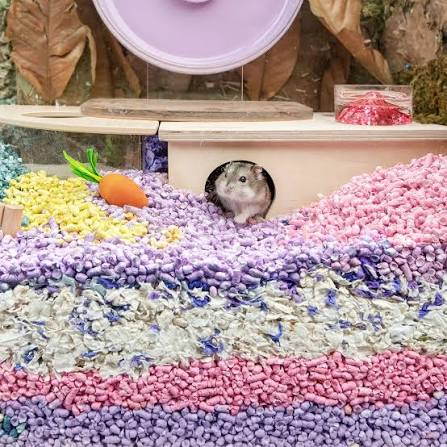
For most pet hamsters, aim for around 20 cm (8 inches) or more of suitable digging bedding, with an even deeper burrowing area where your enclosure allows it. Blue Cross currently recommends a minimum of 20 cm, while Woodgreen recommends at least 15 cm across most of the enclosure plus a deeper area of 25 to 30 cm.
There is no single scientifically proven depth that works as a hard cutoff for every hamster. What the evidence does show clearly is that shallow bedding restricts burrowing, while substantially deeper bedding allows Syrian hamsters to construct and occupy their own burrows.
How deep should hamster bedding be?
Current welfare guidance is slightly different depending on the organization.
Blue Cross recommends at least 20 cm of suitable digging bedding so hamsters can create tunnels and nests.
Woodgreen recommends:
- at least 15 cm across the majority of the enclosure
- a deeper digging area of 25 to 30 cm
The RSPCA does not prescribe one exact number but says hamsters need a deep layer of litter and, where possible, an area deep enough to burrow.
So the practical takeaway is:
Around 20 cm is a useful baseline, but providing a deeper section is better than treating 20 cm as a maximum or magic number.
What does the bedding-depth research actually show?
There is useful experimental evidence, but it needs to be interpreted carefully.
A study of 45 male golden or Syrian hamsters compared bedding depths of:
- 10 cm
- 40 cm
- 80 cm
Hamsters given only 10 cm showed significantly more wire-gnawing and higher wheel activity than the deeper-bedding groups.
All hamsters housed with 40 or 80 cm constructed burrows and used them. Wire-gnawing was not observed in the 80 cm group during the study.
The researchers concluded that deep bedding suitable for burrowing could improve hamster welfare.
That is strong support for giving hamsters substantially more than a thin substrate layer.
What the study does not prove is that:
- exactly 20 cm is the biological minimum
- exactly 25 cm is enough for every hamster
- every hamster needs 40 or 80 cm in a pet enclosure
- the results automatically apply identically to every dwarf species
The experiment only compared 10, 40 and 80 cm in male Syrian hamsters.
Why does deep bedding matter?
Hamsters are burrowing animals.
RSPCA notes that hamsters naturally dig and construct burrows, while both Blue Cross and Woodgreen treat burrowing as a normal behavior that pet housing should allow.
Deep substrate can let a hamster:
- construct tunnels
- create sleeping chambers
- build nests
- store food underground
- choose darker, more enclosed resting spaces
- explore below the surface rather than only across the cage floor
This is why bedding should not be treated simply as absorbent material for urine.
It is part of the hamster’s usable living space.
Does the entire cage need 8 to 10 inches of bedding?
Not necessarily.
Woodgreen’s current approach is particularly practical: provide at least 15 cm through most of the enclosure, then create a deeper 25 to 30 cm digging section.
That allows room for equipment such as the wheel and sand bath without sacrificing meaningful burrowing space.
A useful enclosure might therefore have:
- a large deep-bedding zone
- an even deeper burrowing section
- stable platforms for heavy equipment
- shallower areas only where equipment genuinely requires them
Woodgreen specifically recommends sturdy platforms for heavy items such as wheels, sand baths and ceramic hides.
This matters because a heavy object placed directly on top of a deep burrow can become unstable.
The goal is not to make every square centimetre identical. The goal is to provide enough continuous deep substrate for the hamster to build a real burrow system.
Is 6 inches of bedding enough?
Six inches is about 15 cm.
That matches Woodgreen’s recommendation for the majority of the enclosure, but Woodgreen also recommends a deeper 25 to 30 cm digging area.
Blue Cross uses a higher general minimum of 20 cm.
So I would not describe six inches across the entire enclosure as the ideal final setup.
If your enclosure currently has about six inches everywhere, the next useful improvement is to create a substantially deeper burrowing section rather than assuming the bedding is already deep enough simply because it reaches one published number.
Do Syrian hamsters need deeper bedding than dwarf hamsters?
I would not invent separate bedding-depth rules by species.
Blue Cross gives its 20 cm recommendation for hamster housing generally. Woodgreen similarly uses its 15 cm plus 25 to 30 cm deeper-zone approach across its hamster-care guidance.
The well-known bedding-depth experiment was performed on Syrian hamsters, so we have stronger direct experimental evidence for that species.
That does not prove that dwarf hamsters do not need meaningful burrowing depth.
All commonly kept hamsters should have the opportunity to dig and construct burrows.
Which bedding holds burrows best?
Choose a bedding that is safe, reasonably low in dust and capable of maintaining some structure.
Blue Cross lists suitable options including:
- paper-based bedding
- wood-pulp bedding
- hemp
- aspen
It also specifically says mixing different bedding types can help maintain the structure of burrows.
Woodgreen recommends materials including:
- soft paper bedding
- aspen
- hemp
- shredded cardboard
- some suitable hay mixed with other substrates
Woodgreen also notes that soft paper bedding can hold burrows well, so it is too broad to say paper bedding by itself always collapses.
Mixing materials can help, but it is not a mandatory recipe.
For a fuller safety comparison, see hamster bedding to avoid and best hamster bedding types.
Should you compress hamster bedding?
A little settling and gentle packing can help loose substrate become more stable, but there is no need to compact it into a hard block.
The hamster still needs to be able to dig through it.
More importantly, do not wet or mist the bedding just to make tunnels hold together.
The original article suggested slightly dampening a section. I would remove that advice.
RSPCA specifically says a hamster’s bedding should remain dry and that damp bedding should not be allowed to accumulate.
If tunnels collapse repeatedly, first try:
- a deeper substrate layer
- a different bedding material
- mixing compatible bedding types
- adding suitable structural materials
Moisture should not be the solution.
How should you arrange deep bedding around heavy items?
Heavy equipment should be stable independently of the hamster’s tunnels.
Woodgreen recommends sturdy platforms for items such as:
- wheels
- sand baths
- ceramic hides
It also advises placing large and heavy items into the enclosure before adding bedding during a larger refresh.
This reduces the chance of equipment shifting when the hamster excavates underneath.
Deep bedding should create more usable habitat, not create a collapse hazard.
How often should deep bedding be replaced?
Deep bedding does not need to be routinely thrown away in its entirety on a short schedule.
Hamsters build nests, burrows and food stores inside the substrate, and familiar smells are important to them.
RSPCA recommends spot-cleaning soiled bedding, uneaten food and waste every few days. It says a deeper enclosure clean is often needed only once or twice a month, depending on enclosure size and toilet habits.
Woodgreen uses a somewhat different routine. It recommends regular spot-cleaning and a refresh clean roughly every two to three weeks, during which owners inspect burrows, remove soiled bedding and old fresh food, and top up the substrate.
The exact calendar matters less than the method:
remove what is wet, spoiled or dirty and preserve clean bedding and intact burrows where possible.
During a larger clean, RSPCA recommends transferring some familiar old, unsoiled bedding back into the enclosure.
See how to clean a hamster cage for the full cleaning process.
Do you need to destroy burrows to check them?
Not routinely.
Woodgreen recommends checking burrows during its periodic refresh clean and removing soiled bedding or old food.
That does not mean every tunnel should be collapsed every day.
If a burrow is clean and there is no reason to suspect spoiled fresh food, damp bedding or another hygiene problem, unnecessary destruction simply makes the hamster rebuild the same structure.
Deep bedding works best when owners accept that much of the hamster’s home will exist underground and out of sight.
How much bedding will you need?
Usually more than the first layer suggests.
The amount depends on:
- internal enclosure dimensions
- how much of the floor is used as the deep-bedding zone
- target depth
- how compressed or fluffy the product is
- whether you mix multiple substrates
Do not compare bags only by physical package size. Compressed paper and hemp products can expand considerably after opening.
A useful planning formula is:
enclosure length × bedding-zone width × bedding depth = required loose substrate volume
You do not need to replace that entire volume every cleaning cycle. Once a deep setup is established, routine maintenance should focus on removing dirty material and topping up clean bedding.
This is one reason buying suitable bedding in larger packages can make deep setups more practical.
Can toilet paper be used as the main bedding?
Plain unscented toilet paper can make useful nesting material, but it is not the most practical choice for filling an entire deep enclosure.
Merck recommends plain white facial tissue or unprinted paper towel as nesting material.
You can tear suitable plain tissue into strips and allow your hamster to arrange it inside a hide or burrow.
Use proper digging bedding for the bulk of the enclosure.
Can you use fleece instead of deep bedding?
No, not as a replacement for the hamster’s burrowing substrate.
A fleece liner may cover a solid floor, but it does not allow a hamster to excavate tunnels or construct underground nests.
RSPCA, Blue Cross and Woodgreen all emphasize the importance of providing substrate deep enough for digging and burrowing.
There is little reason to dedicate valuable enclosure floor space to fleece when that same area could provide usable digging depth.
What if your cage cannot hold deep bedding?
That may be a limitation of the enclosure itself.
A cage with a very shallow base can make it impossible to provide meaningful substrate depth without bedding spilling through the bars.
Rather than reducing the hamster’s burrowing area to fit the cage, consider whether the enclosure needs:
- higher bedding guards
- deeper solid sides
- a different internal layout
- or replacement with housing that can safely accommodate deep substrate
See the hamster cage setup guide and hamster cage size guide for the larger housing picture.
The bottom line
Aim for around 20 cm of suitable digging bedding as a practical baseline, with a deeper burrowing section whenever possible.
Blue Cross recommends at least 20 cm. Woodgreen recommends at least 15 cm across most of the enclosure plus a 25 to 30 cm deeper digging area. These recommendations differ slightly, so there is no reason to pretend that exactly eight or ten inches is a scientifically proven universal cutoff.
Experimental research gives us an even clearer message: Syrian hamsters housed with 40 or 80 cm of bedding constructed and occupied burrows, while hamsters kept on only 10 cm showed significantly more wire-gnawing.
So think deeper rather than exact.
Use suitable low-dust bedding, mix compatible materials if you need more structure, keep the substrate dry, support heavy equipment on stable platforms and avoid destroying clean burrows during unnecessary full bedding changes.
Keep reading: Hamster bedding to avoid | Best hamster bedding types | How to clean a hamster cage | Hamster cage setup
Hamster Corner provides general educational information about hamster care. If your hamster develops persistent respiratory signs, skin irritation or another significant health change, contact a hamster-experienced veterinarian.
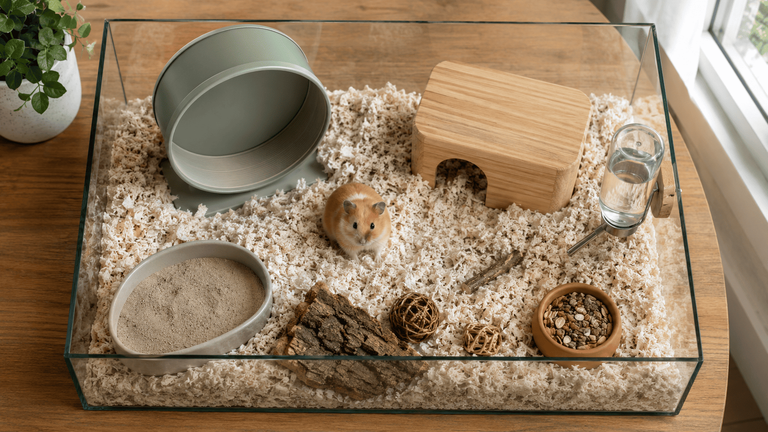
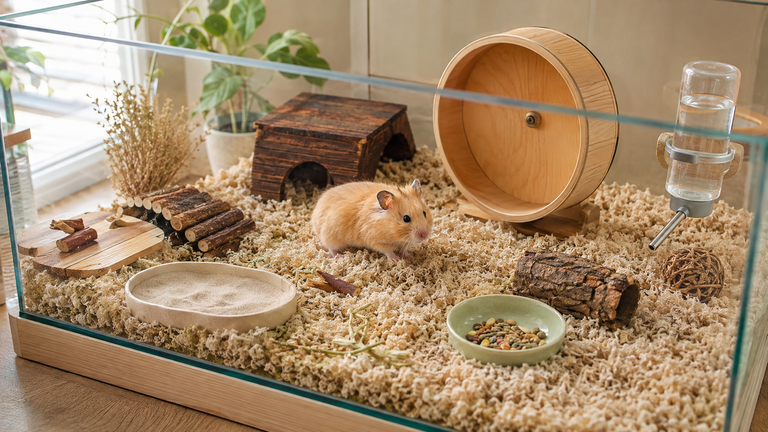
[…] our hamster bedding depth guide for the full […]
[…] For a deeper look at the evidence and different recommendations, see our hamster bedding depth guide. […]
[…] For more detail, see our hamster bedding depth guide. […]
[…] For current bedding-depth recommendations, see hamster bedding depth. […]
[…] For the rest of the enclosure layout, see hamster cage setup and hamster bedding depth. […]
[…] reading: Hamster cage setup | Hamster bedding depth | Hamster sand […]
[…] For the full evidence and setup options, see our hamster bedding depth guide. […]
[…] our hamster bedding depth guide for the evidence behind those […]
[…] our hamster bedding depth guide for the evidence behind deep […]
[…] the fuller setup, see our hamster bedding depth guide and hamster cage setup […]