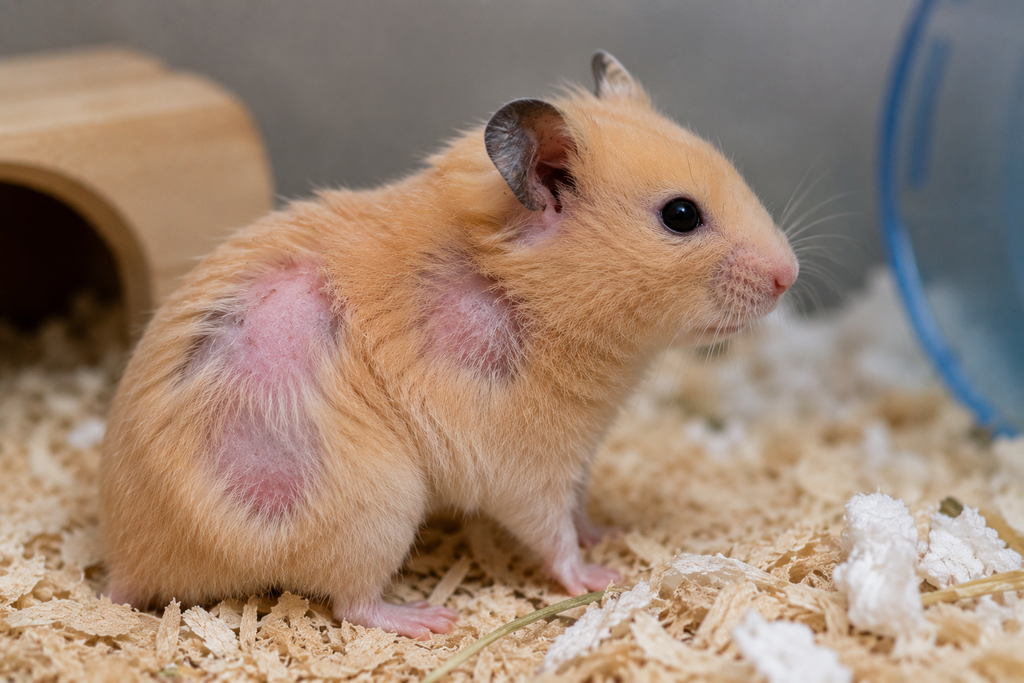
A bald patch on a hamster can have many causes, including mites, ringworm, rubbing against the enclosure, barbering, nutritional problems, and underlying disease. You usually cannot identify the cause from the shape of the bald patch alone.
Some causes are straightforward to treat, while others need a broader medical workup. If your hamster develops unexplained hair loss, especially with flaky or inflamed skin, itching, weight loss, reduced appetite, lumps, or spreading patches, arrange an examination with a hamster-experienced veterinarian.
What can cause bald patches on a hamster?
Hair loss, or alopecia, is a symptom rather than a diagnosis.
The Merck Veterinary Manual lists several possible causes of patchy hair loss in hamsters, including:
- repeated rubbing against parts of the enclosure
- inadequate nutrition
- barbering by another hamster
- mites
- adrenal gland tumors
- thyroid problems
- kidney disease
- cutaneous lymphoma
PetMD’s hamster alopecia guide gives a similarly broad list and also includes age-related changes and environmental trauma.
That variety is why treating a bald patch as “probably mites” or “probably hormones” can easily lead you in the wrong direction.
Could it be mites?
Yes. Mites are a common skin problem in hamsters.
Two of the most important are Demodex criceti and Demodex aurati. Heavy Demodex infestations can cause hair loss, scaling, crusting, redness, or dry-looking skin.
One important correction to common advice is that mites do not always cause intense itching.
PetMD notes that hamster mite infestations can cause hair loss either with or without itching, depending on the type of mite. Merck likewise describes alopecia, redness, scaling, and variable itching with Demodex infestation.
Older hamsters and hamsters with other health problems may be more vulnerable to clinically significant Demodex overgrowth.
A veterinarian can examine skin scrapings or hair under a microscope to look for mites.
Do not start ivermectin, dog or cat parasite products, sprays, powders, or another mite treatment without veterinary guidance. The diagnosis and dose matter.
For a closer look at this specific condition, see hamster mites.
Could it be ringworm?
Yes. Ringworm is a fungal skin infection and can produce bald patches.
Despite the name, no worm is involved.
Possible signs include:
- localized hair loss
- flaky or scaly skin
- crusting
- redness around affected areas
- circular-looking lesions
But the appearance is not diagnostic. Some affected hamsters show only mild hair loss, while others may have much more extensive skin disease.
The Merck Veterinary Manual identifies Trichophyton mentagrophytes and Microsporum species among fungi associated with hamster ringworm. PetMD also notes that veterinary diagnosis may involve examination of hair or skin, fungal culture, microscopy, or other laboratory testing.
Ringworm matters for another reason: it can spread between hamsters, other animals, and people.
If ringworm is suspected, wash your hands thoroughly after handling your hamster or its enclosure. Using disposable gloves while cleaning the enclosure is a sensible precaution until you have veterinary guidance.
Do not apply human antifungal cream on your own. Treatment may involve topical or oral antifungal medication selected and dosed by a veterinarian.
Is adrenal disease a common cause?
It is possible, but the original version of this article overstated it.
Adrenal tumors can be associated with hamster hair loss, but Merck lists adrenal gland tumors among the rarer causes of alopecia in its pet-owner guidance.
The professional Merck hamster reference adds an important nuance: adrenal adenomas occur commonly in Syrian hamsters, but there are only a small number of reports confirming Cushing disease with clinical signs in hamsters.
That means a pattern of symmetrical hair loss should not automatically be diagnosed as “adrenal disease,” even in an older Syrian hamster.
Other systemic and endocrine conditions can also cause alopecia, and cutaneous lymphoma can sometimes resemble endocrine disease.
A veterinarian may need more than a visual examination to distinguish them.
Can cancer cause hair loss?
Yes, although a bald patch does not automatically mean cancer.
Merck describes a form of T-cell lymphoma that affects hamster skin and can cause:
- patchy hair loss
- skin inflammation
- reduced energy
- weight loss
The professional Merck reference notes that cutaneous lymphoma in adult Syrian hamsters can initially resemble hyperadrenocorticism because both can involve alopecia and skin changes.
This is another reason persistent or unexplained alopecia deserves a veterinary examination rather than treatment based only on appearance.
Can rubbing cause a bald patch?
Yes.
Both Merck and PetMD list repeated friction against enclosure surfaces as a possible cause of hamster hair loss.
The location can sometimes provide a clue. For example, hair loss repeatedly occurring where the hamster squeezes through a tight opening or rubs against a particular enclosure surface makes mechanical friction worth investigating.
Check for:
- narrow entrances
- rough edges
- damaged plastic
- exposed wire
- areas where your hamster repeatedly squeezes or rubs
Removing an obvious rubbing point is sensible.
However, do not assume friction is the diagnosis simply because the bald patch is near a tube or cage wall. Skin disease can occur in the same area.
What is barbering?
Barbering means hair is being chewed or excessively groomed rather than falling out because the follicle itself is diseased.
Merck specifically describes hair chewing by cage mates as one cause of hamster alopecia. PetMD notes that barbering can produce thinning fur, unusually short hairs, or bald patches.
This distinction can sometimes be visible: the hair may look broken or clipped rather than completely absent.
If multiple hamsters are housed together and one is being barbered or injured by another, veterinary and husbandry advice is appropriate. Syrian hamsters should normally be housed alone.
Do not automatically label every smooth bald patch “stress barbering.” Parasites, friction, skin infection, nutritional problems, and systemic disease can produce overlapping appearances.
Could a bald-looking patch actually be normal?
Sometimes.
Syrian hamsters have paired flank scent glands around the hip area. These glands can be pigmented and may look like unusual bare or dark patches to an owner seeing them for the first time.
PetMD specifically warns that normal hamster scent glands can be mistaken for hair loss or skin lesions.
Normal paired flank glands are different from a new expanding bald patch.
If one side looks significantly different from the other, becomes swollen, crusted, bleeding, painful, or otherwise changes, have it examined rather than assuming it is a normal scent gland.
Does age cause hamster hair loss?
Age can contribute to coat thinning, but “the hamster is old” should not be used to dismiss a new bald patch.
PetMD includes age-related hair loss among possible causes of alopecia. Older hamsters are also more vulnerable to several medical conditions that can affect the skin and coat.
So age belongs in the history, not as a diagnosis.
New, spreading, inflamed, or otherwise abnormal hair loss in an older hamster still deserves investigation.
What does the skin underneath tell you?
The skin can provide useful clues, although it cannot give you a definitive diagnosis.
Tell your veterinarian if the bald area is:
- dry or flaky
- crusted
- red
- thickened
- bleeding
- irritated
- apparently itchy
- completely smooth with normal-looking skin
Also note whether the hair loss is:
- one patch or several
- symmetrical or irregular
- spreading
- associated with short or broken hairs
- concentrated around the back, rump, face, ears, or another area
Merck notes that determining the distribution of alopecia and whether inflammation or itching is present helps guide the diagnostic workup.
How does a vet diagnose hamster hair loss?
The correct test depends on what the skin and coat look like.
Possible tests include:
- skin scraping to look for mites
- examination of hairs and skin debris
- fungal testing for ringworm
- blood tests when systemic or endocrine disease is suspected
- skin biopsy in selected cases
- further investigation for tumors or organ disease when indicated
PetMD specifically describes skin scraping for parasites and fungal culture or PCR for suspected ringworm. Merck also notes that skin scrapings, biopsy, and blood testing may be needed depending on the suspected cause.
This is why a treatment that works beautifully for mites will not solve ringworm, friction, lymphoma, or an endocrine disorder.
What can you safely do at home?
Keep home treatment conservative while arranging veterinary care.
You can:
- check the enclosure for rough or narrow areas that repeatedly rub the same part of the body
- keep bedding clean and appropriately low in dust
- continue providing a nutritionally complete hamster diet
- monitor whether the patch is spreading
- photograph the area so you can compare changes over time
- note changes in weight, appetite, activity, scratching, drinking, or urination
Do not apply:
- human antifungal cream
- dog or cat flea products
- essential oils
- antiseptic creams
- steroid creams
- mite medication
- medicated shampoo
unless a veterinarian has specifically recommended that product for your hamster.
Different causes need different treatments, and unnecessary topical products can irritate the skin or make diagnosis more difficult.
When should a hamster see a vet?
Unexplained bald patches are worth discussing with a veterinarian rather than waiting for a large area of fur to disappear.
Arrange an examination especially if:
- the bald area is getting larger
- multiple areas are appearing
- the skin is red, crusted, flaky, thickened, or bleeding
- your hamster is repeatedly scratching, biting, or rubbing itself
- there is a lump or swelling
- another hamster is chewing or injuring it
- your hamster is losing weight
- appetite or activity has changed
- there are other signs of illness
Merck includes hair loss among signs owners should watch for, and PetMD recommends veterinary investigation because alopecia has such a wide range of possible causes.
For other symptoms to check at the same time, see signs of a sick hamster.
Are bald patches contagious?
It depends entirely on the cause.
Ringworm can spread to people and other animals. Merck and PetMD both specifically identify it as zoonotic.
Some ectoparasites can also spread between rodents, depending on the mite involved.
Other causes, such as friction, endocrine disease, kidney disease, nutritional problems, or cancer, are not contagious.
So do not assume a bald hamster needs isolation solely because it has lost fur. If you suspect ringworm or another transmissible skin condition, minimize contact with other animals, use good hand hygiene, and ask your veterinarian how to manage the enclosure.
How long does fur take to grow back?
It depends on the cause and whether that cause can be corrected.
PetMD notes that some hamster bald patches may begin regrowing after successful treatment over several weeks, but recovery can take longer when there is an underlying illness.
There is no useful universal regrowth deadline.
Hair may return after parasites, ringworm, friction, or barbering are successfully addressed. Hair loss associated with some systemic diseases or tumors may behave differently.
The goal should be treating the cause rather than trying to stimulate hair growth directly.
The bottom line
A hamster bald patch is not a diagnosis.
Mites are common and can cause scaling and hair loss with or without itching. Ringworm can cause flaky or crusted bald areas and is important because it can spread to people. Friction, barbering, nutritional problems, organ disease, endocrine problems, and cutaneous lymphoma are also possible.
Adrenal disease should not automatically be blamed for symmetrical hair loss in an older Syrian hamster. Merck describes adrenal tumors, thyroid imbalance, and kidney disease as rarer causes of hamster alopecia, and confirmed clinical Cushing disease is not as well documented as many pet websites imply.
Check the enclosure for obvious rubbing points and avoid applying medications yourself, but have unexplained or progressing hair loss examined by a hamster-experienced veterinarian.
Sources
Merck Veterinary Manual: Disorders and diseases of hamsters
Merck Veterinary Manual: Hamsters, professional reference
Hamster Corner provides general educational information about hamster care. It is not a substitute for veterinary diagnosis or treatment.