
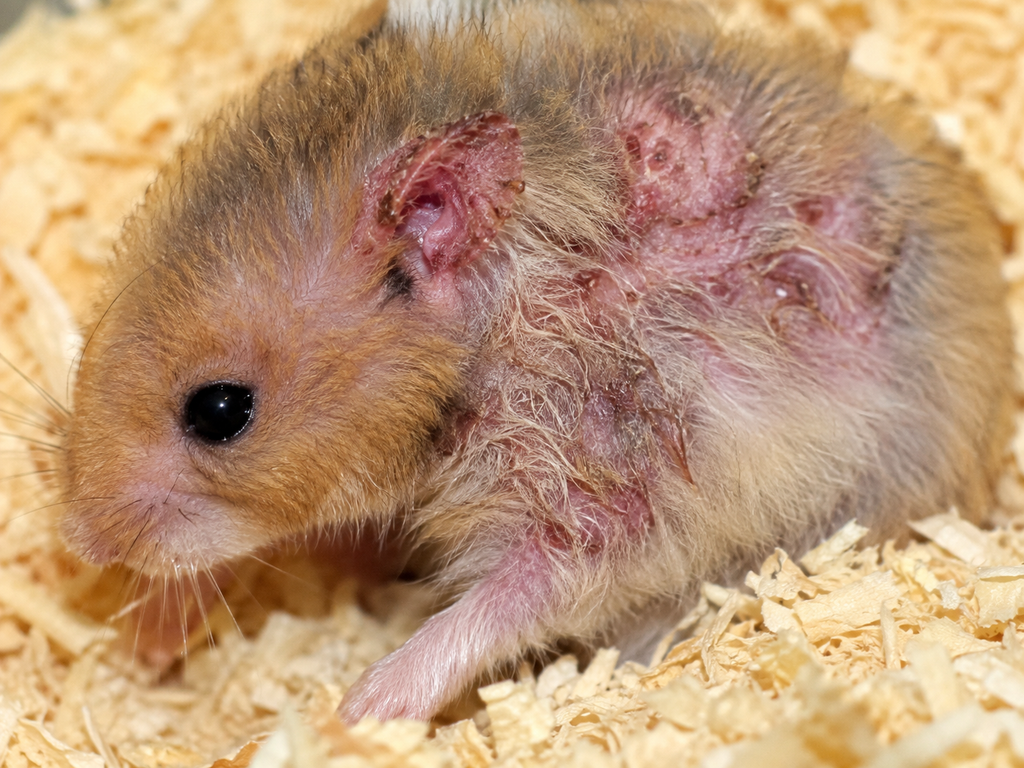
Mites can cause hair loss, scaling, crusting, redness and sometimes itching in hamsters, but these signs are not specific enough to diagnose mites at home. Demodex mites are among the most common hamster mites and may be present without causing disease, while other mites can come from other rodents or contaminated environments. A veterinarian can confirm the cause with skin or hair testing and choose an appropriate antiparasitic treatment.
One important reason not to self-treat is that hair loss and flaky skin can also occur with fungal disease, infection and other health problems. The correct treatment depends on what is actually causing the skin changes.
What are hamster mites?
Several mite species can affect hamsters.
Merck Veterinary Manual identifies Demodex criceti and Demodex aurati as the two most common mites associated with hamster skin disease.
Demodex deserves a little nuance.
Veterinary literature reports that many normal-looking hamsters can carry Demodex without showing clinical disease. Problems develop when mite numbers become high enough to cause demodicosis, also called demodectic mange.
This is different from saying:
Every hamster has mites and stress simply activates them.
That is too broad.
Hamsters can also develop less common infestations involving ear mites, nose mites and the tropical rat mite, Ornithonyssus bacoti. These do not necessarily behave like Demodex.
What do mites look like on a hamster?
You usually cannot identify Demodex simply by looking at the hamster.
The more useful thing to watch for is skin and coat change.
Possible signs include:
- Patchy or progressive hair loss
- Dry or scaly skin
- Crusts
- Red or inflamed skin
- A rough-looking coat
- Scratching or itching in some cases
- Irritation around the ears or face with some mite species
Merck notes that heavy Demodex infestations commonly produce dry, scaly bald areas over the back and rump.
However, itching is inconsistent.
Some veterinary guidance describes Demodex lesions as minimally itchy or non-itchy, while other cases can involve pruritus. So a hamster does not need to be scratching constantly to have mites.
Does hair loss mean my hamster has mites?
No.
Hair loss is one reason to investigate mites, not proof of them.
Veterinarians may also need to consider:
- Ringworm or another fungal infection
- Bacterial skin disease
- Trauma
- Nutritional problems
- Hormonal or systemic disease
- Tumors or other underlying illness
- Normal scent-gland appearance in the appropriate location
PetMD’s hamster hair-loss guide describes several tests a veterinarian may use depending on the pattern of hair loss, including skin scraping, tape preparations and fungal testing.
That is why treating every bald patch with mite medication can delay the correct diagnosis.
Why do Demodex mites become a problem?
Demodicosis is seen more often in hamsters whose health is already compromised.
PetMD notes that Demodex overgrowth is more common in older hamsters, particularly males, and in immunocompromised animals.
Merck similarly reports that mite disease is more frequent in older and male hamsters and links those groups with conditions such as malnutrition and other disease.
Veterinary literature also recommends investigating underlying illness when Demodex is severe, recurrent or does not respond normally to treatment.
So mites can sometimes be more than a skin problem.
A significant or recurring Demodex infestation may be a reason for the vet to look more broadly at the hamster’s health.
Does stress cause hamster mites?
Stress may contribute to Demodex overgrowth, but it does not create mites from nothing.
PetMD specifically includes stress among factors that can compromise a hamster and allow Demodex populations to increase.
However, it is too simplistic to blame an infestation on one stressful event, a new home or a cage being slightly dirty.
Age, malnutrition and underlying disease may also be relevant.
And some other mite species are acquired from an external source rather than arising from an existing Demodex population.
Can mites come from bedding?
Some mites may be introduced from the environment.
PetMD notes that non-Demodex mites can come from other rodents or contaminated bedding.
That does not mean every new bag of commercial bedding needs to be frozen.
I could not find strong veterinary guidance supporting the common rule:
Freeze all new hamster bedding for 24 to 48 hours.
Instead, use appropriate clean bedding, store it somewhere dry and inspect it if you notice visible insects or contamination.
If mites have already been diagnosed, follow your veterinarian’s environmental-cleaning instructions.
How does a vet diagnose hamster mites?
A veterinarian will examine the pattern of skin and coat changes and may take samples.
A skin scraping is commonly used. Cells and material from the skin are collected and examined under a microscope for mites.
Merck notes that skin scrapings can confirm large numbers of Demodex in different stages of development.
Depending on the suspected mite and the appearance of the skin, a veterinarian may also inspect or sample hair.
Additional testing may be useful when mites keep returning or when another condition could explain the skin disease.
How are hamster mites treated?
Treatment depends on the mite species, severity and the individual hamster.
Veterinary sources describe several antiparasitic options for hamster mites, including ivermectin and selamectin, as well as other treatments in selected cases.
PetMD describes ivermectin as a commonly used treatment, while Merck lists multiple possible treatment protocols for Demodex.
That variation is important.
There is no single online mite-treatment recipe that should be copied for every hamster.
Do not calculate an ivermectin dose yourself from a dog, cat, rabbit or livestock product. Hamsters are very small, preparations come in different concentrations, and the appropriate route and schedule depend on the case.
Let the veterinarian choose the medication and tell you exactly how it should be given.
Should you use an over-the-counter hamster mite spray?
I would not use an over-the-counter mite product without veterinary advice.
The original article said all OTC mite products are toxic to hamsters. That is stronger than the evidence supports.
The better reason to avoid self-treatment is that:
- You may not actually be dealing with mites.
- Different mite species may require different treatment.
- Products made for other animal species may not be appropriate for hamsters.
- Concentration and dosing matter greatly in such a small animal.
- An underlying illness may go unnoticed if you treat only the skin.
A veterinarian answering this question through Petco likewise recommends prescription treatment because many OTC products may not work effectively.
So the recommendation remains the same, but the reason is more accurate:
Get a diagnosis before treating.
Do you need to clean the enclosure during mite treatment?
Usually, yes, but the cleaning plan depends on the parasite.
Merck recommends changing bedding frequently and thoroughly cleaning and disinfecting the enclosure when a hamster has a mite infestation.
PetMD also recommends cleaning the enclosure and replacing bedding during treatment.
This is particularly important for mite species that can survive or move through the environment.
However, Demodex primarily lives on the host, so environmental treatment should not be presented as the entire solution.
Follow the cleaning instructions your vet gives for the mite that was actually diagnosed.
Should you throw everything in the enclosure away?
Not automatically.
Wash and disinfect items that can be safely cleaned according to your veterinarian’s instructions and replace material that cannot reasonably be cleaned if advised.
Do not repeatedly strip the enclosure every day unless your treatment plan calls for it.
Frequent major enclosure disruption can itself be stressful.
The goal is effective parasite control, not making the enclosure permanently sterile.
Can hamster mites spread to people?
It depends on the mite.
Hamster Demodex species are generally host-specific and are not considered a normal human infestation risk.
But that does not mean every mite found around a hamster is harmless to humans.
The tropical rat mite, Ornithonyssus bacoti, can feed on people and cause itchy dermatitis. Published case reports have documented pet hamsters as the source of human rat-mite dermatitis.
So I would remove the blanket statement:
Hamster mites cannot live on or affect humans.
If your hamster has a diagnosed external mite infestation and people in the household develop unexplained itchy skin lesions, mention the animal exposure to both your veterinarian and healthcare provider.
Normal hand washing after handling a sick hamster or cleaning its enclosure is sensible.
Can mites spread between hamsters?
Some can.
PetMD notes that contagious mite species, such as certain ear mites, may require affected animals to be separated and treated.
Demodex has different biology and should not be treated as if it spreads around the home in exactly the same way.
If several rodents in a household develop skin problems, tell the vet. Knowing which animals are affected can help identify the parasite and determine whether other pets need examination or treatment.
How can you prevent hamster mites?
There is no reliable way to guarantee that a hamster will never develop mite disease.
Better prevention focuses on general husbandry:
- Provide an appropriate complete diet.
- Keep the enclosure hygienic without unnecessary full clean-outs.
- Avoid contact with rodents known to have parasites.
- Monitor older or chronically ill hamsters carefully.
- Look for changes in the coat and skin during regular health checks.
- Seek veterinary advice when unexplained hair loss or scaling persists.
There is no evidence that adding supplements, vitamins or extra protein specifically prevents Demodex.
For general feeding guidance, see what hamsters can eat.
Should you give extra protein during recovery?
Not specifically for mites.
The original article recommended cooked egg to “support the immune system” during recovery.
I would remove that.
A nutritionally complete hamster diet should already provide appropriate protein and other essential nutrients. There is no hamster-specific evidence showing that adding an extra protein treat improves recovery from a mite infestation.
Continue an appropriate normal diet unless your veterinarian recommends a nutritional change for a specific reason.
What if mites keep coming back?
Tell your veterinarian.
Recurrent or difficult-to-treat Demodex can be clinically important.
Merck’s professional hamster guidance notes that hamsters that fail to respond to treatment or relapse may have serious underlying disease.
That does not mean every recurring case automatically indicates cancer or another severe condition.
It means recurrence deserves reassessment rather than repeated self-treatment.
Your vet may need to reconsider the diagnosis, confirm that mites are still present or investigate an underlying health problem.
Frequently asked questions
Are hamster mites common?
Yes. Merck describes mite infestation as common in hamsters, with Demodex criceti and Demodex aurati the two most common species associated with hamster mite disease.
Do all hamsters naturally have mites?
That wording is too absolute. Veterinary literature reports that Demodex can be carried by many normal-appearing hamsters without causing disease, but not every mite infestation is Demodex and there is no need to claim every individual hamster carries them.
Can hamster mites go away on their own?
Do not rely on that. Hair loss and scaling need a diagnosis because they may not be caused by mites at all. When clinically significant mite infestation is confirmed, follow the veterinarian’s treatment plan.
Is ivermectin safe for hamsters?
Ivermectin is used by veterinarians to treat some hamster mite infestations, but safety depends on the correct product, concentration, dose and route. Do not dose ivermectin yourself.
How long does hamster mite treatment take?
There is no universal one-to-two-week course. Treatment length varies with the mite species, medication and response. Follow the schedule prescribed for your hamster and attend any recommended recheck.
The bottom line
Mites are an important cause of hamster hair loss and flaky skin, but you cannot reliably diagnose them from appearance alone.
Demodex mites are among the most common. Many normal-looking hamsters can carry Demodex without clinical disease, while overgrowth is more likely in older, compromised or ill animals.
Other mites behave differently and may come from other rodents or the environment. Some, including the tropical rat mite, can even bite humans.
If your hamster develops persistent hair loss, scaling, crusting or unusual itching, have a veterinarian identify the cause before using mite medication. Treatment may involve ivermectin, selamectin or another veterinary therapy depending on the diagnosis.
Skip homemade dosing, routine bedding freezing and unsupported “immune boosting” foods. Accurate diagnosis and appropriate treatment matter more.
Keep reading: Signs of a sick hamster | Hamster cage setup






[…] our hamster mites guide for more […]
[…] For a closer look at this specific condition, see hamster mites. […]
[…] For the differential in more detail, see bald patches on hamsters and hamster mites. […]