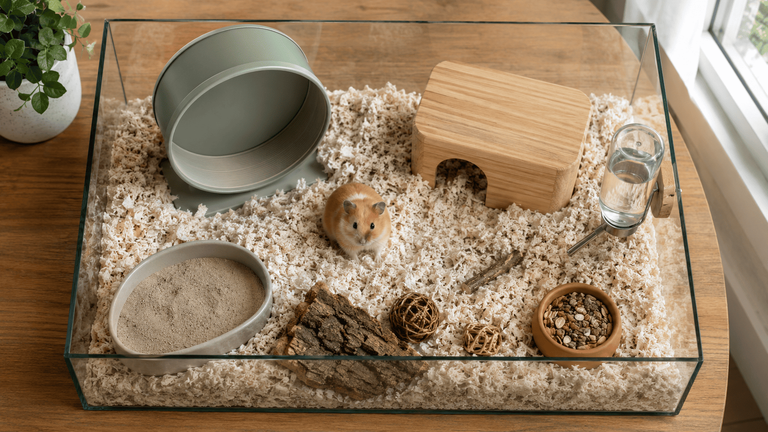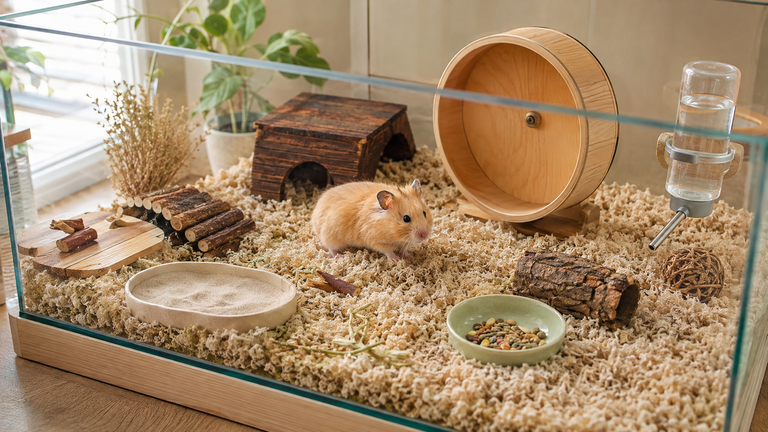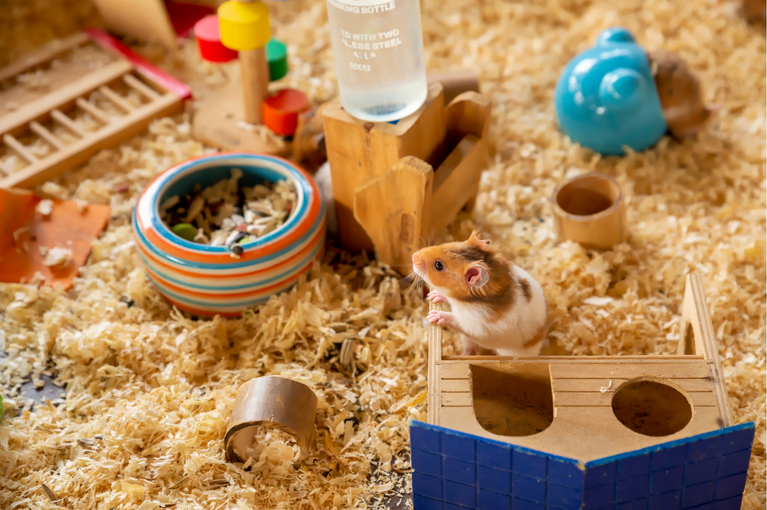
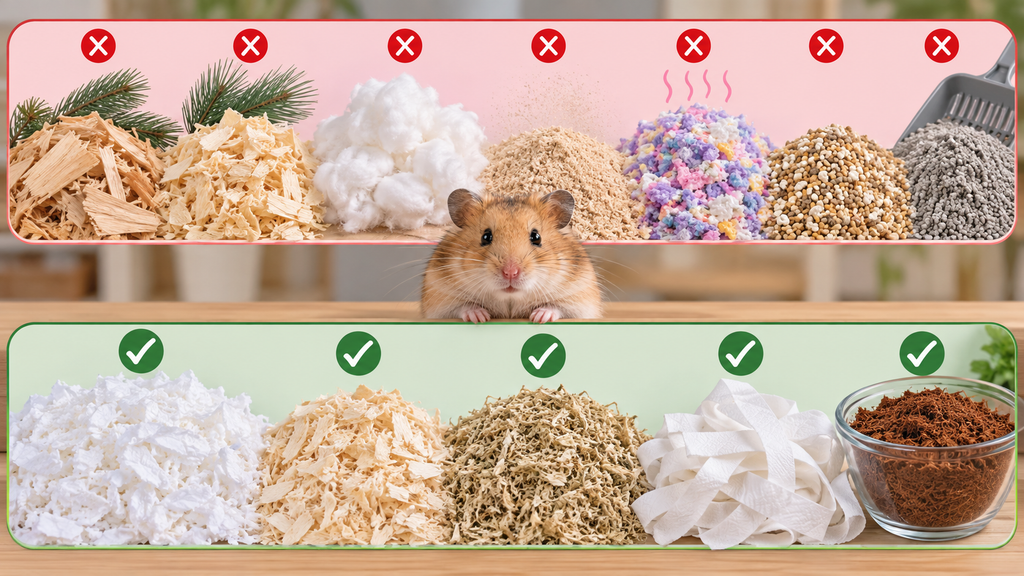
The hamster beddings I would clearly avoid are cedar, unprocessed or strongly aromatic pine, very dusty bedding or sawdust, and cotton-wool-style fluffy nesting materials. Cedar and some pine products can irritate a hamster’s respiratory tract and skin, while fluffy nesting material can be swallowed or become wrapped around limbs.
Other materials need more nuance. Corn cob is not automatically unsafe, conventional printed newspaper is different from commercial recycled-paper bedding, and there is not enough hamster-specific evidence to justify dramatic claims that every clay or clumping litter will harden inside a hamster’s body.
Why bedding choice matters
Bedding is not just something that covers the cage floor.
Hamsters use substrate to dig, construct burrows, sleep, store food and absorb urine. A suitable bedding therefore needs to be reasonably dust-free, safe around the skin and respiratory tract, and able to support normal burrowing behavior.
Blue Cross recommends dust-extracted bedding and lists paper-based bedding, wood pulp and hemp among suitable choices. Aspen can also be used.
Woodgreen similarly recommends options including soft paper bedding, aspen, hemp and shredded cardboard.
The safest way to choose bedding is therefore not to memorize an enormous list of supposedly toxic materials. Look for products with good hamster-care support and avoid the specific hazards we know more about.
Cedar bedding
Cedar is one of the clearest materials to avoid.
PetMD says cedar bedding contains aromatic oils that can irritate a hamster’s sensitive respiratory tract. Its broader hamster-care guidance also says cedar can irritate the skin and mucous membranes.
The Merck Veterinary Manual recommends avoiding cedar chips because of possible toxicity.
That is enough evidence to skip cedar.
The original article went further and claimed chronic cedar exposure causes liver damage and immune suppression in hamsters. I would remove those claims unless there is direct hamster-specific evidence supporting them.
You do not need an elaborate toxicity mechanism to make the practical decision.
Cedar bedding: avoid.
What about pine bedding?
Pine needs more careful wording.
Some hamster-care sources broadly recommend avoiding pine shavings because their aromatic oils may irritate the skin and respiratory tract.
However, newer PetMD hamster guidance specifically refers to unprocessed pine, rather than establishing that every pine product behaves identically.
RSPCA guidance also accepts some dust-free wood shavings, which makes a blanket statement that all wood shavings except aspen are toxic difficult to defend.
So I would use this practical rule:
Avoid fresh, unprocessed, strongly aromatic or dusty pine bedding.
If you are comparing products and want the lowest-uncertainty choice, paper-based bedding, aspen or hemp have clearer support from current hamster welfare guidance.
There is no reason to experiment with an ambiguous bag labelled only “natural wood shavings” when you cannot identify what it contains.
Is kiln-dried pine safe?
I would not put kiln-dried pine in the same category as raw pine, but I also would not promote it as the best hamster bedding.
Kiln drying changes wood products and can reduce volatile compounds, which is one reason newer guidance distinguishes unprocessed pine.
The problem is that product processing varies, and the hamster sources I found do not give a simple rule that every product labelled “kiln-dried pine” is equivalent.
For a beginner, there are easier choices.
If paper bedding, aspen or hemp are available, I would choose one of those rather than trying to evaluate how thoroughly a particular pine product was processed.
Cotton wool and fluffy nesting material
This one has strong direct support.
RSPCA specifically warns against nesting materials that separate into thin strands, including cotton wool and similar fluffy products. The strands can become tangled around a hamster and interfere with circulation.
Woodgreen goes further and warns that cotton-wool-type and seed-pod bedding can contribute to:
- pouch prolapse
- intestinal blockage
- material becoming tightly wrapped around the body or legs
PetMD likewise warns that commercial fluffy nesting materials may be associated with intestinal obstruction, cheek-pouch problems and limb strangulation.
So even if a fluffy product is sold with a hamster picture on the bag, I would skip it.
What should you use for nesting instead?
Plain soft paper is a much simpler option.
Merck recommends plain white facial tissue or unprinted paper towel cut into strips. RSPCA also lists shredded paper and cardboard as suitable nesting materials.
Your hamster can tear and arrange the material themselves.
There is no need to buy cotton-like nesting fluff to create a warm nest.
Dusty bedding and sawdust
Avoid bedding that produces a large amount of fine airborne dust.
Blue Cross says most sawdust and wood-shaving products should be avoided because they can negatively affect a hamster’s respiratory system.
Woodgreen similarly warns that wood shavings or sawdust can harm the skin and airways.
PetMD lists dusty bedding among environmental factors that may contribute to sneezing and respiratory irritation.
This is especially relevant because hamsters spend much of their lives with their noses close to the substrate while digging.
If a bedding creates a persistent visible cloud when poured or disturbed, I would choose another product.
Do not rely only on marketing phrases such as “natural wood” or “odor control.”
What about scented bedding?
I would avoid strongly scented bedding.
Hamsters do not need perfume added to their substrate, and PetMD includes scented bedding among possible environmental irritants when assessing a sneezing hamster.
A fragrance does not make bedding cleaner.
Choose an unscented product and manage odor through appropriate enclosure size, absorbent bedding and sensible spot-cleaning instead.
I would also remove the original claim that every odor-control product containing baking soda is proven harmful to hamsters. That is too broad without product-specific evidence.
Is corn cob bedding dangerous?
Not automatically.
This is an important correction to the original article.
RSPCA hamster housing guidance actually lists granulated corn-cob that is free from preservatives and other chemicals as one possible bedding material.
That means claims such as:
- corn cob always becomes mouldy quickly
- corn cob commonly injures hamster feet
- corn cob causes intestinal blockage
- corn cob is categorically unsafe
should not be presented as established facts without stronger evidence.
Would corn cob be my first choice for a modern deep-bedding enclosure? Probably not.
Paper bedding, hemp and aspen have clearer support across several current care sources and can be easier to use for deep burrowing setups.
But “not my preferred option” is different from “known dangerous bedding.”
Corn cob belongs in the first category based on the evidence I found.
Can you use cat litter as hamster bedding?
I would not use ordinary cat litter as the main hamster substrate.
Cat litter is formulated for cats and does not provide the deep, supportive burrowing material hamsters need.
Clumping, heavily scented and dusty products are especially poor choices because they introduce characteristics we do not need in a hamster enclosure.
What I would remove is the dramatic claim that clumping litter necessarily hardens inside a hamster’s respiratory tract, cheek pouches or digestive system. I could not verify that hamster-specific mechanism from a strong source.
There is no need to make that claim.
Appropriate hamster bedding already exists, so ordinary cat litter is simply an unnecessary choice.
Is newspaper unsafe because of the ink?
This needs a distinction.
The Merck Veterinary Manual recommends shredded paper but specifically excludes newspapers printed with conventional inks.
At the same time, PetMD lists commercial recycled newspaper products among suitable hamster bedding materials.
Those statements are not contradictory.
A commercially manufactured recycled-paper bedding is not the same thing as tearing up today’s printed newspaper and filling the cage with it.
For homemade nesting material, plain unprinted paper, plain white tissue or unscented toilet paper is the lower-uncertainty option.
Commercial paper bedding made for small animals is also widely supported.
Does aspen contain the same problem as cedar?
Aspen is treated differently in major hamster-care guidance.
Blue Cross specifically says aspen shavings can be used.
Woodgreen also lists aspen among its suitable base bedding materials, and current PetMD guidance includes aspen as an alternative.
So the old sentence saying “kiln-dried aspen is the one safe wood shaving because it contains no phenolic oils” is unnecessarily absolute.
The useful point is simpler:
Aspen has direct support as a hamster bedding option from multiple reputable care sources.
That makes it a much easier choice than unidentified or aromatic wood shavings.
What bedding should you use instead?
Three of the clearest options are:
Unscented paper bedding
Paper bedding is widely recommended and can work well for deep digging and nest construction.
Choose a reasonably dust-free, unscented product.
Aspen
Aspen is specifically accepted by Blue Cross, Woodgreen and PetMD.
It can also be combined with softer bedding where needed for burrow structure and nesting.
Hemp
Blue Cross and Woodgreen both list hemp as a suitable bedding material.
Woodgreen specifically recommends non-fragranced hemp.
You can also combine compatible materials rather than insisting that the entire enclosure contain only one substrate.
Woodgreen, for example, suggests mixing suitable bedding types for absorbency and stability.
How deep should hamster bedding be?
There is no single figure used by every reputable organization.
Blue Cross currently recommends at least 20 cm of suitable digging bedding so a hamster can construct tunnels and nests.
Woodgreen recommends at least 15 cm throughout most of the enclosure, with a deeper digging area of approximately 25 to 30 cm for larger burrows and nests.
The exact difference matters less than the shared principle:
Hamsters need genuinely deep bedding, not a thin decorative layer across the cage floor.
Choose an enclosure that can physically hold enough substrate for burrowing.
For more detail, see our hamster bedding depth guide.
What if your hamster has been living on unsafe bedding?
Do not panic.
If you are currently using cedar, fluffy cotton nesting material, highly dusty sawdust or another clearly unsuitable product, replace it with a better-supported bedding.
When making a larger enclosure clean, keeping some familiar clean, unsoiled old bedding can help preserve familiar scents, provided that old material itself is safe.
If the old substrate is the material you are trying to eliminate, do not deliberately keep it simply for scent.
Watch your hamster for health changes such as:
- persistent sneezing
- nasal or eye discharge
- noisy or labored breathing
- skin irritation
- reduced appetite
- lethargy
Contact a hamster-experienced veterinarian if respiratory signs or another significant health change develops.
Quick bedding guide
| Material | Recommendation | Why |
|---|---|---|
| Cedar | Avoid | Aromatic oils can irritate hamster skin and respiratory tissues |
| Fresh or unprocessed pine | Avoid | Aromatic oils and irritation concerns |
| Unidentified dusty wood shavings | Avoid | Composition and dust exposure are uncertain |
| Fine sawdust | Avoid | Dust and airway concerns |
| Cotton wool or fluffy nesting material | Avoid | Ingestion, pouch and limb-entanglement risks |
| Strongly scented bedding | Avoid | Unnecessary potential respiratory irritant |
| Plain paper bedding | Good option | Widely recommended and suitable for burrowing |
| Aspen | Good option | Directly supported by multiple hamster-care sources |
| Hemp | Good option | Supported by Blue Cross and Woodgreen |
| Granulated corn cob | Not automatically unsafe | RSPCA accepts preservative-free products, although other bedding may be easier for deep burrows |
| Conventional printed newspaper | Skip for DIY bedding | Merck recommends avoiding conventionally printed newspaper |
| Commercial recycled-paper bedding | Can be suitable | Different from using ordinary printed newspaper |
| Cat litter | Not recommended as main bedding | Does not meet the hamster’s burrowing needs and products vary widely |
The bottom line
The clearest hamster beddings to avoid are cedar, fresh or unprocessed aromatic pine, very dusty bedding or sawdust, and cotton-wool-style fluffy nesting material.
The reasons are better established than many of the dramatic explanations repeated online. Cedar and some pine products can irritate respiratory tissues. Fluffy bedding can be swallowed or become dangerously tangled around the hamster.
Other products need more nuance.
Corn cob is not automatically dangerous. Kiln-dried pine should not automatically be treated as identical to raw pine. Commercial recycled-paper bedding is different from ordinary printed newspaper. And there is no need to claim that every cat litter will physically clump inside a hamster in order to recommend better substrate.
For a simple setup, unscented paper bedding, aspen and non-fragranced hemp all have good support.
Most importantly, provide enough depth for actual burrowing. Bedding should allow the hamster to build a home inside it, not simply cover the plastic underneath.
Keep reading: Best hamster bedding types | Hamster bedding depth | Hamster cage setup
Hamster Corner provides general educational information about hamster care. If your hamster develops persistent sneezing, breathing difficulty, eye or nasal discharge, reduced appetite or another significant health change, contact a hamster-experienced veterinarian.