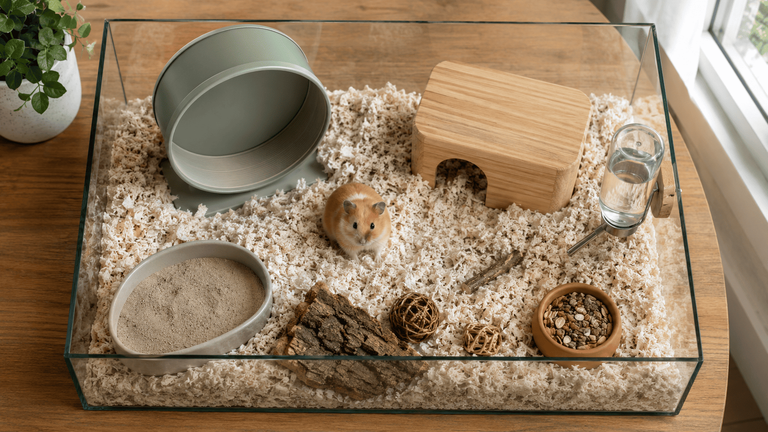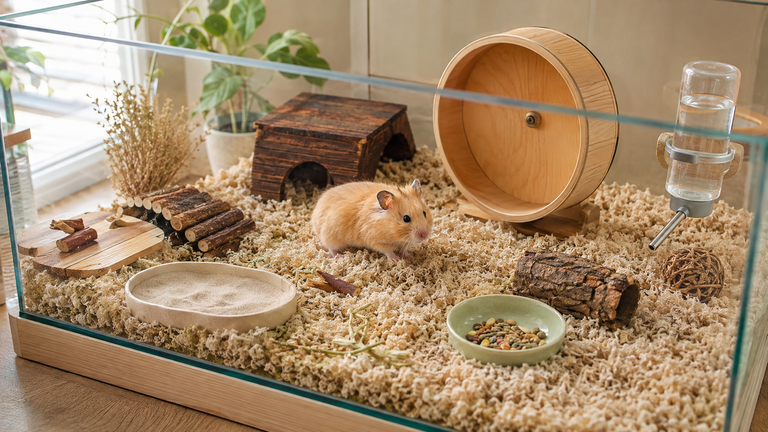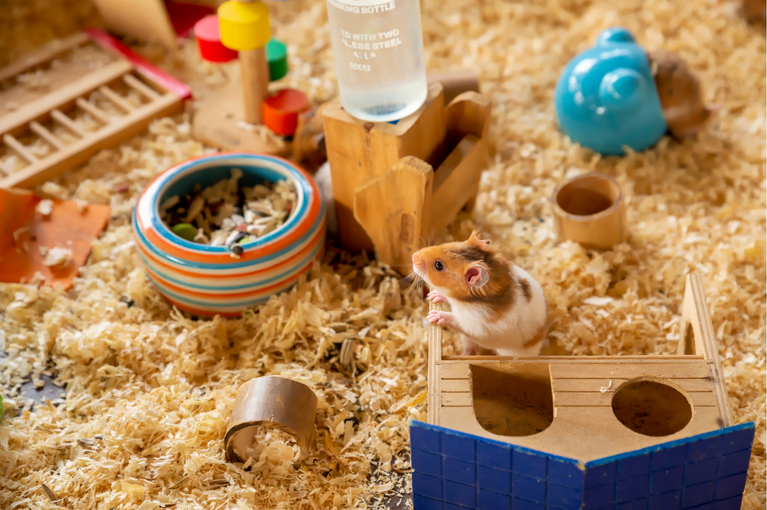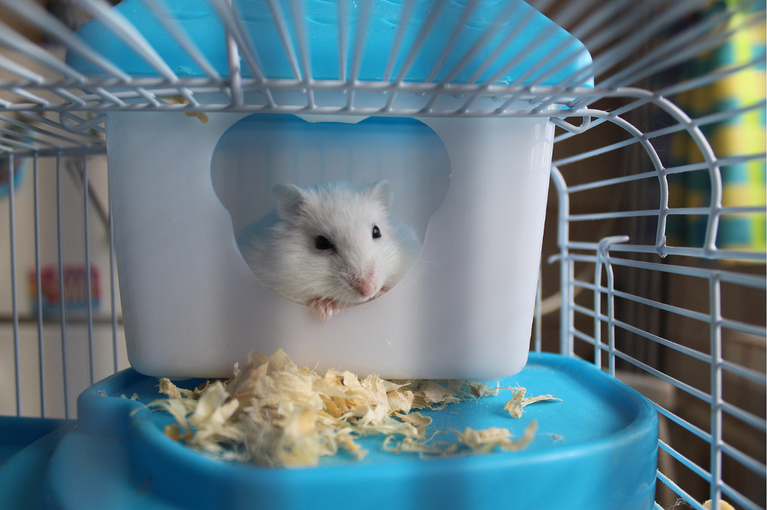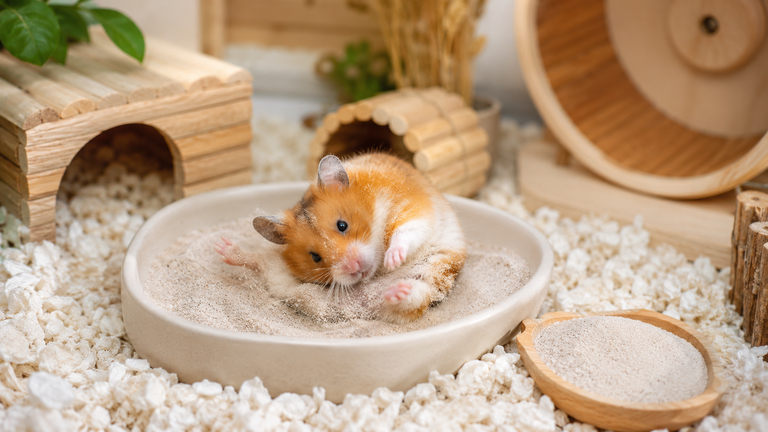
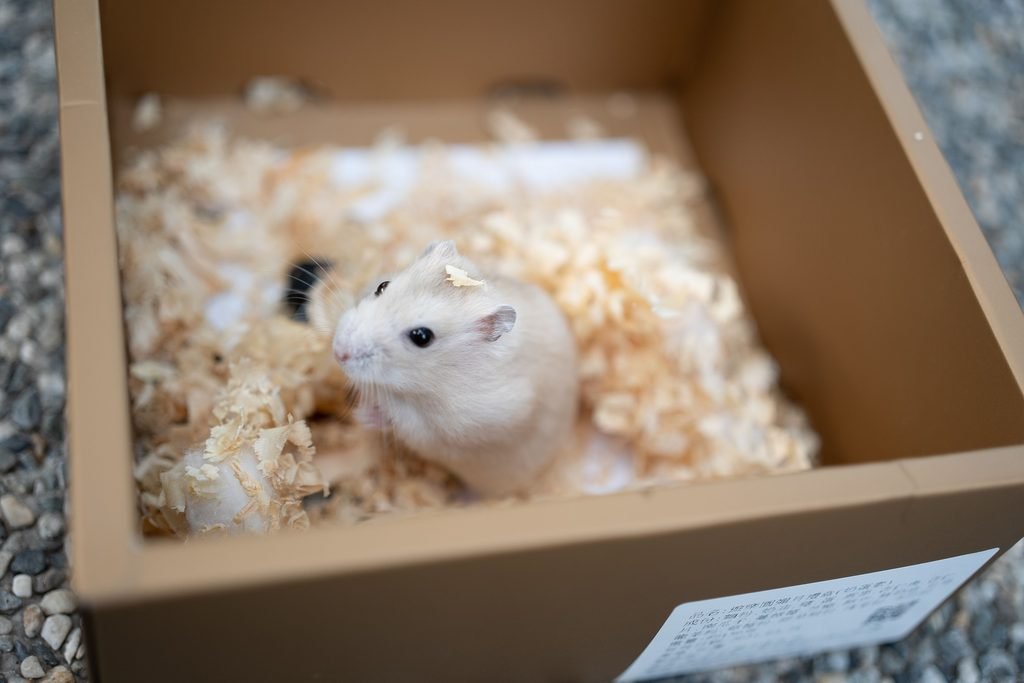
If your hamster setup has several problems, fix the enclosure size, bedding depth, and wheel first. Those three affect how much your hamster can move, burrow, sleep, and exercise every day.
Other common mistakes include unsafe nesting material, an enclosure with nowhere to hide, unstable heavy accessories, poor cage placement, housing hamsters together, and cleaning so aggressively that the entire enclosure loses its familiar scent.
Many products sold with a hamster picture on the box still need to be checked carefully. The label matters less than the actual measurements and materials.
Start with this 5-minute cage audit
Before buying anything, check what you already have.
| Check | What you are looking for | Priority |
|---|---|---|
| Floor space | Around 100 × 50 cm or more of continuous usable floor area | Fix first |
| Bedding | Enough depth for real burrows, ideally with a deeper digging zone | Fix first |
| Wheel | Solid upright surface and a straight back while running | Fix first |
| Nesting material | No cotton-wool-style or long-fibre fluff | Remove now |
| Heavy items | Wheel, ceramic hides, and sand bath cannot sink into burrows | High |
| Enrichment | Hides, tunnels, sand, digging, and foraging opportunities | High |
| Cage location | Away from direct sun, drafts, heat, and constant noise | High |
| Other hamsters | One hamster per enclosure | High |
You do not have to make the enclosure Instagram-perfect in one afternoon. Fix the things that affect daily welfare first, then improve enrichment and layout.
Mistake 1: choosing a cage that is too small
A hamster needs more usable floor space than many starter cages provide.
Blue Cross and Woodgreen currently recommend an enclosure with at least 100 × 50 cm of floor space, while PDSA also uses 100 × 50 cm as a welfare benchmark and notes that evidence does not support one perfect universal number. Bigger is better when you can provide it.
The useful part is not memorizing one number. It is understanding what counts as floor space.
Measure the continuous interior base of the enclosure. Shelves, towers, and narrow connecting tubes do not compensate for a tiny main cage.
If you are buying a plastic storage bin, measure the inside bottom rather than trusting the number of liters or gallons on the label. Tapered bins can lose a surprising amount of usable space near the base.
See our hamster cage size guide before replacing an enclosure.
What to fix first
If your cage is substantially undersized, upgrading the enclosure will usually give you more benefit than spending the same budget on extra toys.
A larger footprint also makes the other important parts of the setup easier to fit properly.
Mistake 2: using bedding that is too shallow
Hamsters are burrowing animals. A thin decorative layer of bedding lets them scratch at the surface but does not let them build the kind of underground space they naturally seek.
Current welfare guidance varies slightly. Blue Cross uses at least about 20 cm of bedding, PDSA recommends at least 25 cm, and Woodgreen recommends at least six inches through most of the enclosure with a deeper area of roughly 25 to 30 cm.
Rather than arguing over one inch, the practical goal is simple:
Your hamster should have a substantial area where it can disappear below the surface and build stable burrows.
A good setup can use a slope, with the deepest bedding at one end and a shallower activity area for the wheel and sand bath.
See our hamster bedding depth guide for the full setup.
Bedding also needs to hold a burrow
Depth alone is not enough if the substrate immediately collapses.
Paper-based bedding is commonly used because it can form stable tunnels. Aspen or hemp can also be useful, and mixing suitable materials can improve structure.
If your hamster has plenty of depth but never seems able to maintain a tunnel, look at the bedding texture as well as the amount.
Mistake 3: choosing the wheel by diameter alone
The most important wheel test happens when the hamster is actually running.
A suitable wheel should be:
- upright
- stable
- solid under the feet
- easy for the hamster to turn
- large enough for the hamster to run without curving its back
Blue Cross recommends replacing mesh or spoke-style wheels because feet can become caught. It gives approximate wheel ranges of 27 to 32 cm for Syrians, 22 to 25 cm for Campbell’s and Winter Whites, 20 to 22 cm for Roborovskis, and 25 to 27 cm for Chinese hamsters.
Those ranges are more useful than pretending every dwarf needs exactly the same wheel.
Watch the hamster’s posture. If its back curves noticeably upward while running, move up in size.
See our hamster wheel size guide and wheel types guide for more detail.
Mistake 4: treating every wood bedding rule as the same
The original version of this guide simply said “cedar and pine are toxic.”
That is too crude to be useful.
The bigger bedding questions are whether a product is dusty, scented, chemically treated, and suitable for a hamster enclosure.
PDSA warns against dusty sawdust and wood shavings and recommends options including paper-based bedding, aspen, spruce, and hemp. Woodgreen recommends paper bedding, aspen, and hemp among its suitable choices.
For a beginner, unscented paper bedding is one of the simplest choices, particularly for a deep burrowing area.
If you use wood-based bedding, buy a product clearly intended and processed for small animals rather than using random workshop shavings or unknown wood.
See bedding to avoid and our best hamster bedding types for the detailed comparison.
Mistake 5: adding fluffy nesting material because it looks comfortable
This one is worth fixing immediately.
Cotton-wool-style nesting fluff, kapok, and similar products can form long fibres. Those fibres can become tangled around a hamster’s limbs, and welfare organizations also warn about problems if the material is swallowed.
The frustrating part is that some of these products are sold specifically for hamsters.
Replace them with suitable nesting material such as soft unscented tissue or appropriate paper bedding.
You do not need to build the nest yourself. Place the material somewhere accessible and let your hamster carry it to the sleeping area.
Mistake 6: leaving the cage too empty
A large cage with deep bedding and a wheel is a good start, but it should not look like an empty box with equipment around the edges.
Hamsters benefit from opportunities to hide, forage, dig, explore, and manipulate their environment.
Useful additions include:
- enclosed hides
- cardboard tunnels and boxes
- a sand bath
- a separate digging substrate
- cork or other suitable cover
- safe chew items
- scatter-fed dry food
- different textures to investigate
Blue Cross and Woodgreen both include hides, tunnels, sand baths, digging opportunities, and foraging as normal hamster enrichment.
A sand bath is useful, but do not oversell it
I would include a suitable sand bath in a modern hamster setup.
Blue Cross lists one among the core supplies for hamster housing and notes that sand helps with coat maintenance while adding another texture to explore. It is particularly valuable for Roborovski hamsters.
That is stronger and more useful than claiming a hamster without sand will automatically develop an oily or matted coat.
See our hamster sand bath guide and best sand for hamster sand baths.
Mistake 7: putting heavy objects directly on deep bedding
This mistake is easy to miss because the enclosure can look perfectly fine from above.
A hamster may tunnel underneath:
- a ceramic hide
- a large sand bath
- a wheel stand
- a heavy piece of decor
If the item is resting only on loose bedding, burrowing can make it shift or collapse.
Woodgreen specifically recommends placing large and heavy enclosure items before adding bedding so they remain stable rather than sitting on top of burrows.
Use stable platforms or support heavy objects from the base of the enclosure.
Then build the bedding around them.
This is one of the most useful setup checks you can do because it costs almost nothing to fix.
Mistake 8: putting the cage wherever there is an empty table
Location affects the enclosure even if everything inside it is excellent.
Keep a hamster away from:
- direct sunlight
- radiators and other heat sources
- cold drafts
- constant TV or speaker noise
- washing machines and other vibration
- areas where dogs or cats can continually disturb the enclosure
Woodgreen recommends a location away from windows, drafts, heat sources, direct sunlight, other pets, and constant loud noise. PDSA recommends a steady room temperature of around 18 to 21°C, or 64 to 70°F.
You do not need to keep the hamster in total darkness or complete silence.
The goal is a stable environment where it can sleep through the day without constant disturbance.
Mistake 9: keeping two hamsters together
For a beginner pet setup, the safest rule is one hamster per enclosure.
Syrian and Chinese hamsters are solitary. Although some dwarf hamsters may live near others in the wild, captive pairs can fight and serious injuries can occur.
Woodgreen recommends housing all pet hamster species individually for this reason.
Do not rely on the fact that two hamsters:
- came from the same litter
- slept together at the pet shop
- appear bonded
- have not fought yet
If you own two hamsters, plan for two complete enclosures.
That means two wheels, two bedding setups, two sets of hides, and enough space for both cages.
Mistake 10: cleaning until the cage smells completely new
A clean enclosure is important. A completely scent-stripped enclosure every few days is not the goal.
Hamsters rely heavily on smell and create nests, food stores, and familiar routes through their territory.
RSPCA recommends balancing cleanliness with avoiding unnecessary disturbance, while Woodgreen advises keeping as much clean used bedding as practical during refresh cleans.
Focus routine cleaning on:
- wet bedding
- soiled toilet areas
- spoiled fresh food
- dirty sand
- dirty food and water equipment
When a larger refresh is needed, preserve clean bedding where practical rather than automatically throwing everything away.
The cage should be sanitary, not scentless.
What should you fix first if the budget is limited?
If your setup has several issues, I would prioritize them in this order:
- Adequate enclosure space
- Deep, suitable bedding
- A safe, correctly sized wheel
- Remove dangerous nesting material
- Make heavy objects stable
- Add hiding and foraging opportunities
- Add a suitable sand bath
- Improve location and cleaning routine
This keeps you from spending $40 on decorative enrichment while the hamster is still living in a cage that cannot hold enough bedding.
Is bar biting always caused by a bad cage?
No single behavior can diagnose the problem by itself.
Persistent bar biting or repeated attempts to escape can be a reason to audit:
- enclosure size
- bedding depth
- wheel
- hides
- foraging opportunities
- general enrichment
But behavior varies between individual hamsters, and bar biting is not proof that one specific item is wrong.
If the hamster injures its mouth, suddenly develops unusual repetitive behavior, or continues behaving abnormally despite a strong setup, contact a hamster-experienced veterinarian.
Are pet-store starter kits always bad?
No, but do not assume a kit is suitable because the packaging shows a hamster.
Check each component individually.
Measure the cage. Check the wheel while the hamster runs. Look at how much bedding the base can physically contain. Read the bedding label. Inspect the nesting material.
If the kit passes those checks, great.
If not, replacing individual parts or starting with a different enclosure may be cheaper than gradually replacing almost everything that came in the box.
What about handling a new hamster?
Handling too soon can be a mistake, but it is not really a cage setup mistake, so I would keep it out of this article.
Woodgreen recommends allowing a new hamster a day or two to settle before handling and then introducing interaction gradually.
Our hamster first day home guide covers that process properly instead of squeezing it into a housing checklist.
The bottom line
A good hamster setup is not about buying the most accessories. It is about getting the foundations right.
Start with enough continuous floor space, deep bedding that supports burrowing, and a solid wheel that lets your hamster run with a straight back. Remove unsafe fluffy nesting material, support heavy objects properly, provide places to hide and forage, and keep each hamster in its own enclosure.
Then look at the details: sand, cage placement, cleaning, textures, and enrichment.
If you are unsure where to begin, measure the enclosure, measure the bedding, and watch your hamster run on the wheel tonight. Those three checks will tell you more about the quality of your current setup than the number of toys inside it.
Keep reading: Complete hamster cage setup | Hamster cage size guide | Hamster bedding depth | Best hamster cage types