
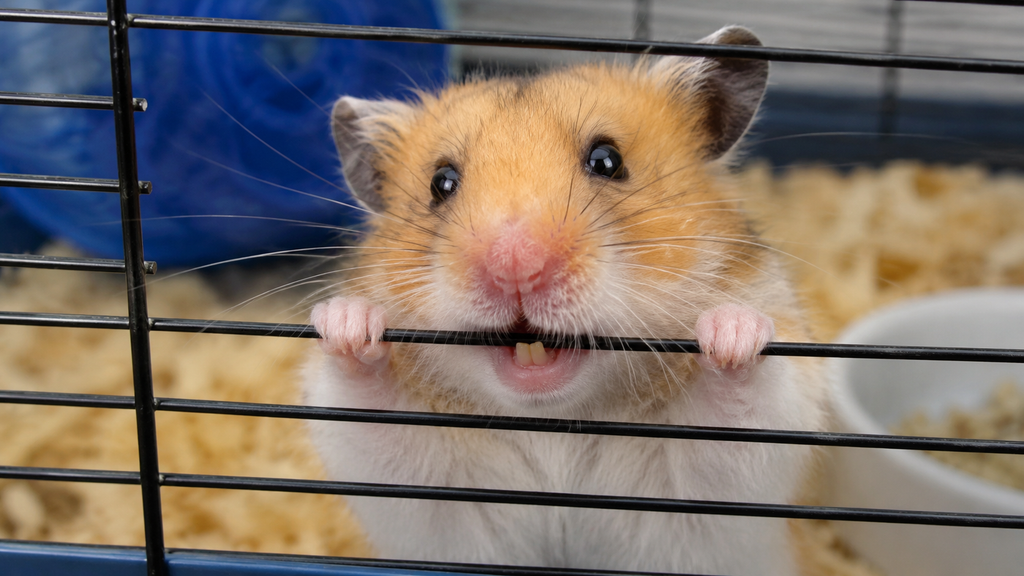
Repeated cage-bar biting can be a sign that a hamster’s environment is not meeting all of its behavioral needs. Research in Syrian hamsters has found more stereotypic wire-gnawing in smaller cages and in cages with shallow bedding, making housing the first thing worth reviewing.
That does not mean every chew on a bar proves your hamster is bored or stressed. Wire-gnawing can have more than one motivation, and simply replacing the cage with a barless tank does not automatically solve whatever caused the behavior.
Is cage-bar biting normal?
Hamsters naturally gnaw things, but repeatedly gnawing the same cage bars is different from ordinary chewing.
Animal-welfare research has used stereotypic wire-gnawing as one indicator when evaluating captive Syrian hamster housing.
In one study comparing four cage sizes, wire-gnawing occurred in all groups, but hamsters in smaller cages performed it significantly more frequently and for longer.
Another study comparing bedding depths found substantially more wire-gnawing in Syrian hamsters housed with only 10 cm of bedding. Hamsters given 40 or 80 cm showed much less, and no wire-gnawing was observed in the 80 cm group during that study.
So persistent bar biting is worth taking seriously.
What those studies do not tell us is that every individual hamster biting a bar has one specific emotional state called “boredom.”
Why do hamsters bite cage bars?
The most defensible answer is that housing and opportunities to perform natural behaviors can influence the behavior.
Possible factors worth reviewing include:
- limited usable enclosure space
- insufficient bedding for burrowing
- limited opportunities to explore and forage
- inadequate enrichment
- inability to reach something outside the enclosure
- an established repetitive behavior that persists even after conditions improve
Researchers have discussed wire-gnawing as stereotypic behavior, a possible coping response, exploratory behavior or an attempt to escape. Its exact motivation is not completely settled.
That uncertainty matters.
It is more accurate to say “persistent bar biting can indicate suboptimal housing or frustration” than to claim you can diagnose exactly why a hamster is doing it from the behavior alone.
Is your hamster chewing the bars to wear down its teeth?
I would not assume so.
Hamsters do need to gnaw because their incisors grow continuously. Appropriate chewable materials are therefore part of good hamster care.
But cage-bar chewing should not be treated as a normal dental-maintenance method.
In the bedding-depth study, gnawing on wood, food, cardboard and similar objects did not correlate with wire-gnawing. The researchers considered it possible that the behaviors had different underlying motivations.
There is also a practical dental reason to discourage cage-bar chewing: veterinary guidance notes that hamsters can break incisors while chewing cage bars.
Give your hamster appropriate materials to gnaw instead, such as safe fruit-tree wood and suitable cardboard.
Start by reviewing the enclosure size
A larger enclosure is one of the most evidence-supported changes to consider.
Research on female Syrian hamsters compared cages with floor areas of:
- 1,800 cm²
- 2,500 cm²
- 5,000 cm²
- 10,000 cm²
Wire-gnawing became less frequent and shorter as cage size increased, and the researchers concluded that welfare appeared better in the largest 10,000 cm² cages compared with the smaller ones.
This does not mean every pet Syrian requires exactly 10,000 cm² before bar biting can stop.
It does show why statements such as “any cage above X size eliminates bar biting” are too simplistic.
For current practical guidance, Woodgreen recommends a minimum floor footprint of 100 × 50 cm for Syrian, Chinese, dwarf and Roborovski hamsters, with different height and bar-spacing requirements depending on species.
Treat that as a welfare organization’s current minimum recommendation, not a scientifically proven anti-bar-biting threshold.
See our hamster cage setup guide if your enclosure needs upgrading.
Give your hamster enough bedding to burrow
This is one of the strongest parts of the evidence.
A controlled study housed male Syrian hamsters with bedding depths of 10, 40 or 80 cm.
The 10 cm group showed significantly more wire-gnawing. Hamsters with 40 and 80 cm of bedding constructed and occupied their own burrows, and wire-gnawing was not observed in the 80 cm group during the study.
That does not mean every pet enclosure must contain 80 cm of bedding.
Current Woodgreen guidance recommends at least 15 cm of bedding throughout most of the enclosure, plus a deeper area of approximately 25 to 30 cm where larger burrows and nests can be constructed.
The important principle is to provide deep, stable bedding that actually allows burrowing, rather than a decorative thin layer covering the floor.
If your enclosure cannot hold meaningful bedding depth, that itself may be a reason to reconsider the setup.
Add opportunities to forage, dig, hide and explore
Space alone is not the entire enclosure.
Woodgreen recommends enrichment including:
- tunnels and tubes
- cardboard boxes
- appropriate hides
- multi-chamber hides
- a digging area
- a sand bath
- a correctly sized solid wheel
- branches and other safe natural materials
Scatter-feeding can also encourage normal foraging behavior instead of putting every meal in one bowl.
The goal is not to fill the enclosure with random toys.
It is to give the hamster opportunities to perform behaviors it is strongly motivated to perform: burrowing, foraging, exploring, nesting, hiding, running and gnawing appropriate materials.
Give appropriate things to chew
Because hamster incisors grow continuously, suitable gnawing materials still matter even though dental maintenance does not adequately explain bar biting.
Woodgreen recommends options such as apple wood or other suitable fruit-tree wood.
Cardboard can also provide destructible enrichment.
The important distinction is:
Provide safe things to gnaw because gnawing is normal. Do not assume that doing so alone will stop stereotypic cage-bar biting.
If the enclosure is too small or offers poor burrowing opportunities, adding one wooden chew stick does not fix those problems.
Should you switch to a tank or bin cage?
Not automatically.
Removing the bars obviously prevents the hamster from chewing those particular bars, but that makes it a physical prevention, not necessarily a behavioral solution.
A hamster moved from an unsuitable barred cage into an unsuitable solid-sided enclosure has not received a welfare upgrade simply because there are no bars left to bite.
Woodgreen accepts both appropriately sized cages and tanks.
Ventilation also matters. RSPCA guidance actually favors cages with stainless-steel bars or mesh sides over completely solid sides because of airflow.
So choose an enclosure based on the whole setup:
- adequate continuous floor space
- enough height for deep bedding and equipment
- safe ventilation
- secure construction
- suitable wheel
- hides
- digging and foraging opportunities
- safe bar spacing if bars are present
A large, well-ventilated tank-style setup can work. So can an appropriately designed barred enclosure.
“No bars” is not the welfare standard.
Can bar biting damage a hamster’s teeth?
Yes, it can.
Veterinary guidance from PetMD notes that hamsters chewing cage bars can accidentally fracture their incisors.
A broken incisor may subsequently grow abnormally, and dental problems can interfere with eating.
Check your hamster if persistent bar biting has been occurring.
Contact a hamster-experienced veterinarian if you notice:
- a visibly broken or uneven incisor
- difficulty eating
- food repeatedly falling from the mouth
- drooling
- bleeding around the mouth
- reduced appetite
- unexpected weight loss
See signs of a sick hamster for other health changes worth monitoring.
Do not attempt to trim damaged teeth yourself.
Should you give a treat when the hamster stops biting?
I would not build the solution around rewarding or ignoring individual episodes.
The original article suggested that treats could accidentally teach a hamster to bar-bite for attention. That is behaviorally plausible, but I could not find strong hamster-specific evidence showing that attention-seeking is a major cause of cage-bar biting.
The higher-value response is to investigate why the hamster has repeated access and motivation to perform the behavior in the first place.
Do not punish, tap the bars, shout or deliberately frighten the hamster.
Instead, evaluate the enclosure and make meaningful husbandry improvements.
How long does bar biting take to stop?
There is no reliable timeline.
I would remove claims that most hamsters stop within days after an upgrade or that an established habit requires several weeks.
Research tells us that enclosure size and bedding depth can influence how much wire-gnawing Syrian hamsters perform. It does not give owners a countdown after changing an individual pet’s enclosure.
After making improvements, monitor whether:
- bar biting becomes less frequent
- sessions become shorter
- the hamster spends more time burrowing or foraging
- another repetitive behavior appears instead
- the behavior continues unchanged
Persistent bar biting after a substantial enclosure upgrade does not necessarily mean the upgrade was pointless. Repetitive behaviors can be complicated and may not disappear immediately.
What if the cage already seems good?
Review it critically rather than adding random toys one at a time.
Ask:
- Is there enough continuous floor space?
- Can the hamster construct real burrows?
- Is the wheel appropriately sized and always available?
- Are there several secure hiding places?
- Does the hamster have opportunities to forage?
- Are there safe materials to gnaw and destroy?
- Is the enclosure in a reasonably quiet, predictable location?
- Is anything outside the bars repeatedly attracting the hamster?
If the setup genuinely meets current welfare recommendations and repetitive bar biting continues, consider discussing the behavior with a hamster-experienced veterinarian, particularly if it appears suddenly or is accompanied by dental damage, wounds, reduced appetite or another behavioral change.
The bottom line
Persistent cage-bar biting is worth treating as a potential welfare signal, but it does not have one simple cause.
Syrian hamster research shows that wire-gnawing increases in smaller cages and with shallow bedding. Deep bedding suitable for constructing burrows can substantially reduce it.
What the evidence does not support is assuming the hamster is biting metal to trim its teeth, promising that a 100 × 50 cm cage will automatically stop the behavior, or treating a barless tank as a guaranteed cure.
Start with the environment. Provide generous usable space, deep bedding, a suitable wheel, hides, foraging opportunities and safe materials to gnaw. Then watch what actually changes.
And remember that eliminating access to bars is not the same thing as eliminating the reason the hamster wanted to gnaw them.
Keep reading: Hamster cage setup guide | Signs of a sick hamster
Hamster Corner provides general educational information about hamster care. If your hamster damages a tooth, stops eating, loses weight or develops another significant health or behavioral change, contact a hamster-experienced veterinarian.



[…] If repetitive bar chewing is an issue, see why hamsters bite cage bars. […]
[…] why hamsters bite cage bars for more […]