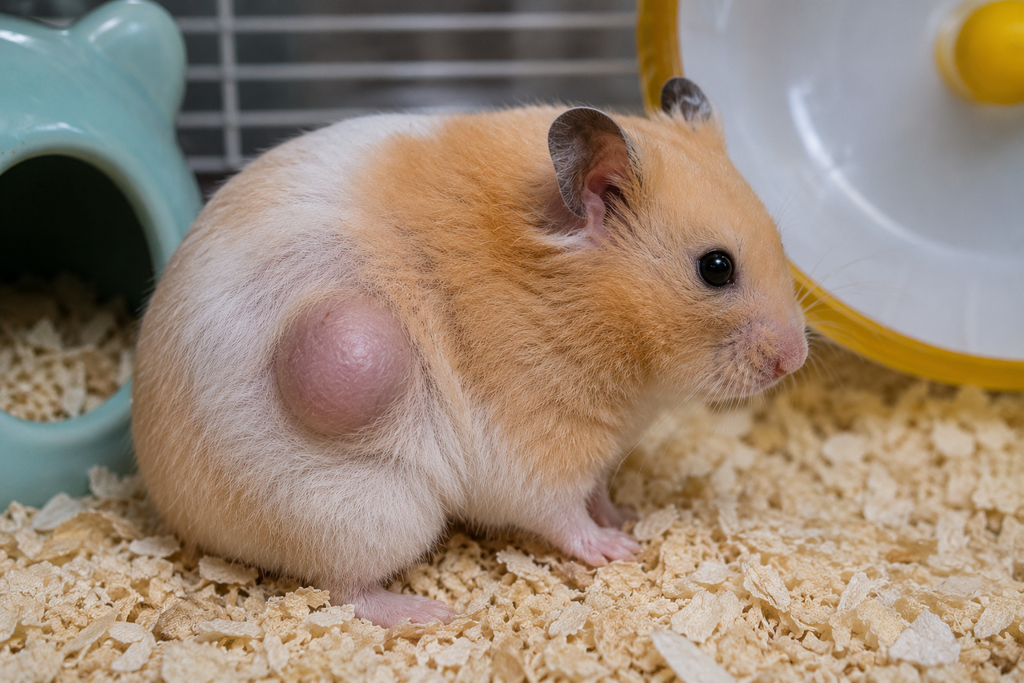
A new lump on a hamster should be checked by a hamster-experienced vet promptly. Abscesses and tumors are two important possibilities, but a swelling can also come from a full or impacted cheek pouch, an infected scent gland, or another problem. You cannot reliably diagnose the cause at home from whether the lump feels soft, firm, movable or fixed.
Some lumps are treatable, and earlier assessment can give your vet more options. Do not squeeze, puncture or try to drain a lump yourself.
What can cause a lump on a hamster?
There is no reliable rule that divides hamster lumps into three neat categories based on how they feel.
Two well-documented causes are abscesses and tumors.
PDSA describes hamster abscesses as swellings that may appear suddenly and can be hot, red and painful. They often develop after wounds caused by fighting or sharp objects.
The Merck Veterinary Manual similarly describes abscesses as infected pockets of pus under the skin and notes that they are often found around the head.
Hamsters can also develop both benign and malignant tumors. Merck advises having any unexpected lump examined promptly, while PetMD explains that veterinary examination, fine-needle aspiration or biopsy may be needed to determine what a growth actually is.
So avoid trying to diagnose a lump from touch alone. A hard lump is not automatically cancer, and a soft lump is not automatically an abscess.
What does a hamster abscess look like?
An abscess is an infected pocket of pus.
PDSA says hamster abscesses can appear quickly and may be:
- swollen
- hot
- red
- painful
Merck notes that abscesses commonly follow infected wounds, including bites from another hamster or injuries from sharp objects in the enclosure.
However, these signs are not enough to diagnose an abscess at home. Other conditions can also cause swelling.
Veterinary treatment may involve draining or surgically removing the abscess and using appropriate antibiotics. That is why an abscess should not be squeezed or lanced at home.
Does a hard lump mean cancer?
No.
Tumors can vary greatly in appearance, location and behavior. Feeling a lump with your fingers cannot tell you whether it is benign, malignant or even a tumor at all.
PetMD notes that veterinarians may use a fine-needle aspiration to collect cells from a mass. If that does not provide an answer, a biopsy may be needed. Internal masses may sometimes require imaging such as an X-ray or ultrasound.
Merck also notes that many hamster growths are not cancerous.
The useful rule is therefore:
new lump = veterinary examination, not home classification.
Where can hamster lumps appear?
A lump can occur almost anywhere.
The RSPCA notes that tumors are not uncommon in hamsters, particularly along the underside of the abdomen. Merck documents tumors in several locations, including the skin, mammary glands, uterus, intestines, eyes and other organs.
Abscesses are often found around the head, although they can occur elsewhere.
A facial swelling deserves particular attention because it can also involve the teeth or cheek pouches rather than being a skin lump.
For other signs that may accompany illness, see signs of a sick hamster.
A swollen cheek is not always a tumor
Hamsters have very large cheek pouches that extend back toward the shoulders. A full pouch can make one or both sides of the face look dramatically swollen.
The Merck Veterinary Manual specifically notes that owners sometimes mistake a distended cheek pouch for a rapidly growing tumor.
Normally, the swelling should disappear when the hamster empties its pouch.
Problems can occur when material becomes stuck. PetMD explains that impacted cheek pouches can become abscessed and cause swelling on one or both sides of the face.
PetMD’s current Syrian and dwarf hamster care sheets advise seeking veterinary care if swollen cheek pouches do not empty after a few hours.
Do not try to dig food or bedding out of the pouch yourself. The pouch lining is delicate, and an impaction or infection may need veterinary treatment.
What is a cheek pouch prolapse?
A cheek pouch can occasionally turn inside out and protrude through the mouth.
PetMD describes this as an everted cheek pouch. It may appear as a large pink or red sac coming from the mouth and can bleed, cause pain and interfere with eating.
That is different from an ordinary filled cheek.
A protruding cheek pouch needs veterinary attention rather than home manipulation.
Could it just be a scent gland?
Sometimes a normal scent gland is mistaken for a lump or skin lesion.
Syrian hamsters have a pair of flank glands on their sides. Merck describes them as dark spots in the coat and notes that they are more obvious in males.
Dwarf hamsters are different. VCA Animal Hospitals explains that dwarf hamsters have a scent gland on the belly near the umbilical area, while Syrians have glands on the flanks.
These glands can look darker or more noticeable than the surrounding skin.
However, do not assume every dark or raised area in the expected gland location is normal. Merck notes that flank glands themselves can become infected, and tumors can also develop in or around scent-gland tissue.
If the area suddenly becomes swollen, red, crusted, bleeding, discharging or noticeably different from its usual appearance, have it examined.
Should you squeeze or drain a hamster lump?
No.
If the swelling is an abscess, veterinary treatment may involve drainage, flushing, antibiotics or surgical removal. Merck specifically describes these as veterinary procedures.
If the lump is a tumor or another type of swelling, squeezing it will not diagnose or appropriately treat it.
So avoid:
- squeezing the lump
- sticking a needle into it
- trying to pop it
- applying human antiseptic or antibiotic creams unless a vet tells you to
- attempting to drain pus yourself
Keep the area clean and leave the diagnosis and treatment to the vet.
When should a hamster with a lump see a vet?
Any new unexplained lump is worth contacting a vet about promptly.
PDSA recommends having new lumps checked because faster diagnosis and treatment can improve the outlook. Merck gives similar advice for unexpected growths.
Seek more urgent veterinary help if the swelling is accompanied by:
- difficulty breathing
- inability or difficulty eating
- significant bleeding
- pus or other discharge
- an open or ulcerated mass
- marked pain
- rapid deterioration
- significant lethargy
- weakness or collapse
- a cheek pouch protruding from the mouth
- facial swelling that is interfering with the eye, mouth or breathing
There is no useful rule such as “watch it for three days first” or “wait one to two weeks unless it grows.”
Hamsters can hide illness and decline quickly, so let the veterinarian decide how urgently the lump needs investigation.
What information should you give the vet?
A few observations can be useful without trying to diagnose the lump yourself.
Note:
- when you first noticed it
- where it is located
- whether it appears to be changing in size
- whether the skin over it looks normal, red or open
- whether there is bleeding or discharge
- whether your hamster is eating normally
- whether body weight is changing
- whether behavior or activity has changed
A photo taken when you first notice the lump can also make later size or appearance changes easier to compare.
Can a hamster lump go away on its own?
It depends entirely on what caused the swelling.
A temporarily full cheek pouch should reduce after the hamster empties it. A disease-related lump cannot be assumed to resolve without treatment.
I would therefore not use “wait and see if it disappears” as the default response to a new unexplained mass.
If you are not sure whether you are looking at stored food, a normal scent gland or a true lump, a hamster-experienced vet can help you distinguish them.
Is every hamster lump cancer?
No.
Hamsters can develop cancer, but an unexpected swelling can have several other explanations.
Merck notes that most growths in hamsters are not cancerous, and PDSA likewise says many hamster tumors are benign.
The important point is not to assume either extreme.
A lump should not automatically be labelled cancer, but it also should not be dismissed because the hamster still seems well. Veterinary examination, and sometimes sampling or imaging, is what establishes the diagnosis.
The bottom line
A new lump on a hamster should be checked by a hamster-experienced veterinarian rather than diagnosed by feel at home.
Abscesses and tumors are important possibilities, but facial swelling may come from a full or impacted cheek pouch, and normal scent glands can sometimes be mistaken for abnormal growths.
Forget the simple rule that “soft means abscess and hard means tumor.” Hamster lumps do not reliably work that way.
Do not squeeze, puncture or drain a lump yourself. Note its location and any changes, watch your hamster’s eating, weight and behavior, and arrange veterinary assessment promptly.
Keep reading: Signs of a sick hamster | How long do hamsters live? | Do hamsters need a vet?
Hamster Corner provides general educational information about hamster care. It is not a substitute for professional veterinary advice. If your hamster has a new lump, swelling or significant change in health, contact a hamster-experienced veterinarian.