
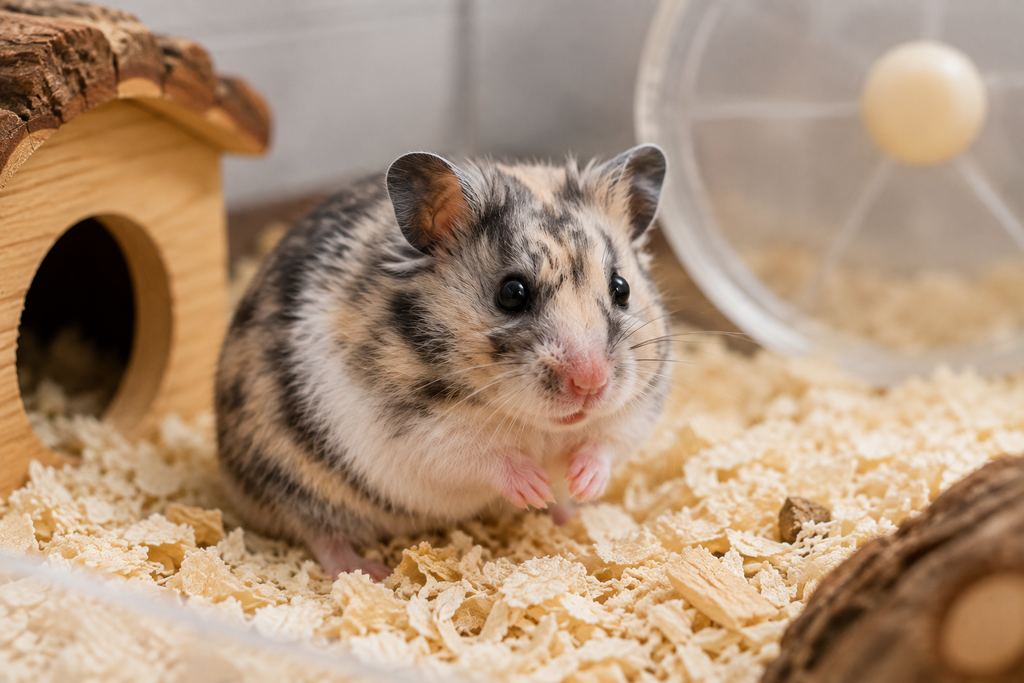
Most pet hamsters live for roughly 2 to 3 years, although individual lifespan varies. Merck gives a broad pet-hamster range of about 18 months to 3 years, while PDSA and Blue Cross both use about 2 to 3 years as a typical expectation.
Species does make some difference, but exact lifespan tables should be treated as estimates rather than promises. Genetics, overall health, diet, environment, and veterinary care can all influence how a hamster ages.
How long do hamsters live?
A realistic expectation for most pet hamsters is about 2 to 3 years.
The Merck Veterinary Manual says pet hamsters may live from around 18 months to 3 years. PDSA and Blue Cross both give a typical lifespan of approximately 2 to 3 years.
Woodgreen Pets Charity gives a broader range of about 1.5 to 3 years and notes that some individuals live longer.
So if you are bringing home a hamster, planning around roughly two years, with many reaching three, is more useful than expecting an exact lifespan from a species chart.
Hamster lifespan by species
Species-specific numbers vary between reputable sources, so these ranges should be read as general expectations.
| Species | What current guidance suggests |
|---|---|
| Syrian hamster | Around 2 to 3 years |
| Roborovski hamster | Around 2 to 3 years |
| Chinese hamster | Around 1.5 to 3 years |
| Campbell’s dwarf | Often somewhat shorter-lived than Syrian, Chinese, and Roborovski hamsters |
| Winter White dwarf | Often somewhat shorter-lived than Syrian, Chinese, and Roborovski hamsters |
| Campbell’s/Winter White hybrid | Often somewhat shorter-lived |
PetMD gives Syrian and Roborovski hamsters a typical range of 2 to 3 years and Chinese hamsters 1.5 to 3 years.
For Winter Whites, however, PetMD gives a much shorter figure of around one year. Woodgreen takes a less exact approach and says Campbell’s, Winter Whites, and their hybrids tend to have a slightly shorter life expectancy than Syrian, Chinese, and Roborovski hamsters.
That disagreement is why I would not tell an owner that every Winter White lives exactly 1.5 to 3 years or that every Campbell’s has a fixed 1.5-to-2.5-year lifespan.
Individual variation is substantial.
Also, “teddy bear hamster” is not a separate hamster species with its own lifespan. It is a common name used for long-haired Syrian hamsters.
Which hamster tends to live the longest?
Syrian and Roborovski hamsters are among the longer-lived common pet hamsters.
PetMD gives both a typical lifespan of around 2 to 3 years, while Woodgreen similarly places Roborovski, Syrian, and Chinese hamsters among the species that tend to outlive Campbell’s and Winter White dwarfs.
That does not mean buying a Roborovski guarantees a longer-lived pet. Two hamsters of the same species can still age very differently.
Can hamsters live longer than three years?
Yes, but it is unusual.
The official Guinness World Records record lists a hamster that reached 4.5 years old.
That is an exceptional case rather than a realistic target for most owners.
PetMD says some hamsters may also exceed the usual 2-to-3-year range, but there is no husbandry method that can guarantee an unusually long lifespan.
A better goal is good health span, meaning keeping the hamster comfortable, active, appropriately fed, and medically supported for as much of its natural life as possible.
Why do pet hamsters have such short lives?
Hamsters are naturally short-lived mammals.
It is tempting to explain this simply by saying they have “fast metabolisms,” but that is an oversimplification and does not add much practical value.
Wild hamsters generally face additional pressures such as predators, food availability, weather, disease, and competition. Woodgreen notes that exact wild lifespans are difficult to establish because these species have not been followed for long periods in their natural habitats.
So I would avoid the claim that “most wild hamsters do not survive one year” unless discussing a specific species with supporting field data.
The stronger conclusion is simply that pet hamsters have a naturally short lifespan even under good care.
What affects a hamster’s lifespan?
Not every factor is under your control.
Woodgreen identifies several broad influences on hamster longevity:
- environment
- diet
- genetics
- overall health
Good husbandry cannot guarantee that your hamster reaches three years. Genetics, congenital problems, cancer, kidney disease, heart disease, infections, and other illnesses can occur even in carefully cared-for animals.
What appropriate care can do is support health and reduce avoidable welfare problems.
That means providing an appropriate diet, suitable housing and enrichment, continuous access to fresh water, and veterinary attention when illness develops.
For feeding basics, see what hamsters can eat. For housing, see our hamster cage setup guide.
Can better care make a hamster live longer?
Good care supports health and longevity, but I would not promise that any checklist will “add years.”
A hamster with excellent housing may still develop cancer. Another hamster may have inherited health problems. Conversely, an individual can sometimes live surprisingly long despite less-than-perfect circumstances.
The useful goal is to reduce preventable problems.
Focus on:
- a nutritionally appropriate hamster diet
- a suitably sized and enriched enclosure
- deep bedding that allows normal burrowing
- an appropriate running wheel
- fresh water at all times
- a clean but not excessively disrupted environment
- gentle handling
- regular health checks
- veterinary care when symptoms appear
Avoid turning foods into longevity treatments. There is no specific vegetable, low-sugar snack, supplement, or “superfood” proven to make a healthy hamster live longer.
Does where a hamster comes from affect lifespan?
Genetics matter, but I would remove the blanket claim that responsible-breeder hamsters live longer than pet-store hamsters.
That may sometimes be true where careful breeding reduces inherited disease, but I could not find strong enough evidence to give pet-store versus breeder hamsters a reliable lifespan difference.
A hamster’s individual history may also be unknown.
Instead of assuming health from where the animal was purchased, pay attention to the hamster in front of you: appetite, weight, coat, movement, breathing, teeth, eyes, stool, water intake, and normal behavior.
When is a hamster considered old?
There is no single birthday at which every hamster becomes a senior.
PetMD considers a hamster around 1.5 years or older elderly as a general guideline.
Woodgreen gives more species-specific context. It says Campbell’s, Winter Whites, and their hybrids may begin showing age-related slowing from around one year, while other common species may show it around 18 months to 2 years.
That is more useful than a universal “18 months = senior” rule.
Signs your hamster may be getting older
Woodgreen lists several changes that can appear with age, including:
- thinner or sparser fur
- shorter active periods
- reduced wheel use
- becoming less steady on the feet
- longer nails
- weight loss
These changes should be interpreted carefully.
Old age should not become an explanation for every new symptom. Weight loss, major hair loss, difficulty walking, reduced appetite, unusual lumps, breathing changes, or a sudden drop in activity can also indicate illness.
Woodgreen specifically notes, for example, that symmetrical hair loss can occur with Cushing’s disease.
If something changes suddenly or significantly, see signs of a sick hamster and contact a hamster-experienced veterinarian.
How to care for an older hamster
The goal with a senior hamster is accessibility and comfort.
Watch whether your hamster can still reach food, water, hides, and other important parts of the enclosure easily. If mobility declines, reducing unnecessary climbing or fall risks can make the enclosure easier to navigate.
Continue providing opportunities for natural behaviors, but adapt them to what the individual hamster can comfortably manage.
Monitoring weight is also useful. Woodgreen’s hamster health guidance recommends weighing hamsters and watching for unexpected or consistent weight change.
Do not assume weight loss is an unavoidable part of getting old. Significant or continuing loss deserves veterinary attention.
Do hamsters live longer alone?
This question depends more on safe housing than on proving a lifespan advantage.
Syrian and Chinese hamsters should live alone. Current welfare guidance varies somewhat for dwarf co-housing, but individual housing is the safest default because fights can cause serious injury.
There is not good evidence for converting that into a claim such as “living alone makes a hamster live longer.”
For the full species-specific discussion, see can two hamsters live together.
Do male or female hamsters live longer?
I could not find strong enough pet-hamster evidence to give one sex a meaningful general lifespan advantage.
Species, genetics, individual health, and husbandry are more useful considerations than telling owners that males or females should live longer.
How old is a hamster in human years?
There is no scientifically useful hamster-to-human-years conversion.
Hamsters develop, mature, and age on a completely different timeline from humans. Saying one hamster month equals a particular number of human years creates false precision without helping with care.
It is better to think in terms of the hamster’s actual stage of life and current physical condition.
Why did my hamster die suddenly?
Sometimes the cause cannot be determined without veterinary examination or a post-mortem examination.
Hamsters are prey animals and can hide signs of illness until disease has progressed. Serious infections, heart disease, kidney disease, tumors, gastrointestinal disease, and other conditions can all affect hamsters.
Do not automatically blame yourself, the diet, stress, or one recent event when the cause is unknown.
If you have multiple unexplained deaths, another hamster in the home appears sick, or you are concerned about infectious disease or the environment, contact a hamster-experienced veterinarian.
Frequently asked questions
How long do Syrian hamsters live?
A typical Syrian hamster lifespan is around 2 to 3 years, according to PetMD and Merck.
How long do Roborovski hamsters live?
PetMD gives Roborovski hamsters a typical lifespan of around 2 to 3 years. Individual Roborovskis can live shorter or longer lives.
How long do dwarf hamsters live?
“Dwarf hamster” covers several species, so there is no single exact number. Overall guidance commonly falls around 1 to 3 years, with Campbell’s and Winter Whites tending to have shorter lifespans than Syrian, Chinese, and Roborovski hamsters.
Can a hamster live four years?
Yes, but that would be unusually long. Guinness World Records lists a hamster that lived to 4.5 years, while most pet hamsters live much shorter lives.
Is an 18-month-old hamster old?
For many hamsters, yes. PetMD considers about 1.5 years elderly as a general guideline, although Woodgreen notes that signs of aging can appear earlier in Campbell’s and Winter White hamsters and later in some other species.
Bottom line
Most pet hamsters live for about 2 to 3 years, with roughly 18 months to 3 years being a useful broader range.
Syrian, Roborovski, and Chinese hamsters tend to be among the longer-lived common pet species, while Campbell’s, Winter Whites, and their hybrids may have somewhat shorter lifespans. Exact species numbers vary between reputable sources, so treat them as expectations, not expiry dates.
You cannot guarantee a hamster a long life through diet or enclosure choices. What you can do is provide appropriate food, housing, enrichment, regular health checks, and prompt veterinary care so your hamster has the best chance of remaining comfortable and healthy throughout the life it has.
Keep reading: Signs of a sick hamster · What can hamsters eat? · Hamster cage setup



[…] Keep reading: Do hamsters need a vet? | Signs of a sick hamster | Hamster wet tail | What can hamsters eat? | How long do hamsters live? […]
[…] For more on aging, see how long hamsters live. […]
[…] reading: Signs of a sick hamster | How long do hamsters live? | Do hamsters need a […]