
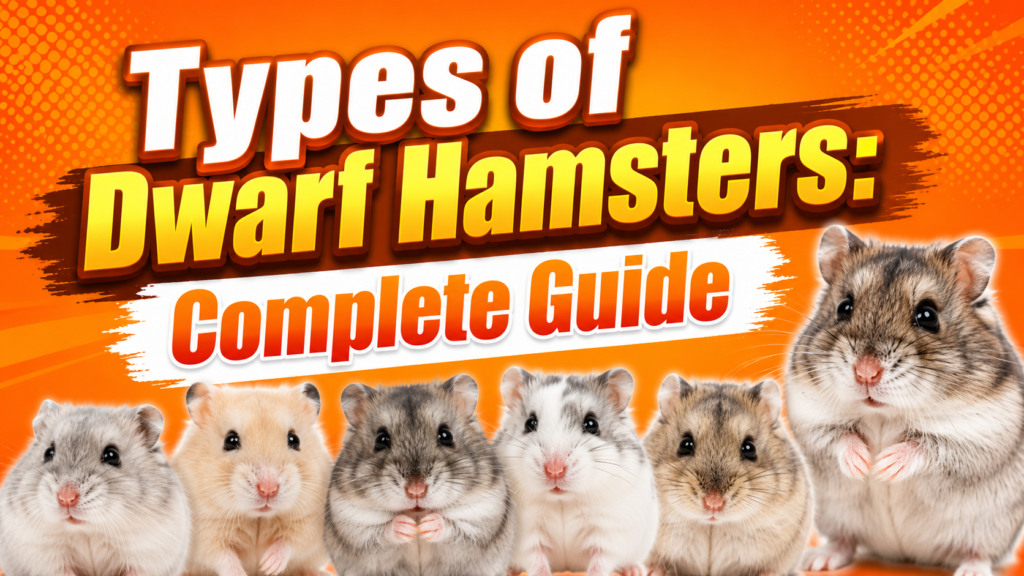
Pet-care guides commonly talk about four dwarf hamster types: Roborovski, Winter White, Campbell’s and Chinese hamsters. But the label needs some explanation. Roborovski, Winter White and Campbell’s are all members of the genus Phodopus, while the Chinese hamster belongs to Cricetulus. They also differ meaningfully in handling, identification and legal status, so “dwarf hamster” should not be treated as one interchangeable type of pet.
This matters because pet stores often sell small hamsters under broad labels such as “Russian dwarf,” “dwarf hamster” or “Winter White.”
Those names do not always tell you exactly what animal you are buying.
In particular, Woodgreen Pets Charity notes that many pet dwarf hamsters are actually Campbell’s × Winter White hybrids unless they come with a known pedigree.
So this guide is less about ranking four tiny hamsters from best to worst and more about understanding what those labels actually mean.
What does “dwarf hamster” mean?
There is not one single pet species called the dwarf hamster.
Three commonly kept small hamster species belong to the genus Phodopus:
- Roborovski hamster, Phodopus roborovskii
- Winter White hamster, Phodopus sungorus
- Campbell’s hamster, Phodopus campbelli
The Chinese hamster is different. It belongs to the genus Cricetulus.
Some veterinary and welfare guides still group the Chinese hamster under “dwarf hamsters” for practical pet-care purposes because of its small size. Blue Cross, for example, describes four dwarf species kept as pets and includes the Chinese hamster.
So calling a Chinese hamster a dwarf is not necessarily wrong in casual pet-care language.
The more precise distinction is:
Chinese hamsters are not Phodopus dwarf hamsters.
That becomes especially important when discussing genetics, hybrids and pet laws.
Dwarf hamster types compared
| Hamster | Taxonomic group | Handling | Important distinction |
|---|---|---|---|
| Roborovski | Phodopus | Particularly difficult to handle regularly because of tiny size and speed | Smallest common pet hamster |
| Winter White | Phodopus | Can become hand-tame | True Winter Whites can develop a paler seasonal coat |
| Campbell’s | Phodopus | Can become hand-tame | Closely related to Winter Whites; hybrids are common |
| Chinese | Cricetulus | Can become hand-tame | Longer body and tail; different legal status in California |
Notice what is missing from that table: “gentle,” “nippy,” “docile,” “shy” and “friendly.”
Those labels are too dependent on the individual hamster to make a useful species comparison.
Roborovski hamster
The Roborovski is the clearest outlier when it comes to handling.
Woodgreen describes Robos as only around one to two inches long, making them the smallest commonly kept hamster species. It also specifically warns that they are exceptionally fast and can be difficult to pick up and handle regularly.
That makes a Robo a different ownership experience from the other small hamsters.
A Robo may learn to:
- approach your hand
- take food from you
- walk voluntarily across your hands
- become comfortable with your presence
But you should not buy one expecting patient taming to eventually turn it into a hamster that sits quietly in your palm.
Robos are particularly rewarding for owners who enjoy watching:
- running
- foraging
- digging
- sand bathing
- nesting
- exploring a complex enclosure
The old version of this article called Roborovskis the “longest-lived” hamster and gave a lifespan of 3 to 3.5 years.
That is too definite.
Woodgreen gives an overall hamster lifespan of roughly 1.5 to 3 years, noting that Roborovskis, Syrians and Chinese hamsters tend to live somewhat longer than Campbell’s, Winter Whites and their hybrids.
Individual hamsters can fall outside those ranges.
Read our full Roborovski hamster profile.
Winter White hamster
The Winter White is Phodopus sungorus, a Russian dwarf hamster best known for its seasonal coat response.
True Winter Whites can develop a much paler coat when exposed to shorter day lengths.
But identification in pet hamsters is not always straightforward.
Woodgreen notes that many animals sold as pet dwarfs are Campbell’s × Winter White hybrids unless they come with pedigree information from a reputable breeder.
That means a label saying “Winter White” does not necessarily prove pure ancestry.
It also makes personality comparisons less useful.
The old article described Winter Whites as calmer than Roborovskis and implied they occupied a predictable middle ground in temperament.
A better distinction is physical:
Winter Whites can become hand-tame, while Roborovskis are particularly difficult to handle because of their speed and size.
Whether one individual Winter White is calm, nervous, curious or reluctant to be held is a separate question.
Read our full Winter White hamster profile.
Campbell’s dwarf hamster
The Campbell’s hamster, Phodopus campbelli, is closely related to the Winter White.
The two species are similar enough that they were historically treated as closely related forms, and hybridization in the pet trade has made visual identification even harder.
The old article described Campbell’s hamsters as:
- commonly nippy
- especially difficult when young
- highly diabetes-prone
- dependent on a strict low-sugar diet
That goes too far.
Woodgreen says Campbell’s hamsters can become hand-tame, alongside Winter Whites, Chinese hamsters and Syrians.
There is no good reason to treat “nippy” as a defining Campbell’s personality trait.
A hamster may bite when frightened, cornered, suddenly grabbed, disturbed while sleeping or in pain, regardless of species.
What about diabetes?
This concern should not be deleted completely.
PDSA specifically states that Russian dwarf hamsters are particularly prone to diabetes.
Campbell’s hamsters are therefore one of the species where it makes sense to be conservative with sugary extras.
But that does not mean every Campbell’s hamster:
- has diabetes
- will develop diabetes
- needs a zero-sugar diet
- can never eat fruit
- must avoid carrot
- needs every commercial food rejected if it contains a sweet-sounding ingredient
The foundation should be a nutritionally complete hamster diet.
If a hamster is actually diagnosed with diabetes, dietary management should be individualized with a veterinarian experienced with hamsters.
Read our full Campbell’s dwarf hamster profile.
Chinese hamster
The Chinese hamster is the reason the phrase “four dwarf hamster species” needs context.
It is a small hamster and is often grouped with dwarfs in pet-care literature, but it belongs to Cricetulus, not Phodopus.
It has a slimmer body and a noticeably longer tail than the three Phodopus species.
Woodgreen also notes that Chinese hamsters can become hand-tame after socialization.
There is no strong reason to rank them as “slightly more handleable” than Campbell’s or Winter Whites.
Individual temperament varies too much.
Chinese hamsters also have a legal distinction that the other small hamster species do not have in California.
Read our full Chinese hamster profile.
Campbell’s vs Winter White: can you tell them apart?
Sometimes, but not reliably from a quick look when ancestry is unknown.
Pure Campbell’s and Winter Whites have physical differences, but the practical problem is hybridization.
If a hamster came from a pet shop without pedigree information, labels such as:
- Russian dwarf
- Siberian hamster
- Winter White
- Campbell’s
- Djungarian
may not provide reliable proof of ancestry.
Woodgreen specifically warns that pet dwarfs are commonly Campbell’s × Winter White hybrids.
That means you should be cautious about using:
- coat color
- body shape
- supposed friendliness
- biting behavior
- seasonal color change
as definitive identification tests.
If you already own an unidentified Russian dwarf hamster, exact genetic classification is usually less important than giving it appropriate dwarf-hamster care.
How big should a dwarf hamster cage be?
Small hamster does not mean small enclosure.
Woodgreen recommends 100 × 50 cm of continuous floor space for all commonly kept hamster species.
For dwarf and Roborovski hamsters, its recommended enclosure height is at least around 40 cm.
For Chinese hamsters, Woodgreen recommends around 50 cm high.
The floor-space recommendation remains 100 × 50 cm in both cases.
This means the small cages and modular “dwarf hamster starter kits” commonly sold in pet shops are not automatically appropriate simply because a hamster can physically fit inside them.
Your hamster needs space to:
- build burrows
- forage
- run
- hide
- use a sand area
- move between different parts of the enclosure
- create food stores
See our hamster cage setup guide before buying an enclosure.
How deep should the bedding be?
All of these hamsters are burrowing animals.
Blue Cross recommends at least 20 cm of suitable digging material so hamsters can create tunnels and nests.
More depth can be provided where the enclosure allows.
A thin layer of bedding is not enough just because a Robo weighs very little.
The important question is whether the hamster can disappear below the surface and create a stable burrow.
What wheel does each dwarf hamster need?
This is one area where species differences are useful.
Blue Cross gives the following upright wheel ranges:
| Hamster | Blue Cross wheel guidance |
|---|---|
| Roborovski | 20 to 22 cm |
| Winter White | 22 to 25 cm |
| Campbell’s | 22 to 25 cm |
| Chinese | 25 to 27 cm |
Woodgreen uses somewhat different guidance and recommends an 8-inch wheel for its dwarf/Robo category and a 12-inch wheel for Chinese hamsters.
That disagreement is a good reason not to treat one number as a universal biological cutoff.
The hamster’s posture is the final test.
A suitable wheel should:
- allow the back to remain straight
- allow a normal head position
- rotate easily
- have a solid running surface
- have no mesh or open rungs that can catch feet
If your hamster has to noticeably arch its back, use a larger wheel.
Can dwarf hamsters live together?
This is an area where reputable welfare organizations differ.
Woodgreen recommends housing pet hamsters individually, including dwarf species, because territorial fights in captivity can cause serious injuries.
The RSPCA takes a somewhat less restrictive position.
It says that established same-sex Roborovski, Campbell’s or Winter White siblings can sometimes live in compatible pairs or trios under suitable conditions.
But the RSPCA also emphasizes two important points:
Dwarf hamsters do not need hamster companionship to be happy.
And even apparently compatible groups can fall out later in life.
Syrian and Chinese hamsters should live alone.
For someone starting with a new hamster, planning one hamster per enclosure is therefore the simplest conservative approach.
If you already have a peaceful established dwarf pair, do not separate them automatically because one website tells you every hamster must live alone.
Instead, monitor carefully and have a second complete enclosure available in case aggression develops.
If serious fighting occurs, the hamsters need permanent separation.
Do all dwarf hamsters need a low-sugar diet?
No.
This is one of the most important corrections to the old article.
The label “dwarf hamster” combines animals for which the metabolic evidence is not identical.
PDSA specifically warns that Russian dwarf hamsters are particularly prone to diabetes.
That is relevant to Campbell’s and Winter White-type hamsters and may also be relevant when ancestry is uncertain because hybrids are common.
It should not automatically be extended to Roborovskis simply because they are small.
Nor should it become a rule that every dwarf hamster needs a “strict low-sugar diet.”
For all species:
- use a nutritionally complete hamster food as the staple
- avoid allowing treats to replace the balanced diet
- keep sugary extras modest
- monitor body condition and health
If a hamster has diagnosed diabetes, follow veterinary dietary advice rather than an internet species chart.
See what hamsters can eat for our broader feeding guide.
Which dwarf hamster is easiest to handle?
There is no reliable ranking between Campbell’s, Winter White and Chinese hamsters.
Woodgreen says all three can become hand-tame.
Roborovskis are the clearer exception because their tiny size and exceptional speed genuinely make handling more difficult.
So if frequent handling is important:
Winter White, Campbell’s or Chinese: reasonable possibilities, depending on the individual.
Roborovski: choose primarily with observation in mind.
If easy physical handling is your highest priority, a larger Syrian hamster may still be the most practical option.
Which dwarf hamster is best for beginners?
There is no universal winner.
A beginner who wants frequent handling may find a Winter White, Campbell’s or Chinese hamster easier to work with than a Robo.
But the individual hamster, its previous handling and the owner’s expectations matter too much to declare one dwarf species “the beginner hamster.”
A first-time owner can successfully keep a Robo if they genuinely want an observation-focused pet.
Likewise, buying a Winter White does not guarantee a cuddly hamster.
See our best hamster for beginners guide for the broader comparison.
How long do dwarf hamsters live?
Do not choose from an overly precise lifespan ranking.
Woodgreen gives hamsters generally a lifespan of about 1.5 to 3 years, sometimes longer.
It says Campbell’s, Winter Whites and their hybrids tend to have a somewhat shorter life expectancy than Roborovskis, Syrians and Chinese hamsters.
That is more useful than promising:
- Robo: exactly 3 to 3.5 years
- Winter White: exactly 1.5 to 2 years
- Campbell’s: exactly 1.5 to 2 years
- Chinese: exactly 2 to 3 years
Individual lifespan varies with genetics, disease and care.
Are Chinese hamsters legal in California?
Chinese hamsters have a different legal status from the Phodopus species.
California’s restricted-species regulation exempts:
- domesticated golden hamsters, Mesocricetus auratus
- domesticated dwarf hamsters in the genus Phodopus
Chinese hamsters are not Phodopus, so they are not covered by that exemption.
The California Department of Fish and Wildlife says restricted-species permits are issued only for limited purposes such as research, education, exhibition or shelter and are not issued simply for pet ownership.
So the old statement:
Chinese hamsters require a permit in California.
is misleading for a normal pet owner.
The practical answer is:
Do not acquire a Chinese hamster as an ordinary private pet in California.
See our Chinese hamster profile for the full explanation.
Are hamsters legal in Hawaii?
Not for ordinary private ownership.
Current Hawaii government guidance lists hamsters among animals prohibited from entry or possession by private individuals.
There are narrow regulatory exceptions involving some species for institutional or government purposes, so “absolutely no exception exists under any circumstances” would be too broad.
For a normal pet owner, however, the answer is straightforward:
do not bring or keep a pet hamster in Hawaii.
Always check current government rules before obtaining an animal because regulations can change.
Which dwarf hamster should you choose?
Rather than asking which one is universally best, match the species to your expectations.
Consider a Roborovski if:
You mainly want to observe fast, natural hamster behavior and do not expect frequent holding.
Consider a Winter White if:
You like the species and are comfortable with a small hamster that can become hand-tame. Be aware that pet-shop “Winter Whites” may have Campbell’s ancestry.
Consider a Campbell’s if:
You are comfortable with a small hand-tame hamster and understand that metabolic risk deserves sensible dietary attention without turning the diet into an extreme zero-sugar regime.
Consider a Chinese hamster if:
You like its longer-bodied appearance, are comfortable with its size and can legally keep the species where you live.
Then choose the individual hamster based on health and realistic handling expectations.
The bottom line
Pet-care guides commonly describe four dwarf hamster types: Roborovski, Winter White, Campbell’s and Chinese hamsters, but they should not be treated as four versions of the same animal.
Roborovski, Winter White and Campbell’s hamsters belong to Phodopus. Chinese hamsters belong to Cricetulus and have important differences, including their legal status in California.
Roborovskis are genuinely difficult to handle regularly because they are exceptionally small and fast. Winter Whites, Campbell’s and Chinese hamsters can all become hand-tame, so there is little value in ranking them with stereotypes such as “calmest,” “nippiest” or “most docile.”
Campbell’s and Winter White identification can also be uncertain because hybrids are common in the pet trade.
All need substantial housing. Aim for at least 100 × 50 cm of continuous floor space, deep burrowing substrate and a solid upright wheel sized for the individual species and hamster.
Do not assume every dwarf hamster needs a strict low-sugar diet. Reputable guidance specifically raises diabetes concerns for Russian dwarf hamsters, not every animal placed under the broad dwarf label.
For a new setup, one hamster per enclosure is the simplest conservative choice. Some established Phodopus dwarf siblings can sometimes remain compatible, but they do not need companions and may later fight. Chinese hamsters should live alone.
Explore the profiles: Roborovski | Winter White | Campbell’s | Chinese
Keep reading: Types of hamsters | Dwarf vs Syrian hamster | Best hamster for beginners | Hamster cage setup
Sources: Woodgreen hamster care guide | Woodgreen hamster lifespan guide | Blue Cross hamster care guide | RSPCA hamster companionship guidance | PDSA hamster care guide | California restricted species regulations | California Department of Fish and Wildlife exotic pet guidance | Hawaii animal guidelines
Hamster Corner provides general educational information about hamster care and is not a substitute for veterinary or legal advice. If your hamster develops a significant health change, contact a veterinarian experienced with hamsters, and check current government guidance before obtaining a species subject to local restrictions.