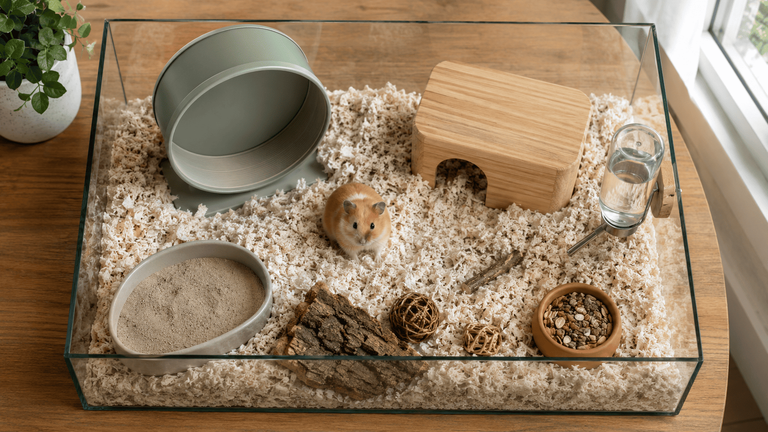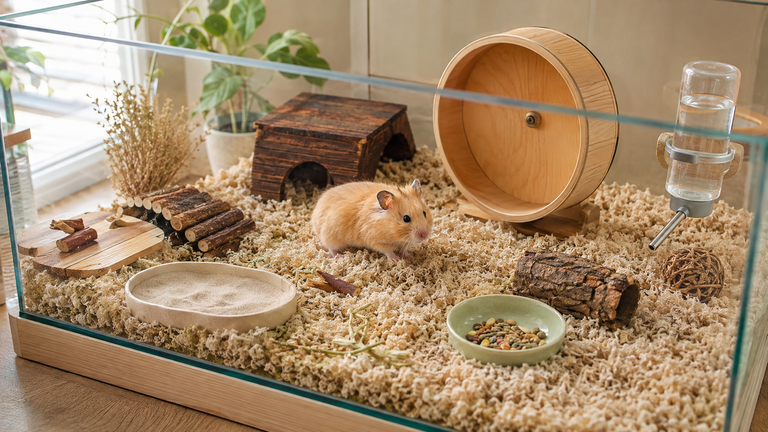
The safest simple choice for a hamster sand bath is a clean bathing sand specifically suitable for hamsters or other small mammals, with sand rather than very fine dust. PetMD notes that veterinarians commonly recommend chinchilla sand instead of chinchilla dust because the finer dust can increase the risk of eye and respiratory irritation.
Woodgreen uses the broader term hamster-safe sand, which is a useful reminder that the product name matters less than whether the substrate is genuinely appropriate for hamster use.
What sand should you use for a hamster?
For the lowest-uncertainty option, choose a commercially prepared hamster-safe bathing sand.
A suitable chinchilla bathing sand can also be an option. PetMD specifically distinguishes chinchilla sand from dust and says sand is generally preferred for small pets to reduce respiratory and eye concerns.
Woodgreen has also previously recommended shallow tubs of chinchilla sand for hamster digging, while its current hamster-care guidance simply recommends a sand bath filled with hamster-safe sand.
The key distinction is:
sand, not an extremely fine bathing dust.
I would avoid buying a product solely because the package contains the words “chinchilla,” “reptile” or “small animal.” Check that the actual product is suitable for hamster use and does not contain unnecessary fragrance or other additives.
Why do hamsters use sand?
Hamsters groom themselves very effectively and generally do not need humans to wash them.
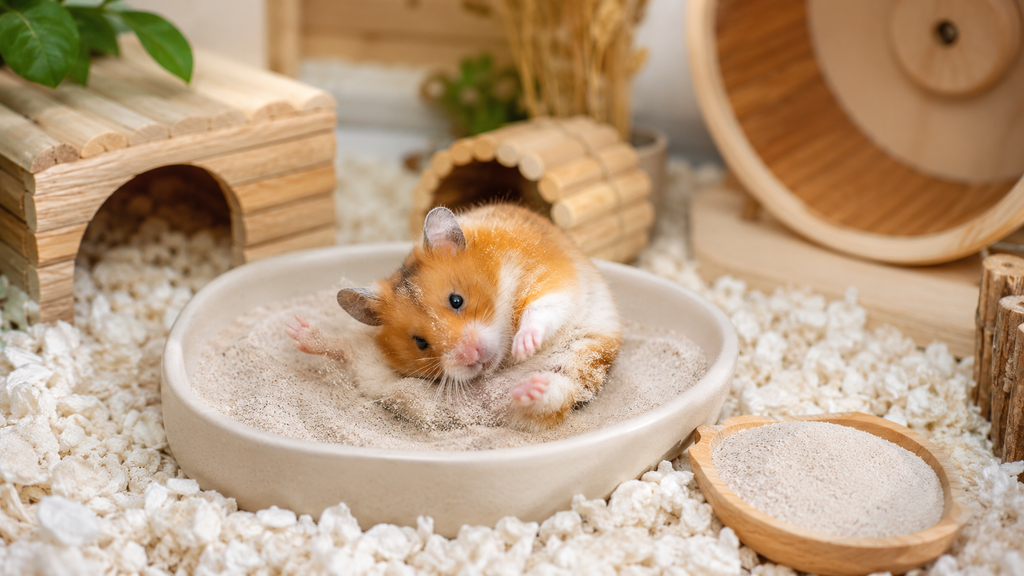
A sand bath gives them another way to groom and also provides a different substrate for digging and exploration.
Blue Cross says a sand bath helps hamsters keep their coat clean while adding another texture to explore.
PetMD similarly says sand bathing can help remove accumulated oil and dirt from the coat while providing enrichment.
That is enough explanation.
There is no need to claim that individual grains coat every hair shaft and mechanically strip oils in a specific way unless there is direct evidence for that mechanism.
Do all hamsters need a sand bath?
A sand bath is a valuable part of a good hamster setup, although authoritative sources vary in how strongly they frame it.
Woodgreen includes a hamster-safe sand bath among its standard enclosure enrichment.
Blue Cross also recommends a sand bath and says a large sand area is particularly important for Roborovski hamsters, which come from naturally sandy environments.
RSPCA describes hamsters as generally requiring little grooming beyond self-grooming and occasional access to a sand bath.
So I would particularly prioritize generous sand access for a Roborovski, while still providing a suitable sand area for other pet hamsters as useful grooming and enrichment.
See our hamster sand bath guide for the broader setup.
Chinchilla sand vs chinchilla dust
This distinction matters more than the animal pictured on the package.
PetMD says veterinarians commonly recommend chinchilla sand rather than dust for small pets because the finer dust can contribute to respiratory and eye irritation.
So if you use a chinchilla product, choose a bathing sand, not an extremely fine powder.
The old rule that every product labelled “chinchilla sand” is automatically perfect is still too broad. Products vary, so check the label and texture.
If pouring or disturbing the substrate creates a large persistent cloud of fine powder, I would choose another product rather than deliberately exposing your hamster to it.
Can you use children’s play sand?
This is where hamster advice online becomes much more confident than the evidence.
Many owners use children’s play sand after sieving, washing or heating it. However, I could not find strong veterinary or major animal-welfare guidance establishing a universal preparation method such as:
“Bake at 250 to 300°F for 20 to 30 minutes and it becomes hamster-safe.”
Different play-sand products can vary in grain size, dust, source and added materials.
Heating sand can dry it and reduce some biological contamination, but it does not magically remove an unsuitable mineral composition, chemical additive or excessive fine dust.
So I would not make prepared play sand the default recommendation for a beginner.
If you are considering a particular play sand because commercial hamster sand is unavailable or expensive, check that it is:
- new and uncontaminated
- plain, without added fragrance or chemicals
- not excessively dusty
- free from sharp debris
- suitable in grain size for a small animal
When there is uncertainty about the product, a commercially prepared hamster-safe bathing sand is the easier choice.
Can hamsters use reptile sand?
I would not say all reptile sand is unsafe, but I also would not recommend the category blindly.
Reptile substrates are formulated for reptiles, and products vary considerably. Some contain added minerals, dyes or other ingredients.
The original article singled out calcium sand and claimed it clumps when wet and can damage a hamster’s eyes, nose and respiratory tract. I could not verify that specific hamster mechanism from a strong veterinary source.
A more defensible rule is:
Do not use a reptile substrate unless you can verify that the individual product is plain, appropriate in texture and genuinely suitable for hamster use.
There is little reason to experiment when hamster-safe bathing sand is available.
What about calcium sand?
I would skip it.
The reason does not need to be an unverified claim that calcium sand becomes toxic or forms dangerous clumps inside a hamster.
It is a reptile substrate with added mineral material, and I could not find reliable hamster-care guidance recommending calcium-enriched sand for bathing.
A plain hamster-safe sand has clearer support and removes the uncertainty.
That places calcium sand in the unnecessary / poorly supported category rather than requiring us to invent a poisoning mechanism.
Can you use beach or outdoor sand?
I would not collect sand from a beach, riverbank, playground sandbox or other outdoor location for a pet hamster.
Outdoor sand introduces variables you cannot easily evaluate, including animal waste, environmental contamination, debris and unknown mineral content.
Rinsing or heating it at home does not necessarily address every possible contaminant.
Commercial clean sand intended for animal use is a much easier product to assess.
What about scented bathing sand?
Skip added fragrance.
A hamster does not need scented sand to stay clean, and adding perfume provides no welfare benefit.
A simple unscented substrate is the better choice.
The same logic applies to colored or heavily formulated bathing products when a plain suitable sand is available.
How big should the sand bath be?
The hamster should be able to enter easily and use the sand normally.
Woodgreen recommends a shallow litter tray, takeaway-style container or glass oven dish filled with hamster-safe sand. Blue Cross emphasizes an especially generous sand area for Roborovski hamsters.
I would not prescribe a universal depth of exactly one or two inches.
Container size, hamster species and how the hamster uses the area all matter.
The useful test is whether the hamster has enough room to:
- enter and turn comfortably
- dig
- roll or groom
- use the substrate without immediately throwing all of it out
A heavier glass or ceramic container can also help prevent tipping.
Should the sand bath stay in the cage all the time?
Interestingly, reputable sources do not completely agree.
Woodgreen treats the sand bath as part of the normal enclosure setup. Its cleaning guidance tells owners to remove wet areas daily when the hamster uses the bath as a toilet and replace dirty sand.
Blue Cross likewise describes a sand bath as an item to include in the cage and stresses a large sand area for Roborovskis.
PetMD takes a more restrictive approach and recommends temporary sand-bath sessions, often around 15 to 20 minutes, because prolonged exposure could potentially irritate the eyes or respiratory system.
There does not appear to be strong comparative research establishing one universal access schedule for every pet hamster.
So I would not pretend that “15 minutes only” or “24/7 for every hamster” has been definitively proven.
For an enclosure using clean, appropriate hamster-safe sand without excessive dust, Woodgreen and Blue Cross provide support for keeping a sand area as part of the habitat. Pay attention to your hamster and the condition of the substrate.
For Roborovski hamsters, I would be particularly reluctant to remove meaningful sand access because Blue Cross specifically highlights its importance for the species.
How often should you clean hamster sand?
Clean according to actual soiling rather than an arbitrary calendar.
Woodgreen recommends checking the sand bath during daily spot-cleaning. If the hamster urinates there, remove the wet area and replace the dirty sand.
During its broader enclosure refresh, Woodgreen recommends cleaning out and replacing the sand bath, particularly when it is being used as a toilet.
That gives us a practical system:
- remove wet or contaminated areas when you find them
- replace dirty sand as necessary
- refresh the whole bath when it can no longer be kept clean through spot-cleaning
There is no need for a universal rule that every sand bath must be completely discarded every two or three weeks regardless of how it has been used.
What if your hamster pees in the sand bath?
That is common enough that Woodgreen specifically addresses it in its cleaning guidance.
You do not necessarily need a second bath.
Remove urine-soaked areas and replace the dirty sand.
Some hamsters may use one sand area mainly for toileting and another for digging or grooming if both are available, but that is individual behavior rather than a rule every hamster will follow.
See how to litter train a hamster if your hamster has developed a consistent toilet area.
Do long-haired Syrian hamsters need more sand?
I could not find good support for giving long-haired Syrians more frequent sand baths simply because their coat is longer.
What reputable sources do support is additional brushing.
RSPCA says some long-haired hamster varieties may need weekly brushing to remove mats, bedding and debris.
PetMD gives similar guidance for long-haired Syrian hamsters.
So if a long-haired Syrian has tangles or debris in the coat, a sand bath should not be treated as a replacement for appropriate coat care.
Should you ever wash a hamster with water?
Routine soap-and-water bathing is generally unnecessary.
PetMD says most hamsters do not need traditional bathing and should only receive a true soap-and-water bath when a veterinarian directs it.
That is more accurate than saying hamsters should never touch water because a bath automatically strips all skin oils or causes dangerous heat loss.
Water bathing can create problems, including chilling and unnecessary stress, so it should not be routine grooming.
If your hamster is dirty because of diarrhea, urine staining, illness or another medical problem, the underlying cause may matter more than making the coat look clean.
See do hamsters need a bath? for more detail.
Quick sand guide
| Sand or substrate | Recommendation | Why |
|---|---|---|
| Hamster-safe bathing sand | Best-supported choice | Directly recommended by current hamster-care guidance |
| Suitable chinchilla bathing sand | Can be appropriate | PetMD favors sand over fine chinchilla dust |
| Chinchilla dust / very fine bath powder | Skip | Finer dust raises eye and respiratory concerns |
| Children’s play sand | Possible, but product-dependent | Common DIY option, but no universal rinse/bake recipe guarantees suitability |
| Reptile sand | Product-dependent | Formulations vary and may contain additives |
| Calcium-enriched sand | Skip | No hamster-specific reason to use it and limited reliable support |
| Scented or colored bath products | Skip | Unnecessary additives |
| Outdoor beach or river sand | Skip | Contamination and composition are difficult to verify |
The bottom line
Choose a clean hamster-safe bathing sand, and avoid very fine bathing dust. A suitable chinchilla bathing sand can also work, and PetMD specifically recommends sand rather than chinchilla dust to reduce eye and respiratory concerns.
I would not call children’s play sand automatically safe after a fixed rinse-and-bake recipe, nor claim that every reptile or calcium sand causes a specific type of internal damage. Those rules are more confident than the hamster-specific evidence allows.
For setup, give the hamster enough room to use the sand naturally and clean according to actual soiling. Woodgreen and Blue Cross support keeping sand as part of the enclosure, while PetMD recommends shorter sessions, so there is no evidence-based reason to pretend one access schedule is universally settled.
Roborovski hamsters deserve special mention: Blue Cross says a large sand area is particularly important for them.
And for long-haired Syrians, remember that sand does not replace brushing when the coat becomes tangled or collects debris.
Keep reading: Hamster sand bath guide | Do hamsters need a bath? | How to litter train a hamster | Hamster cage setup
Hamster Corner provides general educational information about hamster care. If sand exposure is followed by persistent sneezing, eye irritation, breathing changes or another health concern, remove the suspected irritant and contact a hamster-experienced veterinarian.