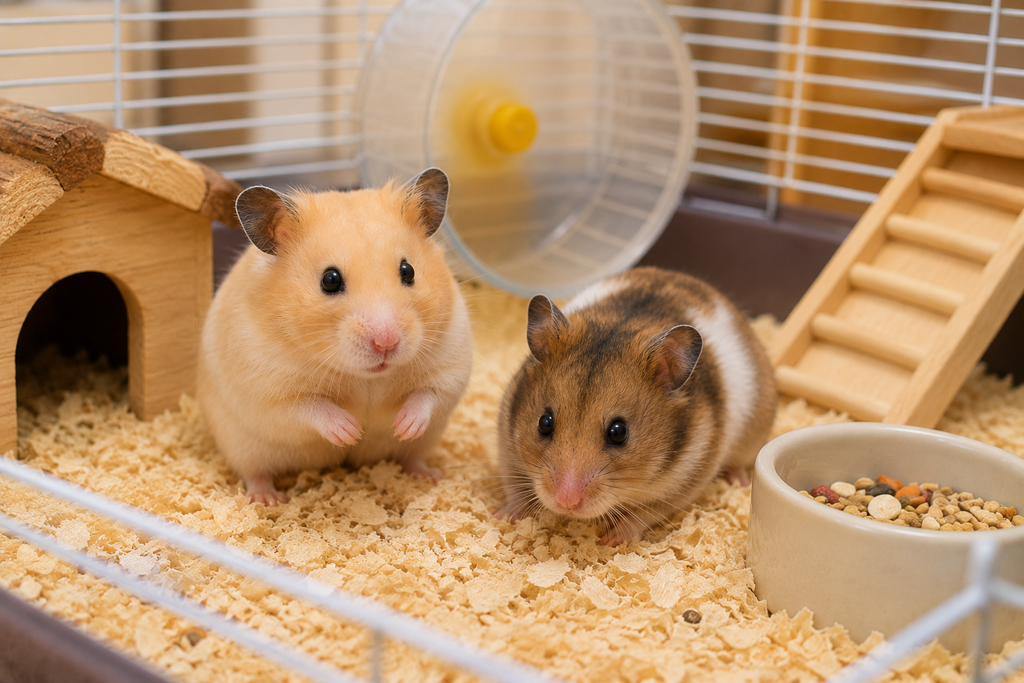
For most pet owners, the safest choice is one hamster per enclosure. Syrian and Chinese hamsters should live alone. Some dwarf species, including Roborovski, Campbell’s Russian dwarf, and Winter White hamsters, can sometimes live successfully in established same-sex pairs or small groups, but they do not need hamster companionship and groups can fall out later.
Because fights can cause serious injury, Hamster Corner recommends individual housing as the safest default, particularly if you are choosing a setup for a new hamster rather than managing an already stable dwarf pair.
Can two hamsters live together?
It depends on the species, but “they can” and “they should” are different questions.
The RSPCA says Syrian and Chinese hamsters are not naturally sociable and should always live alone.
For dwarf hamsters, the guidance is more nuanced. The RSPCA says Roborovski, Campbell’s Russian dwarf, and Winter White hamsters can sometimes live in pairs or trios if the group is formed early, remains stable, and has enough resources and space.
Blue Cross similarly notes that Roborovski hamsters are sometimes kept in same-sex sibling pairs.
However, neither organization says dwarf hamsters need another hamster to be happy.
That distinction is important.
Why do some sources say all hamsters should live alone?
Because the welfare guidance is not completely uniform.
Woodgreen Pets Charity recommends individual housing for all pet hamster species.
Woodgreen acknowledges that some dwarf species live socially in the wild but points out that captive conditions are very different. In a limited enclosure, dwarf hamsters that previously appeared compatible can begin fighting, and injuries can be severe or fatal.
The RSPCA takes a slightly more permissive position. It allows that compatible dwarf hamsters can sometimes be housed together under careful conditions but warns that pairs and groups may fall out later in life and must then be separated permanently.
So there is a genuine difference in recommendation:
- RSPCA: some established dwarf pairs or trios can sometimes work
- Woodgreen: individual housing is safer for all pet hamsters
Hamster Corner takes the conservative position: if you are deciding how to house a hamster from scratch, one hamster per enclosure removes the co-housing risk without depriving the hamster of something it needs.
Syrian hamsters should live alone
This is the clearest part of the guidance.
Syrian hamsters are solitary and territorial. The RSPCA, Woodgreen, Blue Cross, PetMD, and Merck all support housing adult Syrians separately.
The Merck Veterinary Manual says hamsters are normally housed singly outside breeding situations and notes that adults can become aggressive toward one another even when raised together.
Do not buy a second Syrian because you think the first one needs a friend.
It does not.
Chinese hamsters should live alone
Chinese hamsters should also be housed individually.
Both RSPCA and Woodgreen specifically distinguish Syrian and Chinese hamsters from dwarf species that can sometimes tolerate group housing.
They can become aggressive toward other hamsters and do not require another hamster for companionship.
What about Roborovski hamsters?
Roborovskis are where online advice often becomes contradictory.
They are more social in their natural ecology than Syrian hamsters, and some same-sex sibling pairs have been successfully kept together in captivity.
That does not make pairing risk-free.
Blue Cross warns that Roborovski pairs can fall out, particularly when space or enrichment is inadequate. If fighting occurs, the hamsters need to be permanently separated.
The RSPCA gives similar advice and explicitly says hamsters do not play-fight. Actual fighting should therefore be taken seriously.
If you already have a peaceful, established Roborovski pair, that is different from recommending that every owner intentionally buy two Roborovskis.
For a new setup, separate housing is still the lower-risk option.
Can Campbell’s or Winter White hamsters live together?
The RSPCA includes Campbell’s Russian dwarf and Winter White dwarf hamsters among species that can sometimes live in compatible pairs or small groups.
The conditions matter.
The RSPCA recommends that group-housed dwarf hamsters ideally be young littermates, that groups remain stable, and that new animals not simply be added later. Multiple shelters and enough access to important resources are also necessary.
Even with those precautions, fighting can still begin later.
This is why Woodgreen recommends avoiding the risk entirely and housing dwarf hamsters separately.
Both positions acknowledge the same basic fact: successful co-housing is possible in some dwarf hamsters, but it is not guaranteed.
Do not mix different hamster species
Do not house different hamster species together.
A Syrian and a dwarf hamster should not share an enclosure. Neither should different dwarf species be deliberately mixed.
The RSPCA specifically advises against mixing hamster species.
Differences in size, behavior, territoriality, and communication make this an unnecessary risk.
Can a male and female hamster live together?
Do not keep an intact male and female together as household companions.
Apart from aggression risk, mixed-sex housing creates an obvious breeding risk. Hamster breeding also carries welfare and genetic considerations and should not happen accidentally.
The Merck Veterinary Manual notes that even breeding introductions require careful observation because hamsters can become aggressive toward one another.
Companionship is not a reason to create a mixed-sex pair.
What if my two dwarf hamsters already live together?
Do not panic simply because you discover that another welfare organization recommends individual housing.
If you already have an established dwarf pair that is living together without aggression, reputable guidance differs on whether pre-emptive separation is necessary.
The RSPCA permits stable compatible dwarf groups under suitable conditions. Woodgreen considers individual housing safer because fights can develop later.
Whichever approach you take, you should have a second suitable enclosure available so the animals can be separated immediately if fighting begins.
Check them regularly, particularly because hamsters are most active at night and conflict may happen when you are not watching.
What signs mean they need to be separated?
Actual fighting should be taken seriously.
The RSPCA states that hamsters do not play-fight and recommends permanent separation after fighting occurs.
Especially concerning signs include:
- biting or clear physical attacks
- fight wounds
- repeated aggressive chasing
- one hamster being persistently driven away from resources or shelters
- injuries discovered after the night
Do not repeatedly separate fighting hamsters and then put them back together to see whether they “make up.”
The RSPCA advises against reintroducing hamsters after they have been separated because of fighting.
If either hamster has a wound, contact a veterinarian. The Merck Veterinary Manual notes that bite wounds from cage mates can become infected and develop into abscesses.
For other illness and injury signs, see signs of a sick hamster.
Why are hamsters kept together in pet stores?
Do not assume a pet-store enclosure demonstrates that co-housing will work permanently.
Young hamsters may be housed together before sale, and retail housing is temporary. That does not establish that the same animals should share one enclosure throughout adulthood.
I would also avoid the common claim that stores pair hamsters simply to make more money. Without evidence about an individual retailer’s practices or motives, that is speculation rather than useful hamster-care advice.
Judge the long-term housing decision by welfare guidance, not by how the animals happened to be displayed in a store.
Do hamsters get lonely when kept alone?
There is no need to buy another hamster because you are worried that a solitary hamster needs a cage mate.
The RSPCA specifically says even dwarf hamsters that can sometimes live in pairs or groups do not need the company of other hamsters to be happy.
Blue Cross says the same about Roborovski hamsters.
Instead, focus on giving your hamster opportunities to perform normal behaviors such as:
- burrowing
- digging
- nesting
- foraging
- running
- chewing
- hiding
- exploring
See our hamster enrichment ideas for ways to make a single-hamster enclosure more interesting.
Gentle interaction can also help your hamster become comfortable with you. See how to bond with your hamster for a gradual approach.
Can two hamsters live in separate cages in the same room?
Separate enclosures are much safer than sharing one, but avoid placing unfamiliar hamsters directly beside each other without considering scent and stress.
Hamsters communicate heavily through scent. The RSPCA specifically cautions against housing unfamiliar hamsters immediately next to one another because their odors can be stressful. It also advises against positioning males close to females and males close to other males in ways that create pheromone-related frustration or territorial stress.
There is no evidence-based rule that cages need to be exactly “a few feet apart.”
Use enough separation that neither hamster can physically interact and watch for signs that proximity appears stressful.
What should you do after a hamster fight?
Separate the hamsters into secure individual enclosures.
Do not wait for another fight to confirm that there is a problem, and do not attempt routine reintroduction after serious conflict.
Check each hamster carefully for:
- bite wounds
- bleeding
- swelling
- limping
- eye or facial injuries
- reduced activity
- reduced appetite
PDSA notes that wounds in hamsters are commonly caused by fighting with cage mates and recommends separating fighting animals and contacting a vet when a wound is found.
For help finding appropriate care, see exotic vet for a hamster.
Frequently asked questions
Can two Syrian hamsters live together?
No. Adult Syrian hamsters should be housed separately. Multiple major veterinary and welfare sources agree on individual housing for Syrians.
Can two dwarf hamsters live together?
Sometimes, according to RSPCA and PetMD, particularly when compatible same-sex dwarf hamsters were raised together.
However, they do not need companions, fights can develop later, and Woodgreen recommends individual housing for all pet hamsters.
For most owners, separate enclosures are the simpler and safer choice.
My dwarf hamsters have lived together for months. Do I need to separate them?
Authoritative guidance differs.
Woodgreen recommends individual housing because apparently compatible dwarf hamsters can later fight. RSPCA allows stable dwarf pairs or groups to remain together under appropriate conditions.
If you keep an established pair together, monitor them closely and have a second suitable enclosure ready. Any fighting means permanent separation.
Can hamsters play-fight?
The RSPCA says hamsters do not play-fight. If two hamsters are genuinely fighting, take it seriously and separate them.
Does a hamster need a friend?
No. Hamsters do not need a hamster companion to have good welfare.
Focus instead on suitable housing, deep bedding, hiding places, foraging opportunities, an appropriate wheel, and other species-appropriate enrichment.
Bottom line
One hamster per enclosure is the safest default.
Syrian and Chinese hamsters should live alone. Some Roborovski, Campbell’s Russian dwarf, and Winter White hamsters can sometimes live successfully in carefully managed pairs or small groups, so it is inaccurate to say that every hamster species is naturally solitary.
But dwarf hamsters do not need cage mates, and compatible groups can later begin fighting. Because those fights can cause serious injuries, individual housing removes a risk without depriving the hamster of necessary social companionship.
If two hamsters fight, separate them permanently and have any injuries assessed by a hamster-experienced veterinarian.
Keep reading: Hamster enrichment ideas · How to bond with your hamster · Signs of a sick hamster