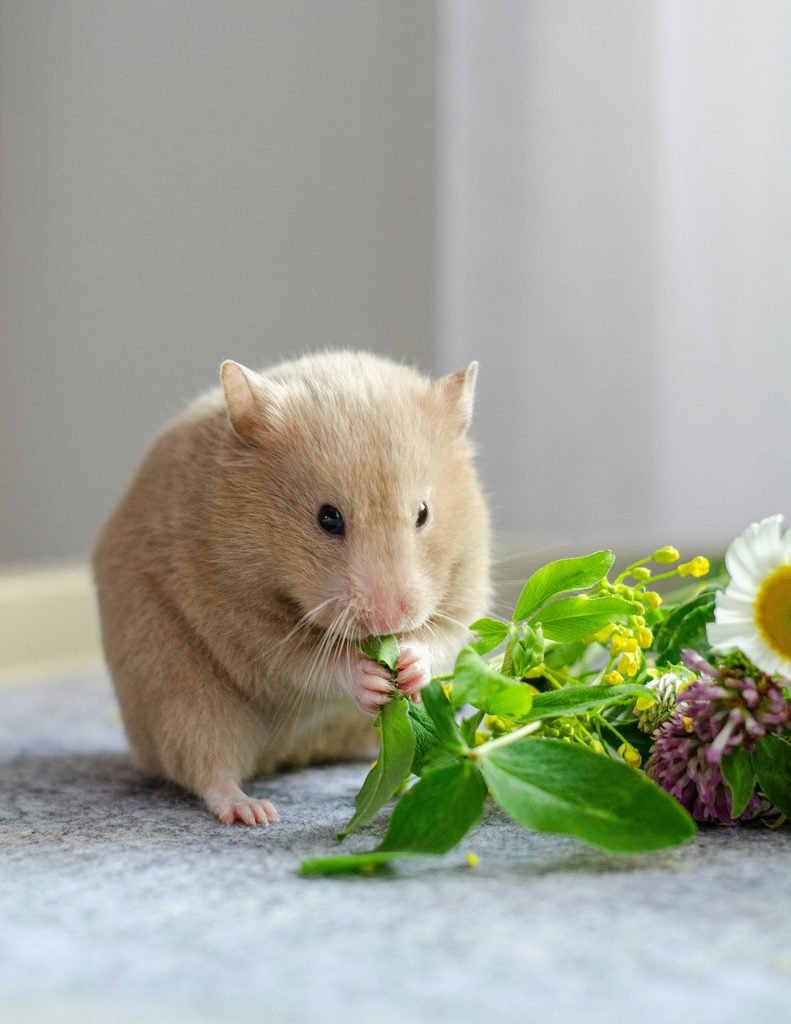
A useful starting point is around 10 g of dry food per day for a Syrian hamster and around 5 to 8 g for Chinese, Campbell’s, Winter White and Roborovski hamsters, according to Woodgreen. That works out to roughly one tablespoon for a Syrian and one teaspoon for the smaller species.
These are practical guidelines, not universal prescriptions. Different hamster foods vary in density and formulation, so check the feeding instructions on your hamster’s complete food as well. Fresh foods and treats should stay small, rather than being calculated as another fixed percentage of the daily diet.
How much dry food should a hamster eat per day?
Woodgreen gives one of the clearest practical feeding guidelines:
| Hamster | General daily dry food guidance |
|---|---|
| Syrian hamster | Around 10 g, roughly 1 tablespoon |
| Chinese hamster | Around 5 to 8 g, roughly 1 teaspoon |
| Campbell’s hamster | Around 5 to 8 g, roughly 1 teaspoon |
| Winter White hamster | Around 5 to 8 g, roughly 1 teaspoon |
| Roborovski hamster | Around 5 to 8 g, roughly 1 teaspoon |
These numbers are more defensible than trying to create a different gram allowance for every dwarf species without a source.
Blue Cross takes a slightly different approach and advises owners to read the feeding instructions on the hamster food itself. That matters because a tablespoon of one food may not contain the same calories or weight as a tablespoon of another.
So use the Woodgreen figures as a starting guide, then consider the food manufacturer’s instructions, your hamster’s weight trend and advice from your veterinarian if something does not look right.
For the bigger diet picture, see what hamsters can eat.
Do not judge portions by an empty bowl
Hamsters are natural hoarders.
They carry food in their cheek pouches and store it elsewhere in the enclosure, so a feeding dish that empties quickly does not necessarily mean the hamster has eaten its entire daily allowance.
That also means you should not automatically add another full serving whenever the bowl becomes empty.
Scatter-feeding some or all of the daily dry food can make portioning easier while encouraging natural foraging behaviour. Both Woodgreen and Blue Cross recommend scatter-feeding as enrichment.
At the same time, do not repeatedly destroy the hamster’s dry food store simply to measure what remains. Blue Cross notes that maintaining a larder is normal hamster behaviour and that removing the whole store can be stressful.
Remove spoiled fresh foods when necessary, but leave clean, dry stored food alone where practical.
How much fresh food should a hamster have?
Fresh food does not need its own precise daily percentage.
Blue Cross recommends keeping individual portions of fresh food about the size of the hamster’s ear. Woodgreen uses a similar ear-sized guideline for treats and recommends offering them in moderation.
That is much more defensible than rules such as:
- one Syrian paw
- half a dwarf paw
- one thumbnail
- one pinky fingernail
- exactly two cucumber slices
- a 2 cm strip of pepper
Those measurements look precise but are not supported by the hamster-care guidance I found.
Small pieces of suitable vegetables can provide variety alongside the complete dry food. You can find individual options in safe vegetables for hamsters.
Fresh foods also spoil more quickly than dry food. Because hamsters hoard, check for uneaten fresh pieces and remove them before they decompose.
Does a hamster need extra protein every week?
A hamster needs protein, but that does not automatically mean it needs a separate protein treat several times every week.
Woodgreen recommends choosing a complete dry hamster mix that already contains a protein source, such as dried mealworms.
Additional protein foods can be occasional extras. Woodgreen lists small amounts of boiled egg and fresh mealworms, with one or two mealworms at a time as practical guidance when mealworms are not already included in the dry food.
There is no need to create a schedule such as “protein every Monday, Wednesday and Friday.”
More importantly, I would not warn that an extra mealworm will lead to fatty liver disease unless there is hamster-specific evidence supporting that claim.
Start with a nutritionally complete staple. Treats come second.
How much fruit can a hamster have?
Fruit is optional rather than a required part of the diet.
Blue Cross specifically says Syrian hamsters can have small pieces of fruit as an occasional treat. Woodgreen lists fruits including apple without the seeds, pear, strawberry, blueberry and banana, while recommending small treat portions.
There is no reason to turn this into a universal rule of “one blueberry twice a week” or “one piece of fruit every seven days.”
The same caution applies to dwarf hamsters. Campbell’s hamsters and some hybrid lines deserve additional metabolic consideration, but Roborovski, Winter White and Campbell’s hamsters should not automatically be treated as having an identical diabetes risk.
If your hamster has diagnosed diabetes or another medical condition, feeding advice should come from a hamster-experienced veterinarian rather than a generic fruit schedule.
For routine feeding, fruit can simply remain an occasional extra rather than something you need to fit into every week.
How do you know if you are feeding too much?
Do not rely on internet checklists such as “fat rolls around the shoulders” or “your hamster waddles.”
A more useful measure is the weight trend.
Woodgreen recommends weighing hamsters on small scales, including kitchen scales, and watching for unexpected or consistent weight gain or loss. Blue Cross also warns that hamsters can become obese and recommends speaking to a veterinarian if you are concerned about weight.
You do not need to compare your hamster with one universal ideal number either.
For example, Merck Veterinary Manual gives an adult Syrian range of approximately 110 to 140 g, but individual body size still varies. A hamster’s own trend can therefore be more informative than trying to force every Syrian toward one target weight.
If weight keeps rising despite an appropriate measured diet, review the staple food, treats and exercise setup rather than simply cutting food drastically.
What if your hamster is losing weight?
Unexpected or consistent weight loss deserves attention too.
Do not automatically solve weight loss by pouring more food into the enclosure. Reduced eating or weight loss can have causes that need veterinary attention, including dental or other health problems.
PetMD lists weight loss, anorexia, drooling and overgrown teeth among reasons to contact a veterinarian for a hamster. Woodgreen similarly recommends monitoring weight and normal appetite as part of regular health checks.
The RSPCA advises contacting a veterinarian immediately if a hamster starts eating less, develops moist droppings or has soiled hindquarters.
That is more useful than trying to diagnose “underfeeding” from body appearance alone.
Should you measure hamster food with teaspoons or grams?
If possible, grams are more consistent.
Woodgreen gives both measurements, but teaspoons and tablespoons are approximate volume conversions. Different pellets and seed mixes can pack into a spoon differently.
For routine feeding, you can weigh the recommended daily amount on a small kitchen scale once, then learn what that quantity looks like with your particular food.
Also check the manufacturer’s instructions. Blue Cross specifically recommends following the feeding guidance on the food packet.
There is no universal rule that one teaspoon of every hamster food weighs 3 to 5 g.
Should you feed less if your hamster has a large stash?
Not automatically.
Hoarding is normal hamster behaviour, and a sizable store does not by itself prove that the hamster is being seriously overfed.
Instead, look at several things together:
- how much dry food you are providing
- whether fresh food is accumulating and spoiling
- whether the hamster’s weight is consistently changing
- whether the hamster appears to be selectively eating only part of a mixed diet
- whether the feeding amount matches the food manufacturer’s guidance
A dry food stash is part of normal hamster behaviour. Spoiled fresh food is what needs more immediate removal.
Do senior hamsters need smaller portions?
Not automatically.
Age alone is not a good reason to apply a fixed percentage reduction to a hamster’s food.
Some older hamsters may become less active, while others lose weight or develop dental problems that change how well they can eat. Those situations require different responses.
Monitor weight, appetite and normal behaviour. If an older hamster is losing weight, struggling to eat, dropping food or showing another significant change, speak with a hamster-experienced veterinarian rather than simply increasing protein or decreasing calories based on age.
A simple feeding framework
You do not need a complicated meal plan.
For most hamsters:
- Start with a complete dry hamster food.
- Use roughly 10 g per day for a Syrian or 5 to 8 g for the smaller commonly kept species as Woodgreen’s general starting guidance.
- Cross-check the serving instructions on the food package.
- Keep individual fresh foods and treats small, around ear-sized when using the Woodgreen and Blue Cross practical guidance.
- Remember that protein should already be present in a complete staple food.
- Scatter-feed where practical to encourage foraging.
- Allow normal dry-food hoarding while removing fresh food before it spoils.
- Monitor your hamster’s weight and appetite rather than constantly adjusting food based on an empty bowl.
The bottom line
A Syrian hamster generally needs around 10 g of complete dry food per day, while Chinese, Campbell’s, Winter White and Roborovski hamsters generally need around 5 to 8 g, according to Woodgreen. The food package should also be checked because products differ.
Fresh food and treats do not need complicated percentage formulas. Keep them small, with an ear-sized portion providing a useful practical reference from both Woodgreen and Blue Cross.
Most importantly, account for hoarding. An empty bowl does not necessarily mean an empty stomach, and a full food store does not automatically mean something is wrong. Feed a measured complete diet, preserve normal hoarding behaviour and monitor weight and appetite over time.
Keep reading: What can hamsters eat? | Safe vegetables for hamsters | Foods toxic to hamsters
Hamster Corner provides general educational information about hamster care. It is not a substitute for professional veterinary advice. If your hamster develops unexpected weight loss, reduced appetite, abnormal droppings or another meaningful health change, contact a hamster-experienced veterinarian.