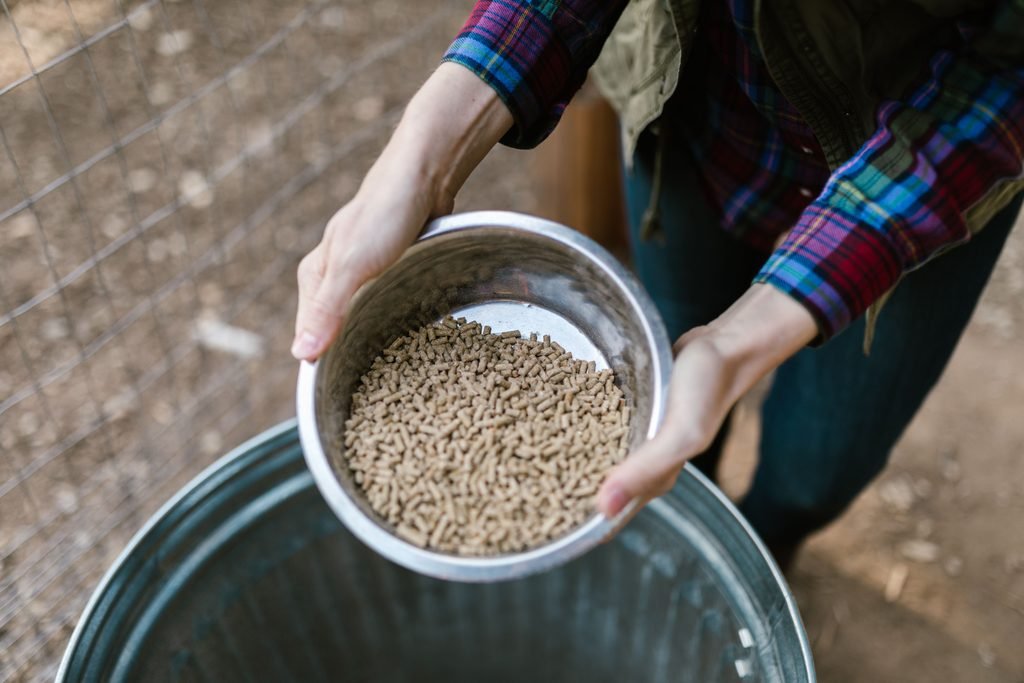
Neither pellets nor seed mixes automatically win for every hamster. PDSA and PetMD favor nutritionally complete pellets because uniform pieces reduce selective feeding, but RSPCA says either a formulated pellet ration or a properly balanced seed mixture can meet a hamster’s needs. Woodgreen goes further and recommends more seed-based mixes for Chinese, dwarf and Roborovski hamsters. The better question is whether the food is complete, appropriate for your hamster and actually eaten as intended.
That makes this less of a simple “pellets good, seeds bad” debate than many hamster guides suggest.
Why pellets have a real advantage
The strongest argument for pellets is nutritional consistency.
PDSA recommends commercial hamster pellets because each piece contains the same nutrients. A hamster cannot pick out its favorite ingredients and leave the rest in the way it might with a mixed food.
PetMD takes a similar position. Its veterinarian-reviewed feeding guide recommends commercial pellets as the central part of a hamster’s diet and warns that a mainly seed-based diet can contribute to obesity or malnutrition.
That selective-feeding concern is legitimate.
What I would not say is that pellets make nutritional imbalance impossible or that a hamster eating pellets “will not develop deficiencies.” The food still needs to be properly formulated, appropriate for hamsters and fed according to its directions.
So pellets have a meaningful practical advantage, but they are not magic.
Why a good seed mix is not automatically inferior
This is where reputable sources disagree.
The RSPCA says hamsters can obtain a balanced diet from either:
- a compound pellet ration, or
- a mixture of different seeds formulated to meet their needs.
That is quite different from saying seed mixes should only ever be occasional treats.
Woodgreen is even more specific. Its current guidance recommends different dry-food profiles by hamster type. For Chinese, dwarf and Roborovski hamsters, it favors a more seed-based mix with plenty of smaller seeds, some protein and fewer grains and cereals.
For Syrians, Woodgreen recommends a mix containing protein alongside vegetables, fruit, grains and cereals.
So a properly formulated species-appropriate mix should not be lumped together with every cheap colorful bag of sunflower seeds, corn and sugary pieces sold as hamster food.
What reputable sources actually recommend
| Source | Position on pellets and mixes | What that means |
|---|---|---|
| PDSA | Prefers pellets; warns against feeding muesli-style food exclusively | Selective feeding is a real concern |
| PetMD | Makes pellets the central diet and treats seeds as extras | Strongly pellet-oriented veterinary guidance |
| RSPCA | Accepts either formulated pellets or a formulated mixture of seeds | A good mix can still be a legitimate staple |
| Woodgreen | Recommends species-appropriate mixes and specifically favors more seed-based mixes for dwarf types | Food format may depend on the hamster |
The conflict itself is useful. There is no need to hide it and pretend every reputable organization recommends exactly the same feeding system.
What is selective feeding?
Selective feeding happens when a hamster eats preferred components of a mixed food while repeatedly leaving others.
PDSA’s concern is that with muesli-style foods, hamsters may select pieces that are higher in sugar while leaving higher-fiber components. Over time, the diet actually consumed may no longer resemble the balanced diet the manufacturer intended.
That is a legitimate reason to pay attention to what disappears from a mixed food.
However, the original rule that a seed mix is acceptable only if the hamster “finishes everything in the bowl” is too simplistic.
Hamsters naturally hoard food. An apparently empty bowl does not mean every ingredient has already been eaten, and leftovers may be stored elsewhere in the enclosure.
If you use a mixed diet, look at the pattern over time rather than judging one empty bowl. Are the same components repeatedly abandoned while favorite pieces disappear? Is a large quantity of uneaten food building up in the hoard? Those observations are more useful than expecting a hamster to clean its bowl like a person finishing dinner.
Pellets vs seed mix at a glance
| Factor | Complete pellets / lab blocks | Properly formulated seed-based mix |
|---|---|---|
| Nutrient distribution | Similar nutrition in each piece | Nutrition depends on eating an appropriate range of components |
| Selective-feeding opportunity | Lower | Higher |
| Supported by PDSA/PetMD | Strongly | More cautiously |
| Supported by RSPCA | Yes | Yes |
| Woodgreen recommendation for dwarf types | Not its preferred approach | Yes, species-appropriate seed-based mix |
| Automatically better? | No | No |
The key distinction is complete versus poorly formulated, not simply pellet versus seed.
Are pellets better for dwarf hamsters?
Not automatically.
The old version argued that pellets were safer because all dwarf hamsters are genetically prone to diabetes. That combines two unsupported conclusions.
PDSA does warn against overfeeding sugary foods and says Russian dwarf hamsters are particularly prone to diabetes. It does not say that Roborovski, Winter White, Campbell’s and every hybrid have exactly the same metabolic risk.
More importantly, diabetes risk does not establish that pellets are inherently superior to a properly formulated dwarf seed mix.
Woodgreen actually recommends more seed-based mixes for Chinese, dwarf and Roborovski hamsters.
So for a dwarf hamster, I would choose a complete food appropriate for that hamster, rather than assuming “pellet = safer for diabetes.”
For the wider feeding question, see our guide to what dwarf hamsters eat.
Are all seed mixes the same?
Definitely not.
A species-appropriate complete mix from a reputable manufacturer is very different from a bag dominated by a handful of highly palatable ingredients.
When comparing foods, look at what the manufacturer says the product is designed to provide, which hamster species and life stage it is intended for, and whether it is meant to function as a complete staple rather than a treat or supplementary mix.
Also look at what your hamster actually does with it.
If a large proportion of one component is consistently left uneaten, the theoretical nutritional profile on the package may not reflect what the hamster is consuming.
That is a more useful reason to reconsider the diet than simply seeing seeds in the bag.
What about muesli-style hamster food?
“Muesli” and “seed mix” should not automatically be treated as synonyms.
PDSA specifically warns against relying exclusively on muesli-style hamster food because of selective feeding.
RSPCA, meanwhile, accepts a mixture of different seeds formulated to meet the hamster’s needs.
Woodgreen recommends carefully selected species-specific mixes.
Those statements can coexist. A varied, properly formulated hamster mix is not necessarily equivalent to a low-quality muesli product containing a few attractive pieces surrounded by ingredients the hamster consistently ignores.
The formulation matters.
Should you switch from seeds to pellets?
Only if there is a reason to switch.
If your current food is not nutritionally complete, is inappropriate for the species, or your hamster is consistently selecting only certain components, changing the staple diet may make sense.
But there is no authoritative hamster-specific evidence supporting the rigid four-week schedule:
- week 1: 75% old food, 25% new
- week 2: 50/50
- week 3: 25/75
- week 4: 100% new
The RSPCA does provide the important principle: avoid sudden dietary changes, because they can upset a hamster’s stomach.
So transition gradually rather than changing the entire diet overnight. How quickly you do that may depend on the foods involved and whether your hamster is actually eating the new diet.
Do not try to force acceptance by coating pellets in peanut butter or another highly palatable human food. That adds another ingredient without solving the underlying question of whether the new staple is appropriate.
If your hamster begins eating significantly less during a diet change, contact a hamster-experienced veterinarian rather than waiting for it to become hungry enough to give in.
Can you feed pellets and seeds together?
Potentially, yes, but there is no evidence-based rule saying the mixture must be 70% pellets.
A combined diet can make sense when the products are being used in a way that still results in a nutritionally appropriate overall diet.
The problem comes when seeds and other extras displace so much of a complete food that the hamster no longer receives the diet as formulated.
If you intentionally combine products long term, check what each food is designed to provide rather than inventing a universal percentage.
Do you need a specific brand?
Not for the purpose of deciding between pellets and mixes.
Formulas change, availability differs by country, and a brand may sell several products with completely different nutritional profiles.
PetMD does recommend several commercial pelleted foods in its hamster care sheets, while Woodgreen publishes its own current list of species-specific mixes. Those recommendations can be useful when shopping, but they do not prove that every product from one brand is automatically superior.
For this decision, it is more useful to ask:
- Is the food intended for hamsters?
- Is it meant to be a complete staple rather than a treat?
- Is it appropriate for the hamster’s species and life stage?
- If it is a mixed food, is your hamster consistently leaving particular components?
- Is your hamster maintaining an appropriate body condition and normal eating behavior?
That is a better framework than choosing a package because it says “premium” or because someone online recommended the brand.
So which should you choose?
For many owners, a complete pellet or lab-block diet is the simplest option because it greatly reduces the opportunity for selective feeding. That is why PDSA and PetMD favor it.
But I would not turn that convenience into the claim that pellets are nutritionally superior in every situation.
RSPCA considers both formulated pellets and formulated seed mixtures valid options, while Woodgreen specifically recommends more seed-based diets for dwarf-type hamsters.
So the practical verdict is:
Choose a nutritionally complete, species-appropriate staple that your hamster actually eats appropriately. Pellets make selective feeding easier to control, but a well-formulated seed-based mix is not automatically an inferior diet.
For more feeding context, see what hamsters can eat and our safe vegetables for hamsters guide.
Hamster Corner provides general educational information about hamster care. It is not a substitute for professional veterinary advice. If your hamster stops eating normally, loses weight or develops another significant health change, contact a hamster-experienced veterinarian.