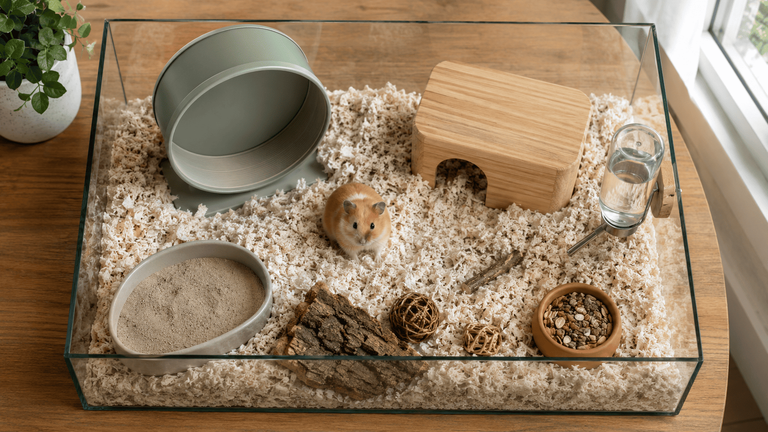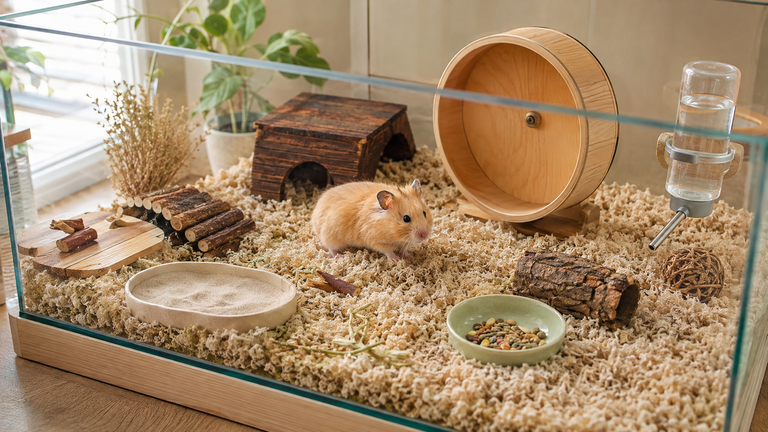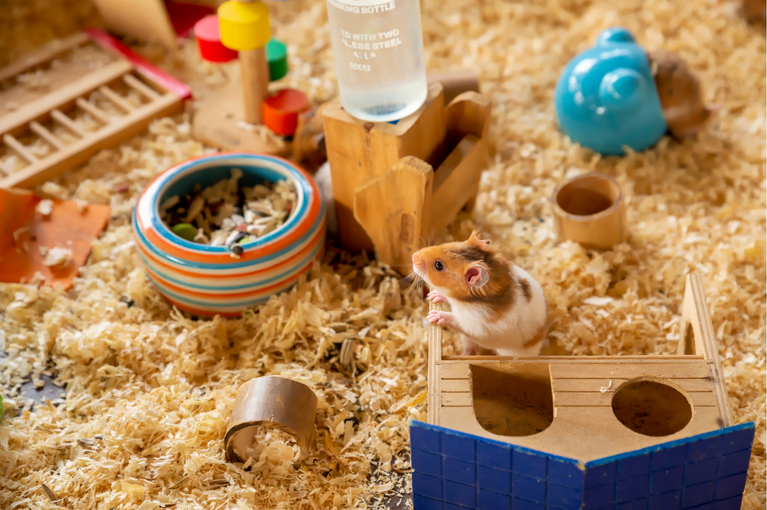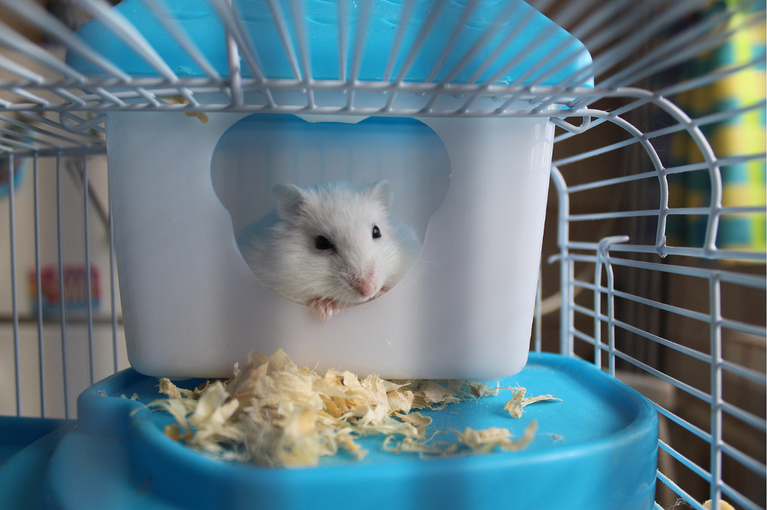
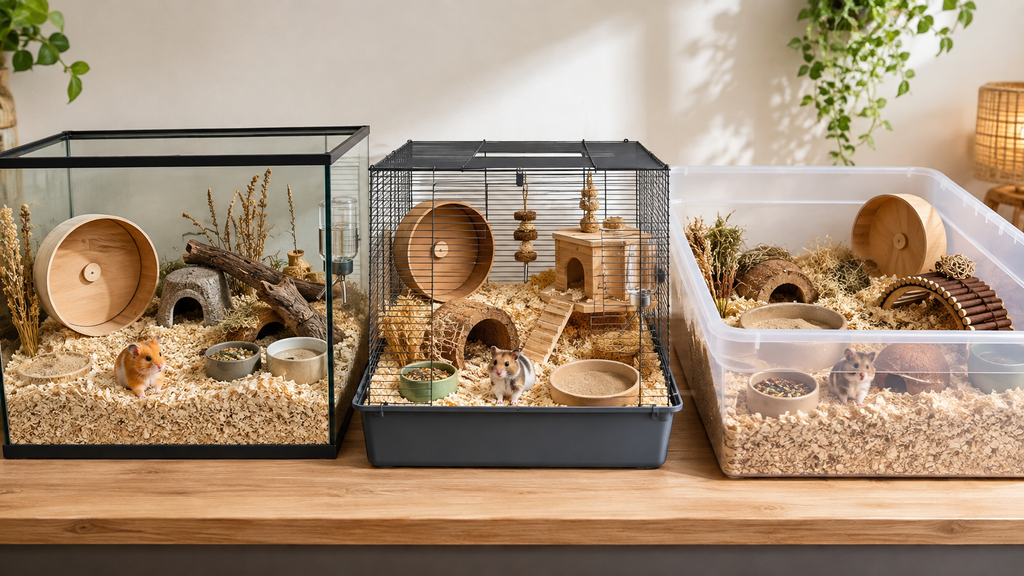
There is no single cage material that is automatically best for every hamster. A good enclosure needs enough continuous floor space, deep bedding, a solid floor, safe ventilation and secure construction. Glass tanks can work extremely well, and large barred cages can also be suitable. DIY bin cages can be a budget option, but only if their actual internal dimensions and ventilation are adequate.
Current guidance from Blue Cross and Woodgreen Pets Charity uses a minimum footprint of about 100 × 50 cm (39 × 20 in) for pet hamsters.
That immediately rules out many cages marketed for hamsters, including some surprisingly large-sounding tanks and storage bins.
What matters more than the cage type?
Before comparing glass, bars or plastic, check five things.
1. Floor space
Woodgreen recommends:
- Syrian and Chinese hamsters: at least 100 × 50 × 50 cm
- Dwarf and Roborovski hamsters: at least 100 × 50 cm, with at least 40 cm of height
Blue Cross similarly recommends housing no smaller than 100 × 50 cm of floor space.
This should be continuous usable floor space. Shelves, towers and attached pods do not compensate for a tiny main enclosure.
There is also an important distinction between a minimum recommendation and an optimum.
A study of female golden hamsters compared cages with floor areas of 1,800, 2,500, 5,000 and 10,000 cm². Hamsters in the smaller cages showed significantly more stereotypic wire-gnawing, and the researchers concluded that welfare appeared better in the 10,000 cm² cages than in smaller ones.
So 100 × 50 cm should not be treated as a magical size above which additional space no longer matters.
Woodgreen also specifically notes that female Syrian hamsters may need larger accommodation.
For a deeper discussion, see hamster cage size.
2. Enough depth for burrowing
Hamsters do not just need bedding to cover the floor. They need enough substrate to dig and construct burrows.
Woodgreen recommends at least 6 inches of bedding through most of the enclosure, with a deeper area of around 10 to 12 inches (25 to 30 cm).
Blue Cross currently recommends at least 20 cm of suitable digging bedding.
There is experimental evidence supporting the value of going deeper.
In a study of male golden hamsters housed with 10, 40 or 80 cm of bedding, animals in the 40 and 80 cm conditions constructed burrows. Wire-gnawing occurred more in the shallow 10 cm condition and was not observed in the 80 cm group.
The researchers concluded that bedding of at least 40 cm appeared to improve welfare in golden hamsters.
That does not mean every enclosure must contain 40 cm of bedding everywhere. It does show why 8 inches should not be treated as an ideal maximum. Give your hamster deeper areas where the enclosure design allows it.
3. A solid floor
The floor itself should be solid and covered with suitable substrate.
The RSPCA advises against wire mesh flooring because it can cause foot problems.
This is different from a cage having wire sides or a mesh lid. Those can provide useful ventilation.
4. Ventilation
An enclosure needs adequate airflow without being placed directly in a draught.
This is one area where respected welfare sources do not frame cage types exactly the same way.
Blue Cross describes tanks and aquariums as ideal, particularly because they allow deep bedding and reduce escape through bars.
The RSPCA, however, says a cage with stainless steel bars or mesh sides is preferable to one with entirely solid sides.
Rather than pretending there is one universal verdict, the practical conclusion is:
Both tank-style and barred enclosures can work when ventilation, space, bedding and security are properly addressed.
A tank should have a large secure mesh top rather than an airtight lid.
5. Security
Hamsters are skilled escape artists.
Check:
- Doors and latches
- Lid fit
- Bar spacing
- Gaps around accessories
- Mesh attachment
- Areas that can be chewed open
Woodgreen currently recommends maximum bar spacing of about 1 cm for Syrian and Chinese hamsters and says 7 mm is the safest option for dwarf and Roborovski hamsters.
Glass tanks and aquariums
A properly sized glass tank is one of the easiest enclosure styles for creating a deep-bedding setup.
Advantages
- Deep bedding stays inside the enclosure.
- The solid floor works well with loose substrate.
- Visibility is excellent.
- Escape through side bars is impossible.
- Heavy glass makes the enclosure stable.
Blue Cross specifically describes tanks and aquariums as ideal hamster housing.
Downsides
- Large tanks are heavy.
- Suitable sizes can be expensive.
- Ventilation needs to come from a large mesh lid.
- Common aquarium sizes can sound much larger than their actual footprint.
That last point is important.
Is a 40-gallon breeder tank big enough?
Not according to a 100 × 50 cm minimum.
A typical 40-gallon breeder tank is about 36 × 18 inches, or roughly 91 × 46 cm at the outside.
That is smaller in both length and depth than 100 × 50 cm.
So the original recommendation:
A 40-gallon breeder meets the minimum.
contradicts the welfare standard used elsewhere in the article.
Do not shop for hamster tanks by gallon capacity alone.
Instead, measure or verify the internal usable length and width. Look for something that actually provides at least the target footprint.
The same problem applies to other aquarium sizes. A tank can have a large gallon rating because it is tall while still having an unsuitable footprint for a hamster.
DIY plastic bin cages
A storage-bin conversion can provide an affordable enclosure, but I would not call every large bin an excellent hamster cage.
The important number is not liters or gallons.
Storage bins often taper toward the bottom, so the internal floor can be substantially smaller than the dimensions listed at the rim.
The original article recommended a 105-liter or roughly 28-gallon bin. I could not find authoritative hamster welfare guidance establishing that capacity as adequate.
Instead, check:
- Internal floor dimensions at bedding level
- Overall height after deep bedding is added
- Lid security
- Size of the ventilation area
- Whether the hamster can reach exposed plastic edges and chew through them
A suitable DIY bin also needs substantial secure mesh ventilation rather than a few small drilled holes.
See the DIY bin cage guide for construction details.
Large barred cages
Barred cages are not inherently bad for hamsters.
A large cage can work if it meets the footprint requirement, has safe bar spacing and allows enough bedding depth.
In fact, the RSPCA currently prefers cages with stainless steel bars or mesh sides over fully solid-sided cages because of ventilation.
The problem is that many commercial hamster cages have very shallow plastic bases. That makes it difficult to provide enough substrate for burrowing.
Possible solutions in an otherwise suitable large barred enclosure include:
- A genuinely deep base
- Bedding guards around part of the cage
- Concentrating especially deep substrate in a well-supported section
Do not assume that a shelf or second level makes up for inadequate floor space.
Do barred cages cause bar biting?
Not by themselves.
Bar chewing can occur in inadequate housing, but it would be an oversimplification to say:
Hamsters bite bars because barred cages are bad.
Research in golden hamsters has found that both cage size and bedding depth affect stereotypic wire-gnawing.
In the cage-size study, hamsters in smaller enclosures gnawed the wire significantly more often and for longer.
In the bedding-depth study, hamsters with only 10 cm of bedding showed more wire-gnawing than animals with deeper substrate.
So repeated bar chewing should prompt you to review the whole environment rather than simply blaming the presence of metal bars.
See why hamsters bite cage bars for more detail.
What about wooden vivariums?
I would not rank wooden vivariums as one of the default best choices.
The RSPCA currently advises that wooden hamster cages should not be used.
That conflicts with some hobbyist setups that use sealed wooden furniture conversions successfully, but it means there is not enough basis to present wooden vivariums as universally recommended welfare housing.
If you are choosing a new enclosure from scratch, a suitable tank or large purpose-built cage has clearer welfare guidance behind it.
Wooden hides and platforms inside an enclosure are a separate issue and are widely used in hamster husbandry.
Cage type comparison
| Cage type | Main advantage | Main limitation | Verdict |
|---|---|---|---|
| Properly sized glass tank | Excellent for deep bedding | Heavy and needs a large mesh lid | Strong option |
| Large barred cage with deep base | Excellent ventilation | Many models cannot hold enough bedding | Strong option if dimensions work |
| DIY plastic bin | Affordable and lightweight | Size and ventilation vary enormously | Can work if carefully built |
| Wooden vivarium | Can provide large floor area | RSPCA advises against wooden cages | Not my first choice |
| Small modular pet-shop cage | Compact and convenient for humans | Often fails space and bedding requirements | Skip |
| Wire-floor cage | Ventilated | Wire flooring can harm feet and prevents normal substrate use | Avoid |
Are plastic tube cages suitable?
A tunnel is not the same thing as floor space.
Plastic tubes can be used as enrichment when they are large enough for the hamster to move through comfortably, but a collection of small pods connected by tubes does not solve an undersized main enclosure.
If the central cage cannot provide appropriate floor space, deep bedding, a suitable wheel and other enrichment, adding more modules does not fix the underlying problem.
How much bedding should the cage hold?
As a practical baseline, choose an enclosure that can accommodate at least 20 cm of bedding over a substantial area, with an even deeper burrowing zone where possible.
Woodgreen’s current guidance is slightly different: at least 6 inches throughout most of the enclosure plus a 10 to 12-inch digging area.
Both recommendations point in the same direction.
Choose the enclosure around the bedding your hamster needs, rather than reducing the bedding to fit the enclosure you bought.
For substrate choices, see best hamster bedding types.
What hamster cage would I choose?
For most owners, I would narrow the decision to two options:
A properly sized tank
Choose this if you want easy deep bedding, clear visibility and no exposed side bars.
A properly sized barred enclosure with a deep base
Choose this if you want stronger passive ventilation and can still provide substantial bedding.
A well-built bin cage can also work when budget is the main constraint, but measure it carefully first.
What I would not do is buy a cage because it says “hamster” on the packaging or because its gallon or liter number sounds impressive.
Measure the usable floor.
Then ask whether the enclosure can hold the bedding, wheel, hides, sand bath and other enrichment your hamster needs without everything being crammed together.
Frequently asked questions
What is the best cage type for a beginner?
A properly sized glass tank is straightforward because it naturally contains deep bedding and is easy to inspect. A large barred cage with a deep base can be equally suitable. Dimensions and setup matter more than whether the walls are glass or bars.
Is a 40-gallon breeder tank enough for a hamster?
Not if you are following the current 100 × 50 cm minimum used by Blue Cross and Woodgreen. A typical 40-gallon breeder is around 91 × 46 cm externally, so it falls short. Measure tanks by floor dimensions rather than gallon capacity.
Are barred cages bad for hamsters?
No. Barred sides can provide excellent ventilation. The problem with many commercial barred cages is inadequate floor space or a shallow base that prevents deep bedding.
Can a hamster live in a fish tank?
Yes, provided the tank is large enough and has a secure, well-ventilated mesh top. Blue Cross specifically recommends tanks and aquariums as suitable hamster housing.
Is bigger than 100 × 50 cm better?
It can be. The 100 × 50 cm figure is a practical welfare baseline, not proof that 5,000 cm² is the optimum enclosure size. Research on golden hamsters found better welfare indicators in a 10,000 cm² cage than in smaller cages.
The bottom line
The best hamster cage is not defined by whether it is made of glass, plastic or wire.
Start with sufficient continuous floor space. Current Blue Cross and Woodgreen guidance uses at least 100 × 50 cm. Then make sure the enclosure can accommodate deep bedding, a solid floor, good ventilation, secure construction and the rest of the hamster’s enrichment.
Glass tanks are an excellent option when their actual dimensions are large enough. Large barred cages can be excellent too. DIY bins can work, but their usable dimensions and ventilation need to be checked rather than assumed from their capacity.
Most importantly, do not use a 40-gallon label, the word “hamster” on a product box or a cage-type ranking as a shortcut for measuring the enclosure.
For the complete interior setup, see hamster cage setup.
Keep reading: Hamster cage size | Hamster cage setup | DIY bin cage | Best hamster bedding types