
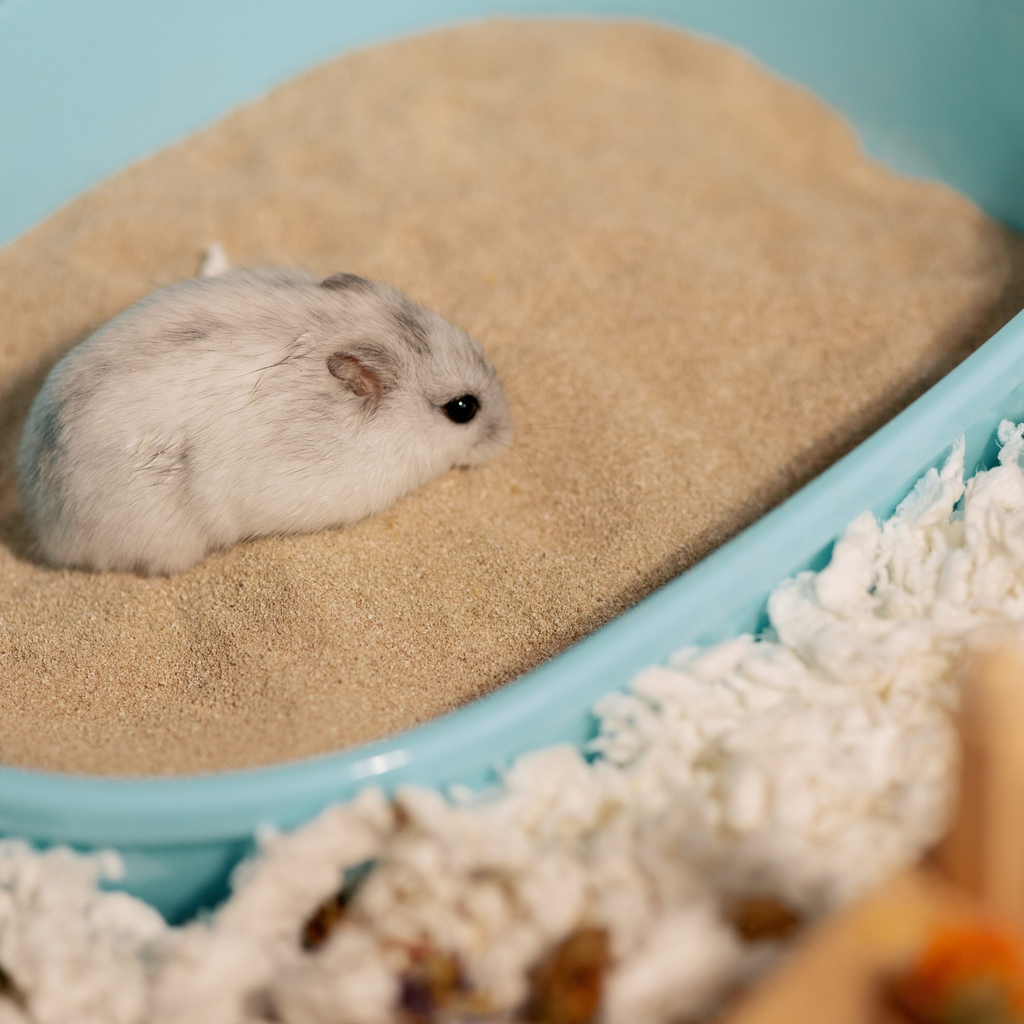
A sand bath gives a hamster a place to groom, dig and explore, and it is a useful part of a well-designed enclosure. Use a clean bathing sand that is suitable for hamsters and avoid very fine dust. The bath should be large enough for your hamster to move around comfortably and cleaned whenever it becomes wet or dirty.
There is no single evidence-based rule saying every hamster should receive exactly 10 to 20 minutes of sand three to five times a week. Reputable care sources give different access recommendations, so the best setup depends partly on the hamster, species and sand being used.
What does a sand bath do for a hamster?
Hamsters already spend a lot of time grooming themselves.
A sand bath gives them another way to maintain their coat while also providing a different substrate for digging and exploration.
PetMD says sand bathing can help reduce accumulated oil and dirt in the coat. Blue Cross similarly recommends sand for coat care while highlighting its enrichment value.
That makes a sand bath useful for two reasons:
- grooming
- natural digging and exploratory behavior
It is not necessary to claim that sand is the hamster’s only cleaning mechanism or that every healthy coat depends entirely on rolling in sand.
Long-haired Syrian hamsters, for example, may also need gentle brushing when bedding and debris become tangled in their coat.
Do hamsters need sand baths?
A sand area is a worthwhile addition for pet hamsters, although care organizations describe its importance slightly differently.
RSPCA says hamsters generally manage their own grooming and can have occasional access to a sand bath.
Woodgreen includes a hamster-safe sand bath among the normal enrichment items in a hamster enclosure.
Blue Cross also recommends including one and makes an important species-specific point: a large area of sand is particularly important for Roborovski hamsters, which naturally come from sandy environments.
So I would provide suitable sand for pet hamsters generally and place particular emphasis on generous sand access for Roborovskis.
What sand should you use?
Use a clean bathing sand that is explicitly suitable for hamsters or an appropriate small-animal bathing sand.
PetMD recommends chinchilla sand rather than very fine chinchilla dust because finer material can increase eye and respiratory irritation.
The important distinction is not simply what animal is pictured on the bag. The actual substrate should be:
- suitable for hamsters
- clean
- unscented
- not excessively dusty
- free from unnecessary additives
If disturbing the product produces a large persistent cloud of fine powder, choose another sand.
For a detailed comparison of chinchilla sand, play sand, reptile products and other options, keep that discussion in your dedicated sand-selection guide rather than turning every sand-bath article into the same substrate list.
Can you use children’s play sand?
I would not make either extreme claim.
It is too broad to say every children’s play sand is automatically unsafe, but it is also too confident to say any bag becomes hamster-safe after being rinsed and baked for a fixed amount of time.
Products vary in:
- dust level
- grain size
- composition
- additives
- contamination
I could not find strong hamster-care guidance establishing a universal home preparation recipe.
For someone who wants the lowest-uncertainty option, commercially prepared hamster-safe bathing sand is simpler.
How to set up a hamster sand bath
The setup itself can stay simple.
1. Choose a stable container
Woodgreen recommends options such as a shallow tray or glass dish.
Ceramic and glass containers are useful because they are stable and easy to clean.
The container should allow your hamster to enter and leave without difficulty and provide enough room to use the sand normally.
2. Add enough sand for normal behavior
There is no universal evidence-based requirement of exactly one inch or two inches.
Provide enough substrate for your hamster to dig, move and groom without immediately reaching the bare bottom of the container.
Roborovski hamsters particularly benefit from a more generous sand area rather than a tiny grooming dish.
3. Put it somewhere stable
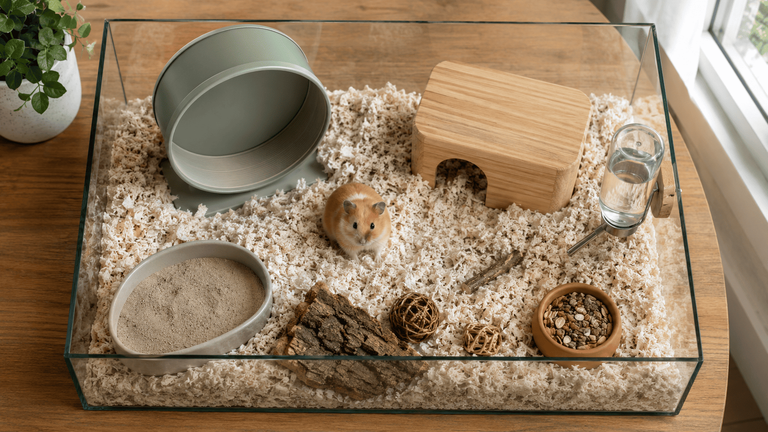
Heavy sand containers should sit securely so they cannot collapse a burrow underneath them.
A sturdy platform can be useful when the enclosure contains deep bedding.
Woodgreen specifically recommends stable platforms for heavy objects such as sand baths, wheels and ceramic hides.
4. Let your hamster decide how to use it
A hamster may:
- roll in the sand
- dig
- sit and groom
- move sand around
- use it as a toilet
All of these can occur.
You do not need to place the hamster into the bath or teach them how to roll.
Should the sand bath stay in the cage?
This is one area where reputable sources disagree.
Woodgreen treats the sand bath as part of the normal enclosure and gives instructions for daily spot-cleaning when a hamster urinates in it.
Blue Cross likewise describes a sand bath as something to include inside the hamster’s cage.
PetMD has historically recommended shorter supervised sessions, with one hamster bathing guide suggesting removal after roughly 15 to 20 minutes to reduce prolonged eye or respiratory exposure.
More recent PetMD care sheets for Syrian and dwarf hamsters are less restrictive and say the bath should not remain in the habitat for more than 12 hours at a time.
That gives us multiple different recommendations from reputable sources, not one proven universal schedule.
For clean, low-dust hamster-safe sand, Woodgreen and Blue Cross provide reasonable support for an enclosure sand area.
I would especially avoid severely restricting sand access for Roborovski hamsters given Blue Cross’s recommendation for a large sand area.
If your individual hamster develops persistent sneezing, eye irritation or another problem associated with the sand, reassess both the product and access with a hamster-experienced veterinarian.
How often should a hamster use a sand bath?
There is no need to force sessions on a calendar.
Hamsters with access to a sand area can decide when to use it.
If you follow a temporary-access approach instead, PetMD suggests sand can be offered several times a week depending on the hamster’s interest and needs.
That should not be turned into a rule such as:
“exactly three to five baths every week.”
Different species and individual hamsters use sand differently.
How do you clean a hamster sand bath?
Clean according to actual soiling.
Woodgreen recommends checking the sand during normal daily spot-cleaning. If your hamster urinates in the bath:
- Remove the wet area.
- Replace dirty sand.
- Keep the remaining clean sand if it is still in good condition.
During a larger enclosure refresh, replace the sand when needed, particularly if the hamster regularly uses it as a toilet.
There is no good reason to throw away the entire bath every seven days if it is still clean, nor to leave wet sand because the hamster likes its scent.
The useful rule is:
remove contamination promptly and replace sand when it can no longer be kept clean through spot-cleaning.
What if my hamster uses the sand bath as a toilet?
That is not unusual.
Woodgreen specifically includes wet sand in its hamster spot-cleaning instructions.
If your hamster urinates in the bath, remove the wet material and replace it with clean sand.
You do not automatically need a second container.
Some hamsters may use separate areas for grooming and toileting if given the opportunity, while others happily use the same sand area for both.
Work with the individual hamster rather than trying to enforce a human idea of what the bath is “supposed” to be used for.
Does a sand bath replace cage cleaning?
No.
Cleaning the sand simply deals with one part of the enclosure.
You still need to:
- remove wet or spoiled bedding
- remove stale fresh food
- maintain clean water
- clean heavily soiled equipment
- refresh bedding without unnecessarily destroying clean burrows and familiar scents
A hamster that uses sand as a toilet may make spot-cleaning easier, but that does not eliminate normal enclosure maintenance.
See how to clean a hamster cage for the larger cleaning routine.
Can you wash a hamster with water?
Routine water bathing is generally unnecessary.
PetMD says hamsters normally keep themselves clean and do not need traditional soap-and-water bathing unless a veterinarian specifically directs it.
That is more accurate than saying water must never touch a hamster under any circumstances.
A full water bath can cause unnecessary stress and chilling, so it should not be routine grooming.
If a hamster is dirty because of diarrhea, urine staining, illness or another health problem, simply giving a bath may also miss the underlying issue.
For more detail, see do hamsters need a bath?.
Does a long-haired Syrian need more sand?
Not necessarily.
I could not find strong hamster-specific support for increasing sand-bath frequency simply because a Syrian has long fur.
What current care sources do support is brushing.
RSPCA says some long-haired hamster varieties may need weekly brushing to remove mats, bedding and debris. PetMD gives similar advice for long-haired Syrians.
Sand and brushing therefore solve somewhat different grooming problems.
My hamster ignores the sand bath. Is that a problem?
Not necessarily.
Some hamsters roll immediately. Others dig, sit in the substrate, toilet there or barely use it while you are watching.
Do not assume that absence of dramatic rolling means the bath is useless.
Check that:
- the container is accessible
- the sand is appropriate
- the bath is stable
- the hamster has enough room to use it
If those basics are right, let the hamster decide how to interact with it.
My hamster sneezes after using the sand
Take that seriously.
First, remove the suspected sand and see whether the exposure is associated with the symptoms.
Very fine dust and unsuitable substrates can irritate the respiratory tract or eyes.
Contact a hamster-experienced veterinarian if sneezing persists or is accompanied by:
- eye or nasal discharge
- noisy breathing
- labored breathing
- reduced appetite
- lethargy
- another significant change in health
Do not simply switch from one dusty product to another while assuming the hamster only needs to “get used to it.”
The bottom line
A sand bath is useful for hamster grooming and enrichment, but there is no universal rule that it must be offered for exactly 10 to 20 minutes several times a week.
Use clean hamster-safe bathing sand rather than very fine dust and provide a stable container large enough for your hamster to use naturally.
Woodgreen and Blue Cross support keeping a sand area as part of the enclosure, while PetMD gives more limited access recommendations. That disagreement should be acknowledged rather than hidden behind a precise schedule.
For Roborovski hamsters, a generous sand area is particularly important.
Clean wet or dirty sand as needed, and remember that routine soap-and-water bathing is generally unnecessary unless a veterinarian specifically advises it.
Keep reading: Do hamsters need a bath? | How to clean a hamster cage | Hamster cage setup
Hamster Corner provides general educational information about hamster care. If your hamster develops persistent sneezing, eye irritation, breathing difficulty or another significant health change, contact a hamster-experienced veterinarian.
[…] For specific products and sand types, see our best sand for a hamster sand bath guide and complete hamster sand bath guide. […]
[…] For more on choosing and using sand, see our hamster sand bath guide. […]
[…] reading: Hamster cage setup | Hamster bedding depth | Hamster sand bath | How to tame a […]
[…] For sand selection and setup, see hamster sand bath guide. […]