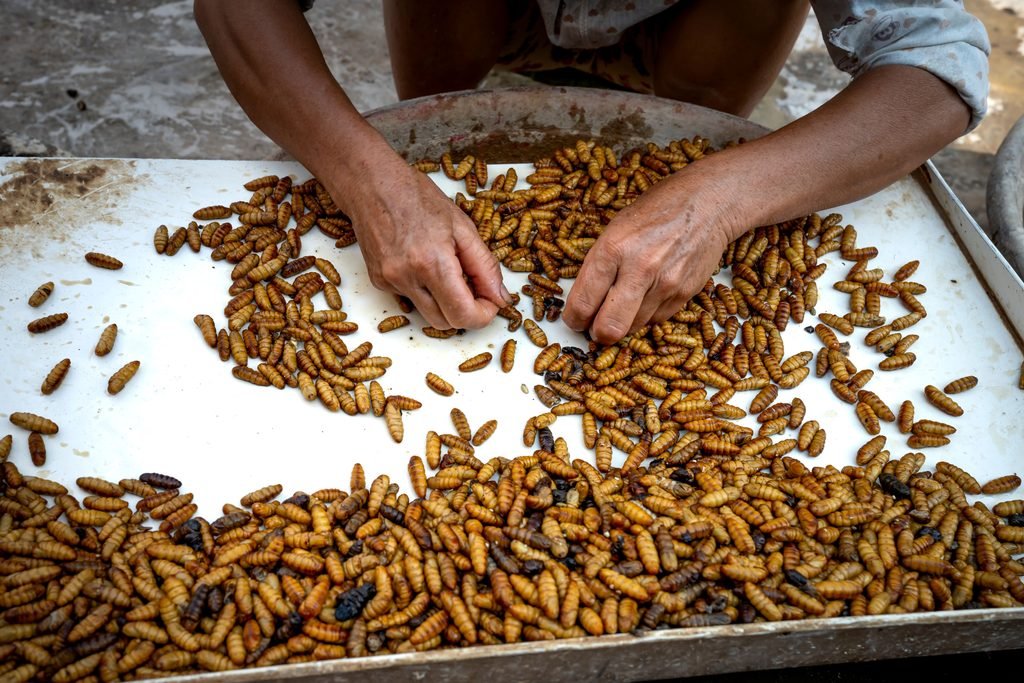
Hamsters can eat some insects, but they do not need a separate insect-feeding schedule if their main diet already provides enough protein. Mealworms have the clearest hamster-specific support. Woodgreen Pets Charity includes dried mealworms in suitable hamster mixes and allows one or two fresh mealworms at a time, while Blue Cross also lists mealworms among suitable fresh foods.
PetMD takes a more cautious position on live prey and recommends freeze-dried mealworms instead because live insects can injure a hamster or remain loose in the enclosure.
So the practical answer is simple: mealworms can be part of a hamster’s diet, but dried or freeze-dried mealworms are the easiest option for most owners.
Do hamsters naturally eat animal protein?
Yes.
Hamsters are omnivores rather than strict herbivores. Merck Veterinary Manual describes wild Syrian hamsters as eating green vegetation, seeds, fruit, and meat.
That does not mean a pet hamster needs you to recreate a wild hunting diet.
In captivity, Merck recommends a complete, balanced diet formulated for hamsters. PetMD makes the same point: commercial hamster food should already provide the protein a healthy hamster needs.
Woodgreen also says a quality dry mix should contain a protein source, often dried mealworms.
That means insects are best viewed as:
part of a balanced mix or an optional extra
rather than:
a protein supplement every hamster must receive.
For the wider diet, see what hamsters can eat.
Which insects can hamsters eat?
Mealworms have the clearest support from the hamster-care sources I checked.
| Insect | My recommendation | Why |
|---|---|---|
| Dried or freeze-dried mealworms | Yes | Direct hamster-specific support and easy to manage |
| Fresh mealworms | Possible, with caution | Woodgreen allows them, but PetMD advises against live prey |
| Crickets | Not my first choice | Much less authoritative hamster-specific guidance |
| Waxworms | Not necessary | Common reptile feeder, but limited hamster-specific guidance |
| Black soldier fly larvae | Not necessary | Nutritionally useful for some species, but little hamster-specific guidance |
| Wild-caught insects | Skip | Unnecessary and harder to control for contaminants |
| Unknown insects | Skip | Species and exposure history may be unclear |
This is more useful than turning every insect sold in the reptile aisle into hamster food.
Are mealworms good for hamsters?
Yes, mealworms can fit into a hamster diet.
Woodgreen specifically recommends dry mixes containing protein sources such as dried mealworms and lists fresh mealworms among occasional foods, with one or two at a time unless mealworms are already included in the hamster’s dry food.
Blue Cross also includes mealworms among suitable fresh foods for hamsters.
PetMD permits freeze-dried mealworms but makes an important distinction: they are optional, because a complete pellet diet should already supply the protein the hamster requires.
That is the balance I would use.
Mealworms are appropriate, but they are not mandatory.
How many mealworms can a hamster eat?
This is one of the few insect foods where we actually have a practical hamster-specific guideline.
Woodgreen suggests one or two fresh mealworms at a time, unless the hamster’s main food already contains mealworms.
That does not mean every hamster needs one or two mealworms twice a week.
Frequency should depend on the rest of the diet.
If your hamster’s complete dry mix already contains dried mealworms, there may be no reason to add a separate mealworm treat regularly.
If you do use them separately, count them as part of the hamster’s overall food and treats rather than an unlimited protein bonus.
Are dried mealworms or live mealworms better?
For most pet owners, I would choose dried or freeze-dried mealworms.
There is a genuine disagreement between reputable sources here.
Woodgreen allows fresh mealworms in small numbers.
PetMD says hamsters should not be given live prey because hamsters may store food rather than kill or eat it immediately, allowing the prey to injure the hamster or infest the enclosure.
That concern becomes particularly relevant with an animal that naturally hoards food.
Because freeze-dried mealworms avoid that problem and still have direct hamster-care support, they are the simpler option.
Should you let a hamster hunt live insects?
I would not recommend live-insect hunting as routine enrichment.
The original article described chasing crickets as a beneficial way to mimic natural behavior.
That idea is common in reptile care, where live-prey feeding is often specifically recommended.
Hamsters are different.
PetMD explicitly advises against live prey for hamsters because prey can injure the hamster or remain loose in the habitat.
There are plenty of safer ways to encourage natural foraging:
- scatter the hamster’s normal food through the bedding
- hide dried mealworms in a forage area
- place food inside a cardboard enrichment toy
- use seed sprays
- hide small portions of suitable food around the enclosure
Blue Cross specifically uses mealworms in a forage-tunnel enrichment activity for hamsters.
That gives the hamster something to search for without releasing a cricket into the cage.
Can hamsters eat crickets?
I would not make crickets a standard recommendation.
There are lower-level hamster-care resources that include crickets, and hamsters are physiologically capable of eating animal material.
But the strongest current sources I checked give much clearer support to mealworms, cooked chicken, and boiled egg.
PetMD’s warning against live prey also makes live crickets particularly awkward.
If you want an insect food, there is no reason to choose a faster-moving feeder insect with weaker hamster-specific guidance when dried mealworms are readily available.
Can hamsters eat waxworms?
I would skip them as a routine recommendation.
Waxworms are commonly sold as feeder insects for reptiles and other insect-eating pets, but reptile feeding guidance should not automatically become hamster guidance.
I could not find the same level of hamster-specific support for waxworms that exists for mealworms.
So I would remove:
“One waxworm once a week.”
That is another exact feeding schedule without a strong hamster-specific basis.
Your hamster does not lose anything by never eating waxworms.
What about black soldier fly larvae?
Same answer.
Black soldier fly larvae are widely used in animal nutrition and are particularly popular as feeder insects because of their nutritional composition.
But “nutritious insect” does not automatically mean “recommended hamster treat.”
For an ordinary pet hamster, mealworms already occupy this role with much clearer welfare guidance.
There is no need to build a five-insect rotation.
Can dwarf hamsters eat mealworms?
Yes.
Woodgreen specifically recommends hamster diets containing dried mealworms for Chinese, dwarf, and Roborovski hamsters as well as Syrians.
I would remove the original explanation that insects are ideal for dwarf hamsters because they contain no sugar.
That is unnecessary.
Protein requirements and food suitability are not determined solely by sugar content, and Roborovski, Winter White, Campbell’s, and hybrid hamsters should not automatically be treated as one identical diabetes-risk group.
The more useful question is whether the hamster’s complete food already contains an appropriate protein source.
If it does, additional mealworms are optional.
Do insects provide protein that seeds cannot?
This needs nuance.
Animal foods such as mealworms contain protein, but seeds, grains, pulses, and formulated feeds can contain protein too.
The original article implied that insects provide amino acids that a plant-based hamster diet cannot adequately supply.
That can mislead owners into thinking insects are nutritionally mandatory.
A properly formulated hamster food should already be designed to provide the nutrients and amino acids the animal needs.
Merck recommends a complete balanced diet, while PetMD says protein should come primarily from the formulated diet.
So do not add insects to “correct” a nutritionally complete food.
Are insects better than egg or chicken?
Not necessarily.
Woodgreen gives all three a place:
- dried mealworms as a protein source in hamster mixes
- small amounts of boiled egg
- small amounts of plain cooked chicken
There is no need to rank one as nutritionally superior.
Mealworms have an advantage for owners who want dry food that can be scattered or hidden for foraging.
Egg and chicken may be convenient if you already have some plain food prepared.
The important part is that none should displace the balanced main diet.
Should you buy insects from a pet store?
If you use mealworms, choose a product sold as animal feed or an appropriate food product from a reputable source.
I would not catch random insects outdoors and give them to a hamster.
An outdoor insect may have encountered:
- pesticides
- herbicides
- parasite hosts
- contaminated soil
- other chemicals you cannot identify
You also may not correctly identify the species.
There is no benefit that makes those unknowns worthwhile.
Dried mealworms sold for pets are cheap, easy to store, and much more predictable.
Are wild insects guaranteed to carry parasites?
No, and the article should not imply that.
A wild-caught insect may carry parasites, microbes, pesticide residues, or other contaminants. That is enough reason to avoid it.
We do not need to write that every garden insect is infected.
Good pet-care writing should distinguish between:
possible uncontrolled risk
and:
known universal danger.
Are fireflies poisonous to hamsters?
I would remove this section entirely.
Fireflies contain defensive chemicals called lucibufagins, and firefly poisoning is well documented in some animals, particularly certain reptiles.
But I could not find hamster-specific evidence establishing that a single firefly is lethal to a hamster.
That means the original line:
“Even a single firefly can be lethal to a small hamster.”
is stronger than the evidence supports.
This does not mean you should feed a hamster a firefly.
It means there is no reason to import a reptile toxicology warning into a hamster article when the simpler rule is already:
do not feed wild or unidentified insects.
Do insects need to be gut-loaded?
Not for an ordinary hamster mealworm treat.
Gut-loading is particularly important in reptile husbandry, where live feeder insects can make up a substantial part of the animal’s diet and are deliberately loaded with nutrients before feeding.
A hamster should already receive a complete diet.
If you are giving one or two mealworms occasionally, you do not need to turn reptile supplementation protocols into hamster care.
Do not dust mealworms with reptile calcium or vitamin powders unless a veterinarian specifically tells you to.
What about seasoned or flavored dried insects?
Skip them.
Use plain dried or freeze-dried mealworms without added:
- salt
- seasoning
- sugar
- oil
- flavor coatings
Products sold as human snack insects can contain spices and salt.
A feeder insect sold for pets is usually the easier option.
What if my hamster refuses mealworms?
Nothing is wrong.
Some hamsters love mealworms. Others show little interest.
PetMD specifically notes that some hamsters may not consume freeze-dried prey at all.
Do not keep increasing the amount or switch to live prey because you think the hamster must eat insects.
If the main diet is nutritionally complete, refusing mealworms does not create a protein deficiency.
You can use another appropriate treat or simply skip the insect category.
Can mealworms be used for enrichment?
Yes, especially dried mealworms.
This is one of the best reasons to use them.
Rather than dropping several mealworms into a food bowl, you can:
- scatter one or two through the bedding
- hide one in a cardboard forage toy
- place one beneath a small amount of hay or forage
- include one in a treat tunnel
Blue Cross specifically suggests mealworms as a food that can be hidden in a cardboard tunnel to encourage hamster foraging.
That adds behavioral value without requiring live prey.
What if a live mealworm escapes into the bedding?
This is one reason dried mealworms are easier.
If you use a live feeder and your hamster does not eat it immediately, remove it rather than leaving it loose in the enclosure.
PetMD’s concern is that live prey may remain in the habitat, potentially injure the hamster, or create an infestation.
Do not assume that because the insect disappeared it was eaten. Hamsters bury and move food constantly.
Does every hamster need extra protein treats?
No.
This is probably the most important correction to the original article.
Hamsters need protein, but that does not mean they need weekly protein treats on top of a nutritionally complete diet.
Woodgreen specifically notes that a quality dry mix should already contain a protein source such as dried mealworms.
PetMD goes further and says all required protein should come from the pellet diet, making freeze-dried mealworms optional.
So check the food you already use before adding more.
The bottom line
Hamsters can eat mealworms, but they do not need a separate insect-feeding schedule if their main diet already contains enough protein.
Mealworms have by far the clearest hamster-specific guidance. Woodgreen allows one or two fresh mealworms at a time and recommends dry mixes containing dried mealworms, while Blue Cross also lists mealworms as suitable hamster food.
For most owners, dried or freeze-dried mealworms are the easiest choice. PetMD advises against live prey because it can injure a hamster or remain loose in the enclosure.
I would not automatically extend mealworm guidance to crickets, waxworms, black soldier fly larvae, or every insect sold for reptiles. Hamsters do not need an insect buffet.
Use mealworms as an optional part of the diet or as dry foraging enrichment, and let the nutritionally complete hamster food do the heavy lifting.
Keep reading: What can hamsters eat? | Foods toxic to hamsters | Safe vegetables for hamsters
Hamster Corner provides general educational information about hamster care and nutrition. If your hamster eats an unknown insect or develops loss of appetite, diarrhea, lethargy, swelling, or another significant health change, contact a veterinarian experienced with hamsters.