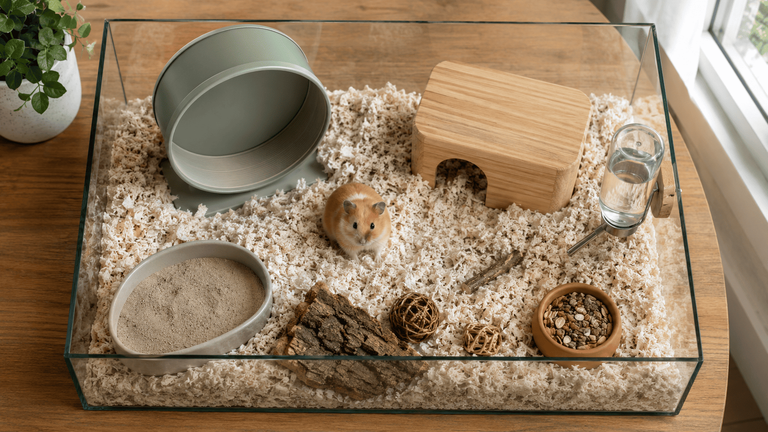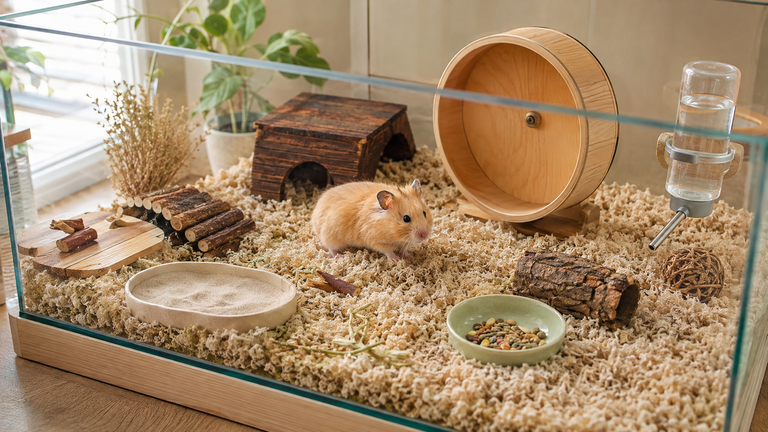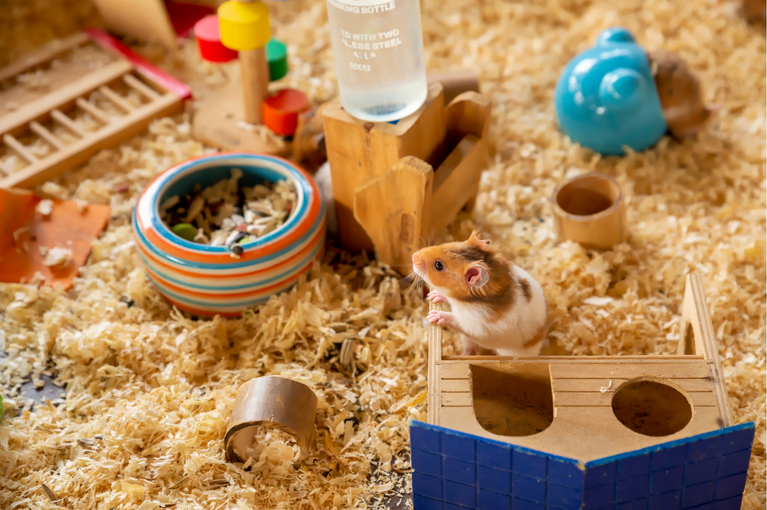
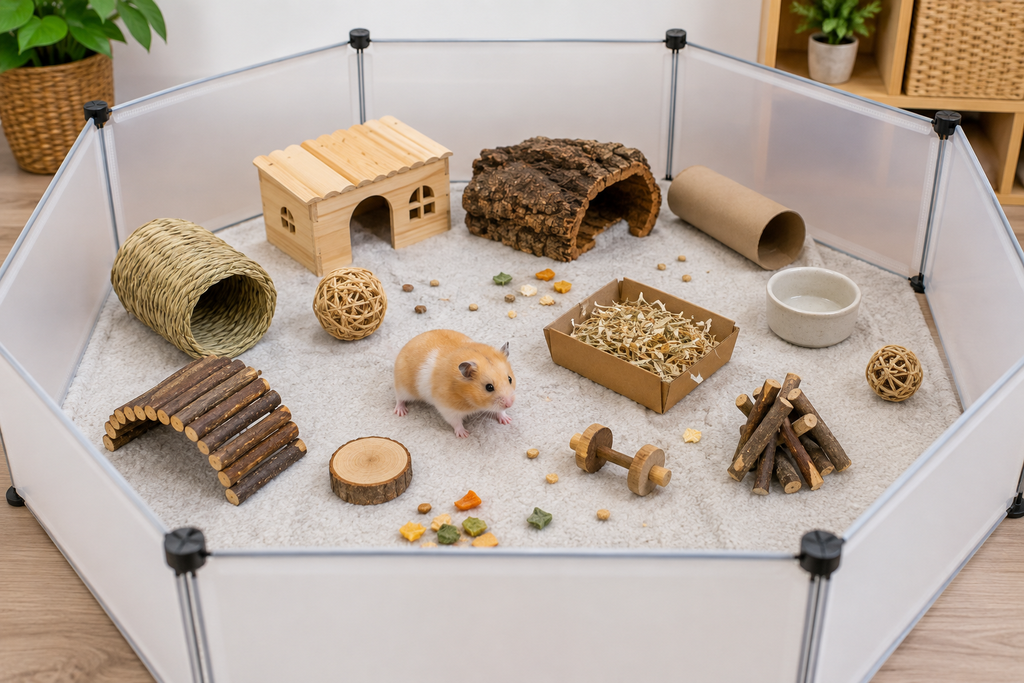
A hamster playpen is a secure, supervised area for exploring outside the main enclosure. Choose a pen your hamster cannot squeeze through, climb out of, or easily escape from, then add hides, tunnels, water, and other familiar enrichment.
There is no evidence-based rule that the walls must be exactly 12 inches tall or that every playpen session should last 20 to 30 minutes. Security, supervision, and your hamster’s behavior matter more than fixed measurements.
Does a hamster need a playpen?
A playpen can be useful, but it does not replace a properly set-up hamster enclosure.
Hamsters need enough permanent space to burrow, forage, run, hide, and explore throughout their active period. A short period outside the enclosure cannot compensate for inadequate everyday housing.
What a playpen can provide is additional supervised exploration and enrichment.
Woodgreen recommends free-roam time in a secure playpen or dry empty bath with plenty of toys and hiding places. Blue Cross also recommends a secure playpen as an alternative to exercise balls.
Woodgreen hamster care guidance
Blue Cross hamster care guidance
A playpen can also be useful during enclosure cleaning, as long as your hamster is awake and the temporary area is secure.
What makes a hamster playpen safe?
The most important requirement is simple: your hamster must not be able to escape.
Blue Cross recommends a playpen with tall, secure sides and stresses that hamsters should always be supervised while outside their normal enclosure.
There is no universal 12-inch wall rule in the welfare guidance I reviewed.
Hamsters vary considerably in size and climbing ability, and the design of the wall matters too. A smooth solid panel and a grippable mesh panel of the same height do not present the same escape risk.
A suitable playpen should have:
- sides high enough that your hamster cannot climb or jump out
- no gaps large enough to squeeze through
- a stable base
- no sharp edges or exposed fasteners
- no easy route from a hide, tunnel, or toy to the top of the wall
- enough ventilation
- continuous supervision
Solid-sided pens can be easier to secure, but solid walls are not mandatory. Blue Cross also allows suitable wire pens when the design prevents climbing and escape.
Do not trust a playpen just because it is sold for hamsters
“Small animal playpen” is a marketing category, not a safety guarantee.
Check the actual construction.
A very low folding pen may be easy to climb. Fabric may be vulnerable to chewing. Wide bars may allow a dwarf hamster to squeeze through. A tall wall can still fail if a tunnel or hide beside it acts as a step.
Before putting your hamster inside, inspect the entire perimeter from the hamster’s point of view.
And keep supervising after the first successful session. A hamster that ignored one corner yesterday may discover an escape route tonight.
What should you put in the playpen?
Do not make the playpen an empty arena.
Blue Cross recommends including hides, tunnels, food, water, and toys. Woodgreen similarly suggests filling free-roam areas with toys and hiding spaces.
Good options include:
- at least one secure hide
- tunnels or cardboard tubes
- safe chew materials
- cardboard boxes
- small amounts of the hamster’s normal food scattered for foraging
- a water source
- other safe enrichment your hamster already knows how to use
You do not need to fill every centimetre with toys. Leave room for your hamster to move between activities and explore.
For more ideas, see hamster enrichment ideas and DIY hamster toys.
Start smaller with a nervous hamster
Bigger is not automatically better on the first session.
Blue Cross notes that hamsters are cautious animals and recommends starting with a smaller playpen area if necessary so the experience does not become overwhelming. The usable area can then be increased as the hamster becomes more confident.
This is more useful than a universal “bigger is always better” rule.
A confident hamster may begin exploring quickly. A newly tamed or nervous hamster may initially prefer staying close to a hide.
Let the individual hamster determine how quickly you expand the experience.
When should a hamster use the playpen?
Only when it is already awake.
Blue Cross specifically advises never waking a hamster to put it in a playpen. The RSPCA likewise recommends respecting a hamster’s normal sleeping pattern and offering supervised exploration while the hamster is awake.
RSPCA hamster behaviour guidance
Wait until your hamster has emerged naturally and is active.
For most hamsters, that means evening or nighttime rather than the middle of the day.
How long should playpen time last?
There is no evidence-based 20-to-30-minute rule.
Neither Blue Cross, Woodgreen nor the RSPCA gives a universal playpen session length in the guidance reviewed for this article.
Instead, watch the hamster.
A comfortable hamster may explore, forage, investigate tunnels, and move between hides. If it becomes persistently agitated, repeatedly tries to escape, or appears uncomfortable with the situation, return it calmly to its enclosure.
Do not keep a hamster outside simply because a timer says the session is not finished.
Likewise, there is no need to end an otherwise calm session at exactly 30 minutes.
How often can a hamster use a playpen?
Regular supervised playpen access can be useful for a hamster that enjoys it.
Woodgreen suggests offering extra exploration space regularly, while Blue Cross describes a playpen as part of hamster enrichment.
But playpen time does not need to become a compulsory daily event.
A hamster that is asleep should be left alone, and a hamster that consistently finds relocation stressful should not be forced into a playpen simply to meet a schedule.
The permanent enclosure remains much more important.
What floor should you use?
Choose a surface that is safe, stable, and easy to monitor.
Woodgreen specifically suggests using a dry empty bath with towels across the bottom as one possible supervised free-roam area.
A purpose-built playpen can also be placed on a suitable indoor surface where you can easily see and retrieve the hamster.
I would not create a rigid rule that tile, laminate, fleece, carpet, or another particular surface is universally best. Different materials create different issues.
Instead, check that:
- the hamster has secure footing
- there are no loose threads or damaged materials
- there are no dangerous gaps
- the surface is clean
- the hamster cannot reach unsuitable objects around the pen
If you use fabric, inspect it for chewing and loose threads rather than assuming every towel or fleece liner is automatically harmless.
Hamster-proof the surrounding room too
A secure playpen should be the first line of protection, but the surrounding area should still be safe in case the hamster escapes.
The RSPCA emphasizes close supervision during out-of-enclosure exploration.
Keep the playpen away from:
- electrical cables
- inaccessible gaps behind furniture
- open doors
- stairs
- unsafe plants
- cleaning products
- other pets
Dogs and cats should not have access to the hamster’s exercise area.
A playpen is safer when one small failure does not immediately put the hamster in danger.
Can you use a storage bin as a playpen?
A large smooth-sided container may work as a supervised temporary exploration area if it is genuinely secure, well ventilated, and large enough for the activities you intend to provide.
But I would remove the claim that any large storage bin becomes an “instant escape-proof playpen.”
Containers vary considerably in height, ventilation, shape, plastic construction, and accessibility.
Woodgreen gives two clearer examples: a pop-up fabric or Correx playpen, or a dry empty bath prepared for supervised exploration.
Whatever you use, judge the setup itself rather than assuming the product category makes it safe.
Should you use a hamster exercise ball instead?
No. A secure playpen is the better option.
This is one area where current welfare guidance is unusually consistent.
The RSPCA does not recommend hamster balls because they can restrict the hamster’s ability to explore normally, remove access to resources such as water and hiding areas, create stress when the ball collides with objects, and potentially trap paws or legs in ventilation openings.
RSPCA hamster ball welfare guidance
Blue Cross says hamster exercise balls must not be used, pointing to exhaustion, inadequate ventilation, inability to escape, and lack of access to food, water, and shelter.
Woodgreen also recommends against them because they can be disorientating and can trap toes or feet.
So I would not say:
“If you use a ball, keep it brief.”
There is no need to offer a fallback recommendation for a product that several major animal-welfare organizations advise against.
Use supervised playpen time instead.
What if my hamster keeps trying to escape?
Do not immediately conclude that your hamster “hates” the playpen.
First check the setup.
Repeated attempts to climb or escape may mean:
- the pen has easily climbable surfaces
- there are too few hiding opportunities
- the hamster was introduced too quickly
- the space feels too exposed
- the hamster is ready to return to its enclosure
Blue Cross’s recommendation to begin with a smaller, well-furnished area is useful here.
Do not punish escape attempts or repeatedly block the hamster with your hands. Adjust the environment or end the session calmly.
How do you move a hamster to the playpen?
Ideally, your hamster should already be comfortable with basic handling before regular playpen sessions.
You can gently cup a tame hamster with both hands. For a hamster that is nervous about being picked up, Woodgreen recommends allowing it to walk into a tunnel and carefully transferring it that way.
Do not chase the hamster around its enclosure to force playtime.
See how to tame a hamster if handling is still stressful.
Never leave a hamster unattended
This is one of the strongest rules in the available guidance.
Woodgreen says never leave a hamster unattended in a playpen because hamsters are excellent escape artists.
The RSPCA likewise says hamsters should never be left outside their enclosure unattended or overnight.
Supervision means you are present and able to intervene, not simply checking the hamster occasionally from another room.
Frequently asked questions
How tall should a hamster playpen be?
There is no authoritative universal minimum such as exactly 12 inches.
The sides need to be tall and secure enough that your individual hamster cannot climb or escape. Wall material, nearby toys, hamster size, and design all affect that.
Can I leave my hamster in a playpen alone?
No. Blue Cross, Woodgreen, and the RSPCA all recommend supervision when a hamster is outside its normal enclosure.
How long should a hamster stay in a playpen?
There is no universal 20-to-30-minute limit. Let the hamster’s behavior guide the session rather than using a fixed timer.
Does my hamster need playpen time every day?
Not necessarily. Regular supervised exploration can be useful enrichment, but the hamster’s permanent enclosure must already meet its everyday behavioral needs.
Never wake or force a hamster into a playpen to maintain a schedule.
What can I use instead of a commercial playpen?
Woodgreen suggests a dry, empty bath with towels across the bottom or a secure pop-up fabric or Correx playpen.
Whichever option you use, supervise constantly and check it for escape routes before each session.
Are hamster balls safe?
Major welfare organizations including RSPCA, Blue Cross, and Woodgreen recommend against hamster exercise balls.
A secure supervised playpen allows the hamster more control over exploration and access to hides, water, and other resources.
Bottom line
A good hamster playpen is secure, supervised, and filled with enough cover and enrichment for the hamster to explore at its own pace.
You do not need a 12-inch wall rule, a 20-to-30-minute timer, or a daily playpen schedule. Choose a setup your hamster cannot escape from, provide hides, tunnels, water, and activities, and only use it while your hamster is naturally awake.
Start gently with nervous hamsters and increase the space as confidence grows.
Most importantly, treat the playpen as extra enrichment, not as compensation for an inadequate home enclosure, and skip hamster exercise balls entirely.
Keep reading: Hamster cage setup · How to tame a hamster · Hamster enrichment ideas