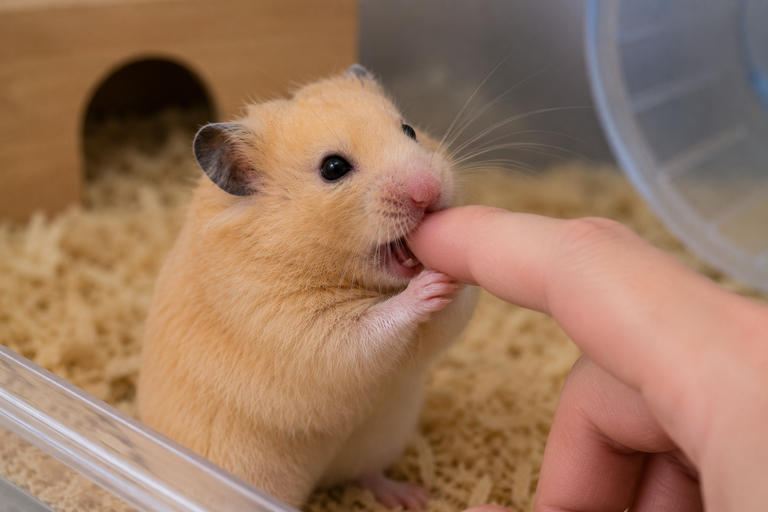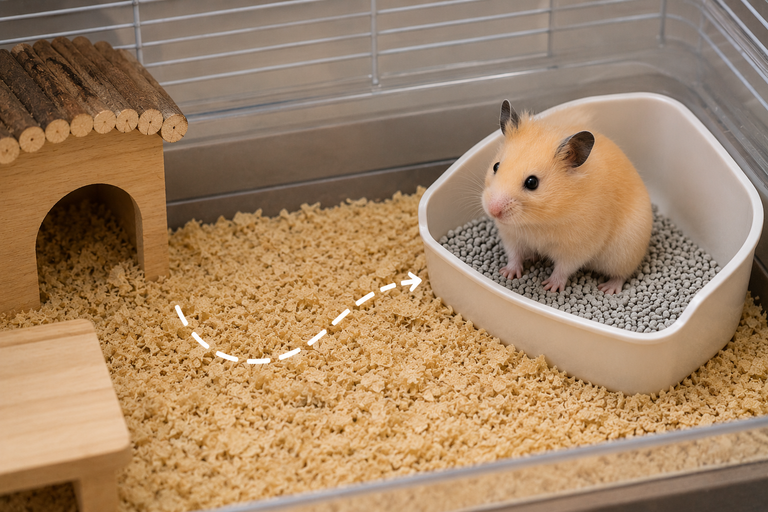

Hamsters can squeak, hiss, chatter their teeth, grind their teeth, or make other small noises, but a sound rarely has one guaranteed meaning. Context matters: look at what your hamster is doing, whether the sound is new, and whether it happens with normal breathing or seems synchronized with each breath.
Some sounds are behavioral. Others, especially wheezing, coughing, or persistent noisy breathing, can signal a health problem.
The most useful rule is not to memorize a “hamster language dictionary.” Learn your hamster’s normal behavior and pay attention when a sound appears together with fear, pain, breathing difficulty, reduced appetite, or another significant change.
Hamster sounds at a glance
| Sound | What it may mean | What to do |
|---|---|---|
| Squeaking | Distress, surprise, protest, fear, or sometimes pain | Look at the situation and body language |
| Hissing | Fear, irritation, or feeling threatened | Stop handling and give the hamster space |
| Teeth chattering or grinding | Irritation, fear, or a warning that the hamster wants space | Back off and reassess what is stressing the hamster |
| Sudden loud squeal or scream | Significant fear, distress, or possibly pain | Check what happened and look for other abnormal signs |
| Wheezing or noisy breathing | Possible respiratory problem | Contact a hamster-experienced veterinarian |
| Repeated noise synchronized with breathing | Possible respiratory problem rather than communication | Seek veterinary advice, especially with discharge or reduced activity |
This table is a guide, not a diagnostic tool. The same hamster may sound different in different situations, and some apparently “cute” noises can be difficult to distinguish from respiratory sounds without seeing the animal.
What does hamster squeaking mean?
Squeaking is one of the better-documented hamster vocalizations, but it does not have one meaning.
The Irvine Animal Care Center’s hamster behavior guide says some hamsters squeak when disturbed, surprised, or picked up. The sound may be a protest or a response to pain.
The Humane Society Silicon Valley hamster care guide similarly associates squeaking with fear or agitation, particularly when a hamster is settling into a new environment.
That is stronger support than the common internet claim that a hamster squeaking when food appears must be “excited.”
Could an individual hamster vocalize in a positive situation? Possibly. But the sound by itself does not prove happiness.
Ask what happened immediately before the squeak.
If your hamster squeaks when you reach toward it, pick it up, wake it, or enter its hide, give it more control over the interaction.
If a normally quiet hamster suddenly begins squeaking repeatedly without an obvious behavioral trigger, especially with reduced activity, difficulty breathing, or apparent pain, treat the change more seriously.
What does hissing mean?
Hissing is much easier to interpret.
Animal-care guidance describes hissing as a defensive sound associated with fear, irritation, or feeling threatened. A hamster may also stand upright, show its teeth, or adopt another defensive posture.
That means give the hamster space.
Do not keep reaching toward it to prove that your hand is harmless. Remove the immediate pressure and let the hamster settle.
A newly adopted hamster may simply need more time before handling. See how to tame a hamster for a gradual approach.
What does teeth chattering mean?
Teeth chattering or grinding deserves more caution than the common “happy bruxing” explanation suggests.
The Irvine Animal Care Center describes teeth chattering, grinding, and hissing as signs that a hamster is irritated or afraid and may bite if the pressure continues.
Humane Society Silicon Valley gives similar guidance, describing teeth grinding or chattering as a sign that the hamster is irritated and wants to be left alone.
So if your hamster chatters its teeth while you are approaching, handling, cleaning around it, or putting it into an unfamiliar situation, take that as useful feedback and give it some space.
Is bruxing a sign that a hamster is happy?
You will often see hamster websites describe quiet tooth grinding, or “bruxing,” as the hamster equivalent of a cat purring.
I would not use that as a reliable standalone interpretation.
Hamsters do grind their continuously growing incisors, and owners may hear tooth sounds while a hamster appears relaxed. However, stronger hamster-specific behavioral guidance also associates audible grinding and chattering with irritation or fear.
Context therefore matters much more than the label bruxing.
If your hamster is otherwise relaxed and behaving normally, occasional quiet tooth movement does not automatically mean something is wrong. But the sound alone is not enough to declare that the hamster is happy.
What does screaming mean?
A sudden loud scream or squeal should get your attention, especially because hamsters are generally not highly vocal pets.
It can occur when a hamster is extremely frightened or distressed. A hamster that suddenly vocalizes when touched may also be experiencing pain.
First remove whatever appears to be frightening the hamster and observe it without forcing further handling.
Look for:
- limping or reluctance to move
- visible injury
- unusual posture
- repeated vocalization
- difficulty eating
- reduced activity
- breathing problems
If there is reason to suspect pain, trauma, or illness, contact a veterinarian.
Which hamster noises can mean a respiratory problem?
This is the most important distinction in the article.
A behavioral sound usually occurs in response to something the hamster is doing or experiencing. A respiratory sound tends to occur with breathing itself.
PetMD’s current hamster care guidance tells owners to contact an exotic veterinarian for:
- coughing
- wheezing
- sneezing
- nasal discharge
- other respiratory difficulties
So take notice if you hear a repeated clicking, crackling, wheezing, or other abnormal sound that appears to follow the rhythm of the hamster’s breathing.
Concern increases if it occurs with:
- nasal discharge
- wet or crusted eyes
- repeated sneezing
- faster breathing
- obvious effort when breathing
- reduced appetite
- weight loss
- lethargy
- reduced normal activity
Do not try to decide whether a respiratory noise is harmless based solely on how similar it sounds to teeth chattering.
If noisy breathing is new or persistent, veterinary assessment is the safer choice.
For more on respiratory signs, see hamster runny nose.
How can you tell teeth chattering from respiratory clicking?
Watch rather than relying only on your ears.
Teeth chattering is more likely to occur in a behavioral context, such as when the hamster is being approached, handled, disturbed, or placed in a situation it dislikes.
A respiratory sound may repeat with each breath even while the hamster is otherwise sitting still.
Also look for respiratory symptoms such as nasal discharge, sneezing, abnormal breathing effort, or reduced activity.
If you cannot confidently tell where the noise is coming from and it continues, do not spend days trying to decode it from online sound descriptions. A hamster-experienced veterinarian can listen to the breathing and examine the animal.
Why is my hamster suddenly making more noise?
A new environment can change hamster behavior.
Hamsters are prey animals and can be nervous around unfamiliar sights, smells, sounds, people, and handling. RSPCA notes that they are naturally timid and can find loud or threatening noises stressful.
A hamster may therefore vocalize when:
- newly brought home
- unexpectedly disturbed
- picked up before it is comfortable with handling
- awakened during its normal sleeping period
- frightened by another animal
- exposed to an unfamiliar situation
But do not automatically blame a sudden change on “stress.”
A normally quiet hamster that begins making repeated new sounds can also be sick or uncomfortable.
Check appetite, activity, breathing, eyes, nose, movement, posture, and general behavior.
For a broader health checklist, see signs of a sick hamster.
Do dwarf hamsters make more noise than Syrian hamsters?
I would not use that as a general rule.
Some care guides mention dwarf hamsters squeaking during interactions or conflict, but I could not find strong evidence establishing Roborovski, Winter White, or Campbell’s hamsters as inherently more vocal than Syrians.
Individual variation may be more useful to an owner than a species stereotype.
Some hamsters rarely make an audible sound. Others vocalize more readily when disturbed.
What matters most is your hamster’s baseline. A sudden change from its normal behavior is more informative than whether its species is supposed to be “chatty.”
Do hamsters chirp or coo when they are happy?
You may see chirping, cooing, clicking, and similar words used in online hamster communities, often with very specific emotional translations.
The problem is that hamster-specific authoritative evidence for many of these interpretations is weak.
Rather than saying:
“chirping means curiosity”
or
“cooing means excitement”
look at the full situation.
A hamster voluntarily exploring with normal posture, appetite, movement, and breathing is very different from one making a similar noise while hiding, freezing, struggling to breathe, or trying to escape handling.
The body and context provide more information than the name humans give the sound.
Do hamsters make noises while sleeping?
A hamster may occasionally make a small sound while resting, but I would not automatically describe this as dreaming.
Evidence that other mammals experience REM sleep does not establish that a particular squeak from a sleeping hamster is a dream vocalization.
Do not wake a hamster just because of one brief, isolated sound if everything else appears normal. RSPCA specifically recommends allowing hamsters to sleep undisturbed during the day.
However, repeated clicking, wheezing, or other sounds that continue with each breath should not be dismissed as “sleep talking.”
Watch the hamster’s breathing and check for other respiratory signs.
Should you wake a hamster that is making noise?
Usually not for ordinary behavioral sounds.
Hamsters need to sleep undisturbed, and waking them unnecessarily can be stressful.
But a suspected health problem is different.
If the hamster appears to be struggling to breathe, repeatedly vocalizes as though in pain, has collapsed, or shows another urgent abnormal sign, welfare takes priority over preserving its sleep.
How should you respond to a defensive sound?
If your hamster hisses, chatters its teeth, backs away, freezes defensively, or otherwise appears frightened:
- Stop advancing your hand.
- Give the hamster space.
- Avoid grabbing it from above.
- Let it investigate you voluntarily when it is awake.
- Continue taming gradually rather than forcing interaction.
RSPCA recommends allowing hamsters to investigate hands in their own time and avoiding handling while they are resting or sleeping.
Repeatedly ignoring defensive communication can make handling more stressful and increase the likelihood of a bite.
When does a sound mean you should call a vet?
Contact a hamster-experienced veterinarian if a new or unusual sound occurs with:
- wheezing
- coughing
- repeated sneezing
- nasal or eye discharge
- difficult or labored breathing
- reduced appetite
- weight loss
- unusual lethargy
- weakness
- obvious pain
- sudden behavior change
PetMD specifically lists coughing, wheezing, sneezing, nasal discharge, and respiratory difficulty among reasons to call an exotic vet.
Do not wait for a hamster to become dramatically ill before acting. RSPCA notes that hamsters can lose condition quickly and may show few outward signs of pain.
The bottom line
Hamster sounds are useful clues, but they are not a perfect emotional dictionary.
Squeaking is documented in situations involving disturbance, surprise, fear, protest, and pain. Hissing and teeth chattering are stronger signals that a hamster is frightened, irritated, or wants space.
Be more cautious with claims that a specific chirp means curiosity or that tooth grinding always means contentment. Those interpretations are not supported strongly enough to use without context.
Most importantly, separate behavioral noises from breathing noises. Wheezing, coughing, repeated respiratory clicking, sneezing, or noisy breathing, especially with nasal discharge or reduced activity, deserves veterinary attention.
Learn what is normal for your own hamster. A change from that baseline is often more useful than trying to translate every squeak.