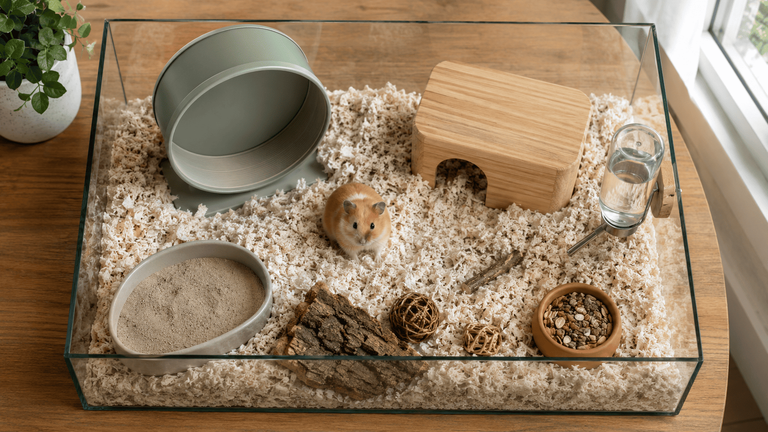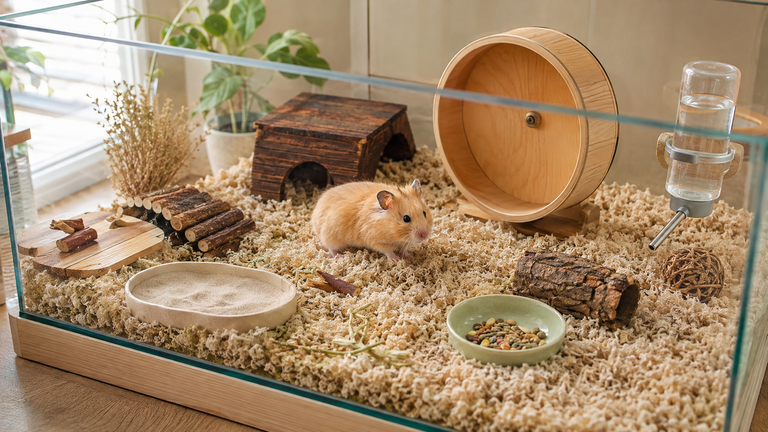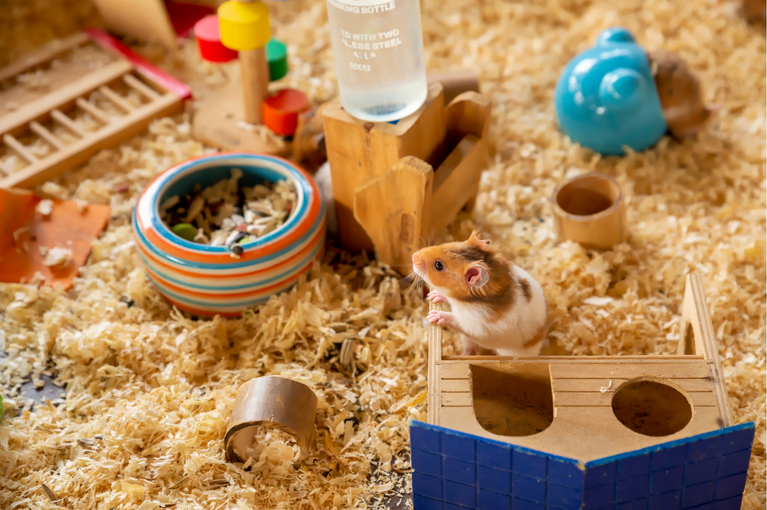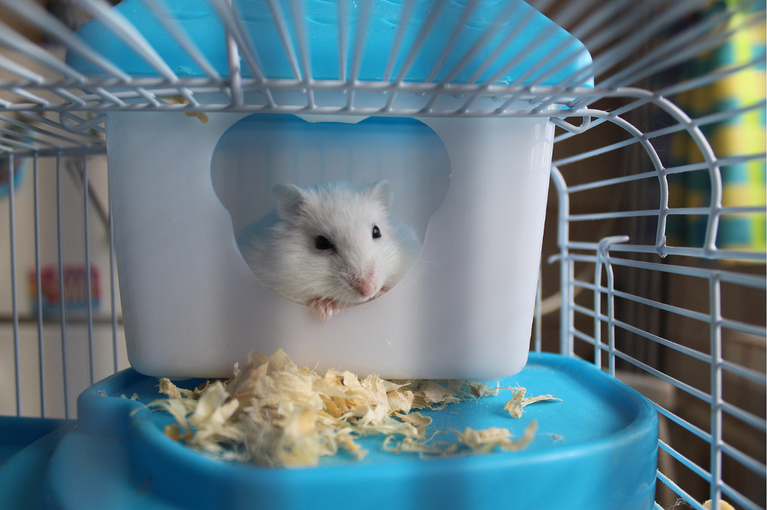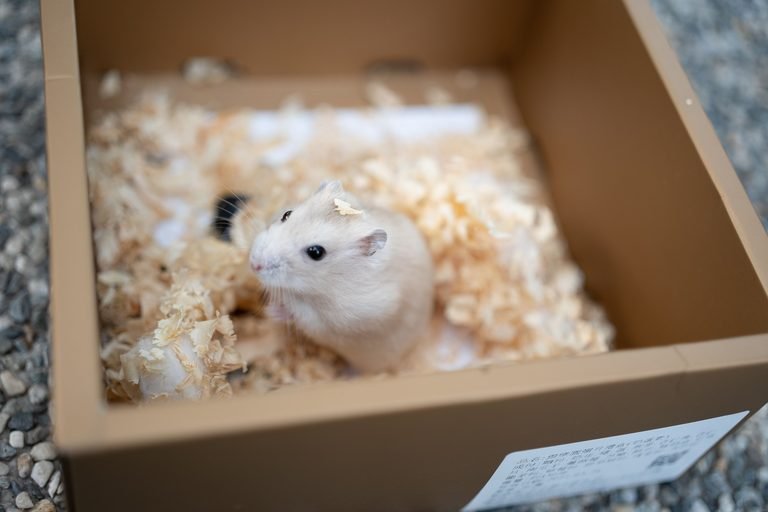
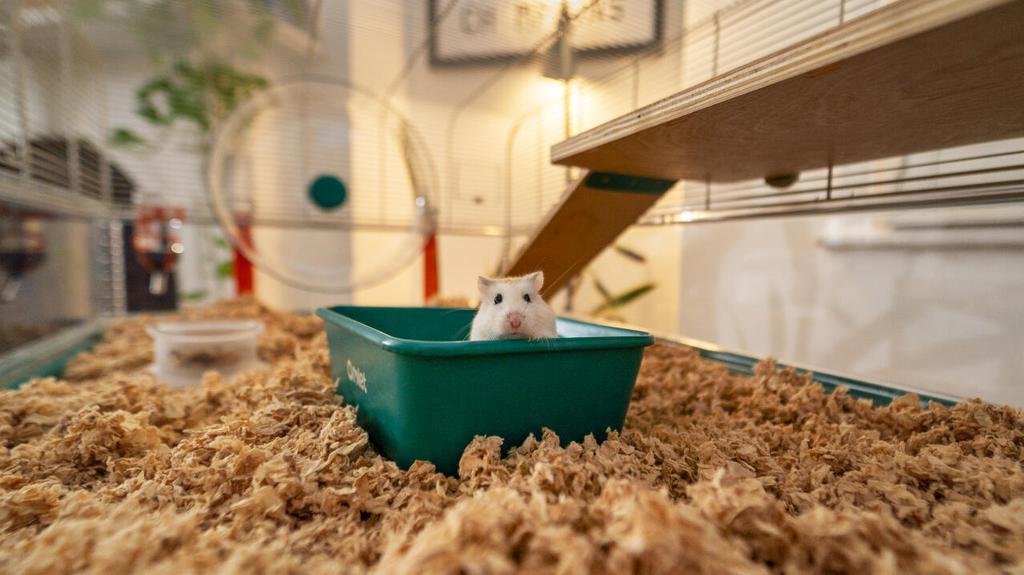
There is no single enclosure type that is automatically best for every hamster. A well-designed glass tank, barred cage, or homemade enclosure can work if it provides enough continuous floor space, deep bedding, secure ventilation, and room for appropriate enrichment.
Glass tanks are particularly good at containing deep bedding. Some barred cages provide excellent ventilation but may need a deeper base or bedding guards. Large plastic bin-style enclosures can be affordable, but only if the finished enclosure genuinely meets the hamster’s space, ventilation, security, and height needs.
So do not choose by material alone. Judge the actual enclosure.
Tank vs cage vs bin at a glance
| Enclosure | Main advantage | Main limitation |
|---|---|---|
| Glass tank | Excellent for containing deep bedding and easy viewing | Heavy and depends on a large ventilated top |
| Barred cage | Very good airflow and easy access | Shallow bases can restrict bedding depth; bars may allow climbing or chewing |
| Large homemade/bin enclosure | Can provide a large usable area at lower cost | Quality depends entirely on dimensions, ventilation, construction and escape-proofing |
A large, well-designed barred cage is better than a tiny aquarium.
A properly ventilated tank is better than a barred cage that cannot accommodate meaningful burrowing depth.
And a storage bin is not automatically suitable simply because someone calls it a “bin cage.”
What matters most in a hamster enclosure?
Before deciding between glass, bars, or plastic, check whether the enclosure can provide the basics.
Current welfare guidance consistently emphasizes:
- a large continuous floor area
- deep bedding for burrowing
- a solid floor
- secure construction
- effective ventilation
- enough height for bedding, a suitable wheel, hides and other enrichment
- no dangerous gaps or escape routes
The PDSA recommends an enclosure with a large floor area and notes that single-level space is generally more useful than relying on tall multi-level cages.
Blue Cross and Woodgreen also prioritize continuous floor space and enough depth for burrowing.
That means enclosure design matters more than whether the walls happen to be glass or wire.
How much floor space does a hamster need?
Several major UK welfare organizations currently use 100 × 50 cm of continuous floor space as a minimum benchmark.
Blue Cross recommends housing no smaller than 100 cm long by 50 cm wide and 50 cm high.
Woodgreen uses 100 × 50 cm as its minimum footprint for Syrian, Chinese, dwarf, and Roborovski hamsters, with different height recommendations depending on species.
PDSA also uses 100 × 50 cm, but adds an important qualification: there is limited research establishing one exact minimum hamster cage size. Its recommendation is based on guidance from the German Veterinary Association for Animal Welfare.
That context matters.
I would therefore phrase 100 × 50 cm as a current welfare benchmark, not a scientifically proven threshold where 99 × 49 suddenly becomes harmful and 100 × 50 becomes perfect.
Larger usable space can still be beneficial, particularly when needed to fit deep bedding, a suitable wheel, hides, sand, and enrichment without overcrowding the enclosure.
See our hamster cage size guide for the full discussion.
How much bedding should the enclosure hold?
This is where enclosure design makes a major difference.
PDSA recommends at least 25 cm, or about 10 inches, of bedding so hamsters can build burrows.
Blue Cross recommends a minimum of 20 cm of suitable digging bedding.
Woodgreen uses a more detailed approach: at least 6 inches across most of the enclosure, with a deeper area of approximately 10 to 12 inches, or 25 to 30 cm, for more extensive burrows and nests.
These recommendations are not identical, but they agree on the important point:
A shallow decorative layer of bedding is not enough.
Your enclosure needs enough usable height to provide meaningful digging depth while still safely fitting the wheel and other essential items.
See our hamster bedding depth guide for more detail.
Are glass tanks good for hamsters?
Yes, a properly sized and ventilated glass tank can make an excellent hamster enclosure.
Blue Cross specifically describes tanks and aquariums as ideal because they allow deep bedding and reduce the risk of escape through wire bars.
The Merck Veterinary Manual also says smooth plastic or glass is preferred for enclosure walls because hamsters can chew wire.
Practical advantages include:
- deep bedding stays inside
- no bar spacing to worry about along the walls
- excellent visibility
- solid surfaces are easy to inspect
- fewer opportunities for bar climbing and chewing
But a tank still has to meet every other requirement.
A small aquarium does not become good hamster housing simply because it is made from glass.
Do glass tanks have enough ventilation?
They can, but ventilation must be designed properly.
Blue Cross says a hamster tank should have a mesh lid for good ventilation. VCA Animal Hospitals similarly says rodents can be housed in glass aquariums when they are well ventilated and use a secure wire or screen top.
Merck also says any cage or tank selected for a hamster must be well ventilated.
So the useful rule is not:
glass tank = poor ventilation
or
mesh lid = ventilation automatically solved
Instead, use a tank with a large, unobstructed ventilated top and avoid sealing the enclosure with a solid lid.
Also consider where the enclosure sits. Direct sunlight, heat sources, and poorly ventilated rooms can create problems regardless of enclosure type.
Are barred cages bad for hamsters?
No.
A suitable barred cage can work very well.
Woodgreen explicitly allows either tank-style setups or cages, while the RSPCA actually expresses a preference for stainless-steel bars or mesh sides over fully solid sides because of ventilation.
Barred cages can offer:
- excellent airflow
- lighter construction
- convenient doors
- easy attachment of some accessories
The real problem is that many commercial hamster cages have shallow plastic bases.
If the base cannot contain enough bedding, the hamster loses an important opportunity to burrow.
That is a design failure, not proof that all barred cages are bad.
What about bar biting?
Bars create an opportunity for bar chewing, but I would not frame this as:
bars cause bar biting, so barless enclosures prevent stress.
Blue Cross has documented hamsters climbing and chewing bars when housed without sufficient space or deep bedding. In one case, a hamster’s behavior improved after moving to a larger, enriched glass setup.
That supports the idea that bar chewing can be associated with inadequate housing or established repetitive behavior.
It does not prove that every hamster with access to bars will chew them or that simply removing bars solves the underlying welfare problem.
If your hamster repeatedly bites or climbs cage bars, review the entire enclosure:
- usable space
- bedding depth
- wheel
- hides
- foraging opportunities
- tunnels
- chewing materials
- other enrichment
Changing to a tank may remove the bar-chewing surface, but the hamster still needs its behavioral needs met.
Are plastic bin cages good for hamsters?
A large plastic enclosure can potentially work, but I would be more cautious than the original article.
PDSA accepts homemade enclosures as one housing option, and Merck considers smooth plastic a suitable wall material.
However, neither fact means that any storage tote becomes good hamster housing after cutting a hole in the lid.
Storage bins vary enormously.
Many:
- taper sharply toward the base
- provide much less internal floor area than their advertised outer measurements suggest
- are too shallow once deep bedding and a large wheel are added
- have solid lids with inadequate ventilation
- are made from plastic that may be vulnerable to persistent chewing
- require DIY cutting that can leave sharp edges
If you build a bin-style enclosure, evaluate the finished internal habitat, not the litre or gallon capacity printed on the packaging.
It still needs appropriate floor space, height, deep bedding, ventilation, a secure lid, and safe construction.
Should you measure a tapered bin at the bottom?
Yes, the usable internal floor area matters more than the widest measurement around the rim.
Many storage containers narrow toward the bottom.
Because your hamster actually occupies the internal floor and bedding area, using only the manufacturer’s maximum exterior dimensions can exaggerate how much continuous space the animal receives.
Do not rely on container volume alone either. A tall narrow storage box can hold many litres while providing poor floor space.
Measure the usable internal length and width where the hamster actually lives.
Is a bin cage always the cheapest option?
Often, but not necessarily.
Bins can be inexpensive compared with large glass tanks and some commercial enclosures, but costs vary by country, available storage-container sizes, mesh, tools, and construction materials.
A bargain bin that is too small is not better value than an appropriately sized enclosure.
Think about cost per suitable finished habitat, not simply the purchase price of the container.
Tank vs barred cage: which would I choose?
If two options both meet the same welfare requirements, I would usually prefer the one that makes deep bedding easiest to provide and maintain.
For many owners, that makes a large glass or other solid-sided enclosure very practical.
But I would not tell someone to replace an excellent 100 × 50 cm or larger barred enclosure simply because a tank is supposedly always superior.
A barred enclosure with:
- adequate floor space
- a deep solid base or effective bedding containment
- safe bar spacing
- a suitable wheel
- deep bedding
- abundant enrichment
can still provide very good housing.
The enclosure should be judged as a system.
What about ventilation differences between sources?
This is one area where reputable guidance is not perfectly aligned.
Blue Cross actively recommends tanks and aquariums when fitted with a ventilated mesh lid.
Merck accepts glass and smooth plastic walls as long as the enclosure is well ventilated.
RSPCA, however, states that stainless-steel bars or mesh sides are preferable to solid sides.
Rather than pretending this disagreement does not exist, the practical conclusion is:
ventilation matters regardless of material.
A tank needs a large ventilated top.
A barred cage naturally provides substantial airflow but still needs appropriate positioning away from draughts.
Neither format excuses poor overall enclosure design.
Which enclosure is easiest to clean?
This depends heavily on size and setup.
Glass and smooth plastic surfaces are easy to wipe, while barred enclosures may involve cleaning bars and joins.
But hamster cleaning should not mean stripping the entire enclosure constantly.
Blue Cross recommends spot cleaning soiled areas regularly and retaining some clean familiar bedding during larger cleans because hamsters rely strongly on scent.
So “easy to deep clean every week” should not be the deciding factor.
A good enclosure is one that lets you remove soiled areas without repeatedly destroying the hamster’s burrow system and scent environment.
What should you avoid?
Regardless of enclosure style, avoid designs that:
- provide very little continuous floor space
- rely on shelves to compensate for a small footprint
- cannot contain meaningful bedding depth
- have wire mesh flooring
- have unsafe bar spacing
- allow easy escape
- have poor ventilation
- expose sharp DIY edges
- cannot safely fit an appropriately sized solid wheel
- use elaborate narrow external tube systems as a substitute for floor space
PDSA specifically favors larger single-level housing over tall, multi-level designs because hamsters have relatively poor eyesight and can be injured by falls.
Blue Cross also warns against elaborate tube systems because of ventilation, access, and size concerns.
Frequently asked questions
Is a tank better than a cage for a hamster?
Not automatically.
Large tanks are excellent at holding deep bedding and have direct support from Blue Cross, Merck, and VCA when properly ventilated.
A large barred cage with a deep base and suitable enrichment can also work well.
Are glass tanks bad because they do not breathe?
No. A tank with a large secure mesh top can provide ventilation, and major animal-welfare and veterinary sources explicitly accept properly ventilated tanks.
Do not use a sealed solid lid.
Is 100 × 50 cm the minimum hamster cage size?
It is a widely used current welfare benchmark from PDSA, Blue Cross, and Woodgreen.
PDSA also acknowledges that there is limited scientific evidence establishing one exact minimum, so treat the number as a welfare guideline rather than a biological cutoff.
How deep should hamster bedding be?
Current recommendations vary somewhat.
PDSA recommends at least 25 cm, Blue Cross recommends at least 20 cm, while Woodgreen recommends at least 6 inches across most of the enclosure plus a 10 to 12 inch deeper digging area.
The consistent message is that hamsters need substantial burrowing depth, not a thin bedding layer.
Are bin cages safe?
They can be if the completed enclosure is genuinely large enough, secure, well ventilated, tall enough for deep bedding and a suitable wheel, and constructed without sharp edges.
Do not assume every large-looking storage box meets those requirements.
Can I keep my existing barred cage?
Yes, if it provides appropriate continuous floor space, enough bedding depth, safe bar spacing, ventilation, and the rest of your hamster’s enrichment needs.
You do not need to replace a genuinely suitable enclosure simply because another material is fashionable.
Bottom line
There is no universal winner between a hamster tank, barred cage, and homemade bin enclosure.
Glass tanks are excellent for holding deep bedding and are recommended by several veterinary and welfare sources when properly ventilated. Barred cages provide excellent airflow and can also work well when they have enough floor space and bedding depth. Large plastic or homemade enclosures can be affordable alternatives, but their suitability depends entirely on the finished design.
Prioritize continuous space, deep bedding, ventilation, security, and enrichment before enclosure material.
If two enclosures meet those needs equally well, choose the one that makes it easiest for you to maintain a deep, secure, enriched habitat for your hamster.
Keep reading: Hamster cage setup · Hamster cage size · Hamster bedding depth