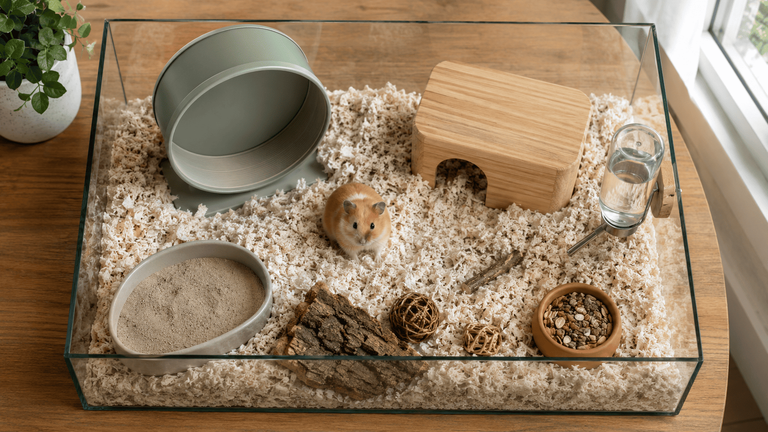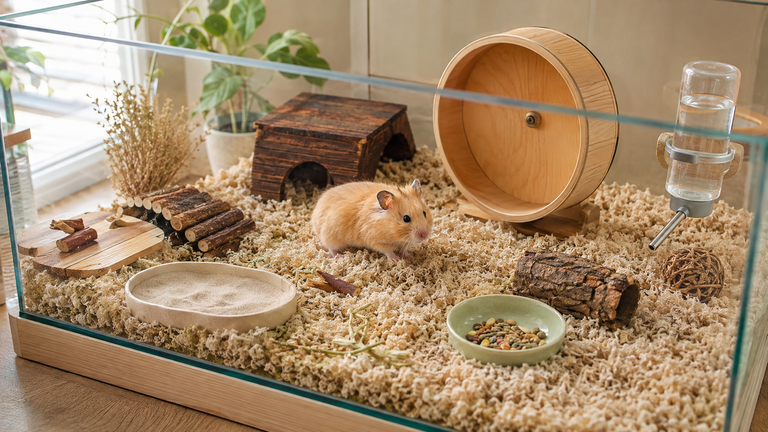
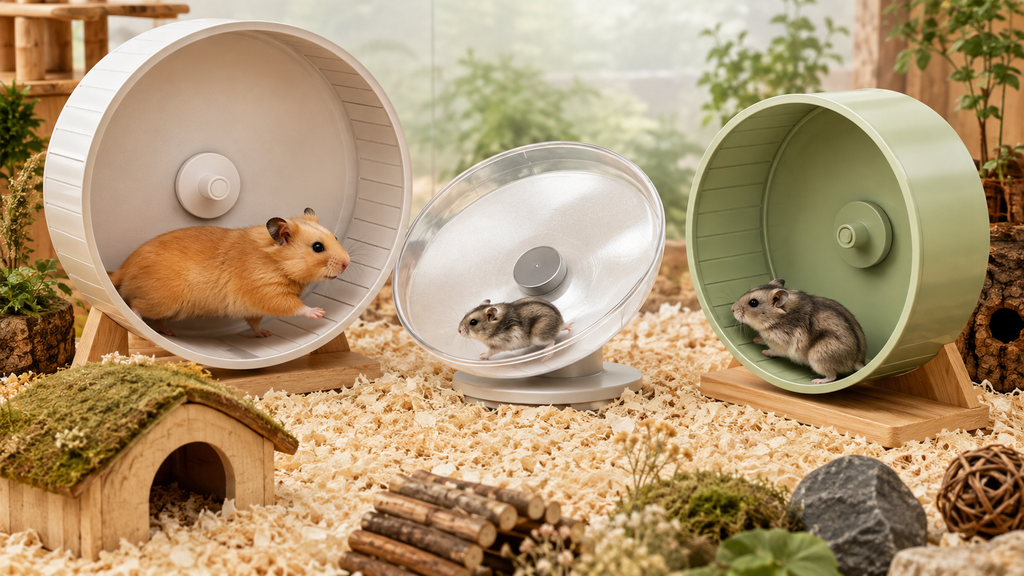
For most hamsters, the best default is a solid upright wheel that is large enough for the hamster to run with a straight back. Flying saucer discs can be used as extra enrichment, but major welfare organizations such as Blue Cross and Woodgreen specifically recommend upright wheels, so I would not use a saucer as the only wheel. Avoid mesh, wire, barred or spoked running surfaces, and skip hamster exercise balls altogether.
You do not need to choose between three supposedly equal wheel “types.” What matters most is the running position, surface, stability and whether the hamster can turn the wheel comfortably.
What actually makes a hamster wheel safe?
A suitable hamster wheel should meet four basic requirements:
- It should be upright.
- The running surface should be solid.
- It should be large enough for a natural running posture.
- It should turn easily and remain stable during use.
Blue Cross says a hamster should be able to run with a straight back without raising its head unnaturally. It also recommends an upright wheel with a solid running surface.
PDSA gives similar advice, warning that wheels that force a hamster to run with a curved back may cause long-term pain and that the running surface should not contain slats or bars that could trap a leg.
Those characteristics matter more than whether a product is marketed as “silent,” “premium,” “bucket-style” or something else.
Solid upright wheels: the best default
A solid upright wheel is the easiest type to recommend.
This is the familiar vertical wheel mounted on a stand or attached securely to part of the enclosure. Modern versions may use plastic, wood, cork-lined material or another solid running surface.
Both Blue Cross and Woodgreen specifically recommend solid upright wheels.
When comparing models, look for:
- an appropriate diameter
- a solid, continuous running track
- enough track width for the hamster to run comfortably
- stable construction that does not wobble or tip
- smooth rotation that the hamster can control
- a design that can be cleaned and inspected easily
A quiet bearing is convenient for you, especially when the hamster runs at night, but “silent” is not a safety category. A silent wheel can still be too small or poorly designed.
What about enclosed or “bucket-style” wheels?
These do not really need their own wheel category.
Products sometimes described as bucket, drum or enclosed wheels are still upright wheels. The main difference is that the running track has more substantial side walls or a partially enclosed front.
An enclosed design is not automatically safer or better than an open-front upright wheel.
Judge it using the same criteria:
Is it large enough? Is the running surface solid? Can the hamster enter and leave easily? Does it spin smoothly? Is it stable and easy to keep clean?
This is more useful than assuming a deep cup or enclosed feeling has a special behavioral benefit. I could not find good hamster-specific evidence showing that nervous hamsters prefer enclosed wheels or that these designs provide better exercise.
Are flying saucer wheels safe for hamsters?
Flying saucers are horizontal or angled spinning discs rather than traditional upright wheels.
They are commonly sold for hamsters, and some hamsters will use them readily. However, I would not describe them as equally recommended alternatives to upright wheels.
Blue Cross says an appropriate hamster wheel should be upright, and Woodgreen also specifies solid upright wheels in its current hamster-care guidance.
That does not prove every saucer is harmful. It does mean the evidence-based recommendation is stronger for an upright wheel.
A saucer can therefore be treated as optional additional enrichment if:
- it is large enough for the hamster to run comfortably
- it has a solid surface
- it is stable
- the hamster can enter and leave freely
But it should not replace a suitable upright wheel simply because the hamster appears to enjoy it.
Wire, mesh and barred wheels should be replaced
This part of the old article is well supported.
Blue Cross advises replacing wheels with spokes or mesh because feet can become caught. PDSA likewise recommends a solid running surface rather than slats or bars that could trap the hamster’s legs.
So avoid:
- wire rung wheels
- mesh running surfaces
- ladder-style tracks
- designs with large openings where feet or limbs can slip through
There is no welfare advantage that makes these designs worth the additional injury risk.
How large should a hamster wheel be?
This is where a single rule such as 11 inches for Syrians and 10 inches for all dwarfs becomes misleading.
Current welfare organizations do not all use exactly the same numbers.
For example, Blue Cross gives these species-specific ranges:
| Hamster | Blue Cross wheel guidance |
|---|---|
| Syrian | 27–32 cm |
| Campbell’s dwarf | 22–25 cm |
| Winter White | 22–25 cm |
| Roborovski | 20–22 cm |
| Chinese hamster | 25–27 cm |
PDSA uses a simpler minimum of 30 cm for Syrians and 20 cm for dwarf hamsters, while Woodgreen recommends 12 inches for Syrian and Chinese hamsters and 8 inches for the other commonly kept species.
So there is no useful reason to pretend that one exact diameter is universally agreed upon.
The most important fit check is the hamster itself.
Its back should remain straight while running rather than bending into an obvious curve, and the hamster should be able to turn the wheel without struggling.
For the full species-by-species discussion, see our hamster wheel size guide.
Can a hamster wheel be too big?
Potentially, yes.
“Bigger is always better” is too simplistic.
Blue Cross specifically says a wheel should be large enough to allow a straight running posture but small enough that the hamster can rotate it easily.
A large wheel that turns smoothly may be perfectly usable by a small hamster. A very heavy wheel that the hamster struggles to start or control is not automatically better simply because its diameter is larger.
Choose for both posture and usability.
How can you tell if a wheel fits correctly?
Watch the hamster while it is actually running.
The clearest warning sign is an obvious curve through the back caused by the wheel being too small. Blue Cross also says the hamster should not need to lift its head unnaturally while running.
A suitable wheel should allow smooth, controlled running without the hamster appearing cramped.
Do not focus on a perfectly horizontal back measured to the millimeter. You are looking for a clearly natural posture rather than obvious bending caused by an undersized wheel.
Does every hamster need access to a wheel?
A wheel is standard enrichment in current hamster welfare guidance.
PDSA, Blue Cross and Woodgreen all include an appropriate exercise wheel among the basic equipment hamsters should have.
I would not justify that by claiming a pet hamster will become unhealthy because wild hamsters run a specific number of miles each night. Running-distance figures vary between studies and captive wheel running does not directly equal wild movement.
Likewise, bar biting, pacing or other repetitive behavior can have several environmental causes. It is too simplistic to say that the absence of a wheel directly causes each of them.
The stronger point is enough:
Hamsters are active animals, and major welfare organizations recommend providing an appropriate wheel as part of an enriched enclosure.
Where should you put the wheel?
The wheel needs a stable base.
Woodgreen specifically recommends sturdy platforms for heavier enclosure items such as wheels, sand baths and ceramic hides.
That is especially useful in an enclosure with deep bedding. Instead of balancing a heavy wheel directly on loose substrate where it can tilt or sink, place it on a secure platform or install it according to the manufacturer’s mounting instructions.
The surrounding area should still leave enough room for the hamster to enter and leave the wheel comfortably.
See our hamster cage setup guide for arranging wheels, bedding, hides and other enclosure essentials.
Are hamster exercise balls a type of wheel?
No, and they should not be used as a substitute.
Woodgreen does not recommend exercise balls for any pet, citing concerns including disorientation, lack of access to water and feet becoming trapped.
Blue Cross also advises against hamster balls and recommends a secure playpen instead when owners want to provide supervised exploration outside the enclosure.
So I would go further than the old article’s wording that balls should not be used as a “primary exercise option.”
You do not need to use one at all.
A suitable enclosure wheel plus a secure playpen or other safe enrichment provides better options.
What if a hamster wheel becomes noisy?
Noise alone does not mean a wheel is unsafe, but a new rattle, wobble or resistance is worth investigating.
Check that:
- the stand or mount is secure
- bedding has not become trapped around the moving parts
- the wheel is not cracked or warped
- the axle or bearing still turns freely
- the wheel remains stable at running speed
I would not automatically put olive oil, coconut oil or another household product on the axle. Different wheel materials and bearing systems have different maintenance requirements.
Follow the manufacturer’s cleaning and maintenance instructions where available. If a wheel is damaged, unstable or no longer turns correctly, replacing it may be safer than improvising a repair.
Which hamster wheel type should you choose?
For most owners, the decision is straightforward:
| Option | Recommendation |
|---|---|
| Solid upright wheel | Best default choice |
| Enclosed/drum upright wheel | Fine if size, surface and stability are appropriate |
| Flying saucer | Optional extra, not my first choice as the only wheel |
| Wire, mesh or barred wheel | Avoid |
| Hamster exercise ball | Avoid |
There is no need to search for a special wheel because your hamster is a Syrian, dwarf or “nervous hamster” beyond choosing an appropriate size and design.
Species matters primarily for fit.
The bottom line
Choose a solid upright wheel that lets your hamster run comfortably with a straight back and that turns easily under its weight.
That recommendation has much stronger welfare support than treating upright spinners, flying saucers and “bucket wheels” as three equally safe categories.
An enclosed wheel is simply a variation on the upright design. A flying saucer may provide additional activity, but current Blue Cross and Woodgreen guidance specifically favors upright wheels, so I would still provide a proper upright wheel as the main option.
Avoid wire, mesh, barred and spoked running surfaces. Skip hamster exercise balls too.
And do not rely on one universal 11-inch Syrian / 10-inch dwarf rule. Wheel guidance varies by organization and species, so use both reputable size recommendations and your hamster’s actual running posture.
Keep reading: Hamster wheel size guide | Hamster cage setup | Hamster cage size
Hamster Corner provides general educational information about hamster care. If your hamster develops difficulty walking, lameness or another health problem, contact a hamster-experienced veterinarian.