
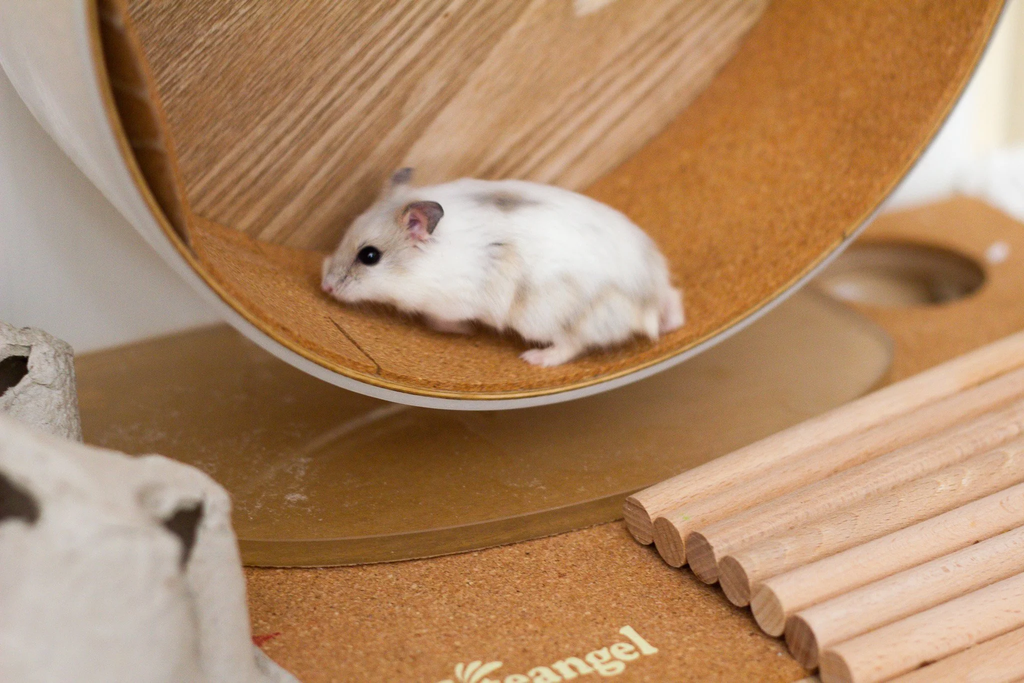
A hamster wheel should be large enough for the hamster to run with a straight back and without lifting its head. It should also be upright, stable, and have a solid running surface without mesh, widely spaced bars, or spokes.
There is no single wheel diameter that fits every hamster species. Current welfare organizations use slightly different size recommendations, so the hamster’s running posture matters more than memorizing one universal number.
For many Syrians, that means a wheel around 27 to 32 cm (roughly 11 to 12.5 inches). Smaller species may need substantially less, while Chinese hamsters often need a larger wheel than the smallest dwarf species.
What size wheel does a hamster need?
Blue Cross currently gives species-specific wheel ranges:
| Hamster | Blue Cross wheel guidance |
|---|---|
| Syrian | 27 to 32 cm |
| Campbell’s dwarf | 22 to 25 cm |
| Winter White | 22 to 25 cm |
| Roborovski | 20 to 22 cm |
| Chinese hamster | 25 to 27 cm |
Other reputable organizations simplify the guidance.
PDSA recommends at least 30 cm for Syrian hamsters and at least 20 cm for dwarf hamsters.
Woodgreen recommends a 12-inch solid upright wheel for Syrian and Chinese hamsters and an 8-inch wheel for other hamster species.
So the original rule of:
- 11 inches for every Syrian
- 10 inches for every dwarf
- 10 inches for every Chinese hamster
is too rigid.
A better approach is to use the published ranges as a starting point and then watch the hamster run.
The straight-back test matters most
The strongest practical rule across current hamster-care guidance is posture.
Blue Cross says the hamster should be able to run without curving its spine or raising its head. Woodgreen similarly says the hamster should be able to stretch out and run with a straight back.
Watch your hamster from the side while it is running normally.
The wheel may be too small if:
- the back stays noticeably curved
- the hamster has to raise its head while running
- the body appears cramped into the curve of the wheel
Move up a size if necessary.
A slightly larger wheel is usually preferable to forcing a hamster into a smaller wheel, provided the hamster can still move it comfortably.
Blue Cross specifically notes that a suitable wheel also needs to be light enough for the hamster to rotate easily.
Why are wheel-size recommendations different?
Because most wheel-size charts are husbandry recommendations, not results from trials comparing every hamster species on every wheel diameter.
Blue Cross uses species-specific ranges, while PDSA and Woodgreen use broader practical minimums.
That does not necessarily mean one organization is right and another is wrong.
For example, both of these can be reasonable:
- a 20 to 22 cm wheel for a small Roborovski
- a 30 cm wheel for a Syrian
What matters is whether the individual hamster can run normally.
This is why a posture-based check is more useful than treating a number such as 25 cm as a universal dwarf-hamster law.
Can a wheel that is too small hurt a hamster?
There is a legitimate welfare concern here, but the claim should be kept precise.
Blue Cross warns that hamsters will often continue using wheels that are too small and says repeated curved-spine running can eventually cause back problems or spinal damage.
PDSA similarly warns that an undersized wheel can force the hamster to run with a curved back and may cause long-term pain.
So a visibly curved running posture should not be dismissed simply because the hamster still chooses to use the wheel.
What we do not have is a simple evidence-based formula such as:
“28 cm prevents spinal injury but 27 cm causes it.”
Wheel suitability depends on the hamster’s actual body size and posture.
Why should the running surface be solid?
A hamster wheel should have a solid, continuous running surface.
Blue Cross advises replacing wheels with spokes or mesh because hamster feet can become caught. PDSA likewise recommends avoiding slatted or barred wheels because legs can become trapped.
The RSPCA’s hamster housing guidance also says running wheels should be solid to reduce injury risk.
That means I would avoid:
- wire mesh wheels
- widely spaced rung wheels
- open spoke designs that expose the hamster’s feet or legs to gaps
A textured solid track that gives appropriate grip is different from an open mesh surface.
Does the wheel need to be upright?
Current Blue Cross and Woodgreen guidance specifically recommends an upright wheel.
That makes an appropriately sized upright wheel the simplest primary recommendation.
It allows you to judge the hamster’s running posture relatively easily and has much clearer welfare guidance behind it than alternative designs.
What about flying saucer wheels?
Flat or angled saucer wheels are widely sold, but the authoritative hamster-care sources I checked do not provide the same clear species-specific guidance for them that they do for upright wheels.
Because of that, I would not use a saucer as the only wheel in the enclosure.
If you want to offer one as additional enrichment and your hamster uses it comfortably, that is different from claiming it is an evidence-based substitute for a correctly sized upright wheel.
For the primary wheel, an upright, solid design is the better-supported choice.
Free-standing or cage-mounted wheel?
Either design can work.
The original article said free-standing wheels are usually best, but I could not find strong evidence supporting that as a general rule.
What matters is stability.
A wheel should:
- stay upright during use
- rotate freely
- not wobble excessively
- not tip over
- remain accessible after bedding is added
Woodgreen recommends sturdy platforms for heavy items such as wheels, sand baths, and ceramic hides.
That is particularly useful in a deep-bedding enclosure. A heavy wheel should not simply balance on loose bedding where a hamster can burrow underneath and destabilize it.
A mounted wheel can also be suitable if it is secure, correctly positioned, large enough, and does not interfere with the bedding depth.
How should a wheel sit in deep bedding?
Do not reduce the hamster’s burrowing area just to make a small wheel fit.
Instead, design a stable wheel zone.
Common options include:
- a sturdy platform
- a securely mounted wheel
- a solid supported section beside the deep bedding
The hamster should be able to enter and exit the wheel easily without climbing a steep unstable surface.
The wheel also needs enough clearance to rotate without bedding constantly jamming underneath it.
For the rest of the enclosure layout, see hamster cage setup and hamster bedding depth.
How wide should the wheel be?
Diameter gets most of the attention, but the hamster also needs enough usable track width to run without repeatedly slipping off the edge.
Current welfare sources generally describe wheels as needing to be sufficiently large and wide rather than giving a universal track-width number for every species.
So I would not invent an exact width table.
Watch the hamster.
If it regularly struggles to stay on the running surface despite the wheel being stable and appropriately sized, the design may simply not suit that animal.
Does every hamster really need a wheel?
A suitable wheel is strongly supported as part of an enriched hamster enclosure.
There is also direct Golden hamster research suggesting that wheel access can affect behavior.
In a 2005 study, female Golden hamsters kept in large enriched cages with a functioning 30 cm wheel showed less climbing and stereotypic bar-mouthing than hamsters given an identical wheel that could not rotate.
The researchers concluded that a large, well-constructed wheel did not show detrimental effects in their setup and may have benefited welfare.
You can read the study in Applied Animal Behaviour Science.
This was a small study involving Golden hamsters, so it does not establish a wheel-size minimum for every species.
It does support treating the wheel as meaningful enrichment rather than a decorative accessory.
A separate year-long Golden hamster study also concluded that wheel running appeared to be a useful enrichment and was associated with improved physical condition.
PubMed: Running-wheel activity and body composition in Golden hamsters
Does a wheel replace other enrichment?
No.
A hamster that has a large wheel still needs opportunities to:
- burrow
- hide
- forage
- explore
- dig
- gnaw appropriate materials
Interestingly, research on Golden hamsters has found that hamsters with deeper bedding used their wheels less than hamsters kept with shallow bedding.
That does not make wheel running bad. It shows why wheel use should be viewed as one part of the behavioral environment, not the hamster’s entire activity program.
For a broader setup, see hamster enrichment.
How do you know a wheel is working properly?
Check the wheel regularly.
Look for:
- smooth rotation
- excessive wobbling
- cracks or sharp edges
- loosened fittings
- bedding trapped underneath
- visible wear to the running surface
- changes in how your hamster runs
If a hamster suddenly stops using a wheel it previously used regularly, inspect the wheel before assuming the hamster has simply lost interest.
But remember that reduced wheel activity can also occur with illness, age, pregnancy, environmental changes, or changes in enrichment.
If your hamster also shows reduced appetite, unusual lethargy, abnormal movement, or another health change, see signs of a sick hamster.
Does a hamster wheel need to be silent?
No. Silence is mainly an owner-convenience feature.
A good wheel needs to be safe, appropriately sized, stable, and easy for the hamster to turn.
If the wheel becomes unusually noisy, first check for:
- a loose stand
- rubbing against the enclosure
- bedding trapped around the base
- damaged bearings or fittings
I would not routinely recommend putting household oil or an unspecified “food-safe lubricant” onto a hamster wheel. Materials and bearing designs vary between products.
Follow the manufacturer’s maintenance instructions instead.
Should you measure the wheel yourself?
Yes, especially when product listings are vague.
The useful measurement is the diameter of the running track the hamster actually uses, not decorative outer housing or the full height of the stand.
But even an accurate measurement does not replace the posture check.
Two Syrian hamsters can differ in body length, and a wheel that works well for one may still make another curve its back.
Hamster wheel checklist
Before keeping a wheel in the enclosure, ask:
Is it large enough?
The hamster runs with a straight back and does not have to lift its head.
Is the track solid?
No open mesh, widely spaced bars, or dangerous foot-catching gaps.
Is it upright?
This is the format most clearly supported by current welfare guidance.
Is it stable?
It does not wobble, tip, or sink into deep bedding.
Can the hamster turn it easily?
Larger is useful only if the hamster can actually move the wheel comfortably.
Does it rotate freely?
Bedding and enclosure furniture should not obstruct it.
If all six answers are yes, the wheel is much more likely to be appropriate than one chosen only because the package says “hamster size.”
The bottom line
Do not use one universal number for every hamster.
Blue Cross currently recommends approximately 27 to 32 cm for Syrians, 22 to 25 cm for Campbell’s and Winter Whites, 20 to 22 cm for Roborovskis, and 25 to 27 cm for Chinese hamsters. PDSA and Woodgreen use somewhat different simplified minimums.
The consistent message is more important than the disagreement: the hamster should run with a straight back, the wheel should be upright and solid, and the hamster’s feet should not encounter open mesh or dangerous gaps.
If the back curves, size up.
And remember that even the perfect wheel is only one part of a good hamster environment. Deep bedding, hides, foraging, digging opportunities, and suitable enclosure space still matter.
Sources
Woodgreen: Caring for hamsters
Woodgreen: Hamster habitat guide
Applied Animal Behaviour Science: How does the running wheel affect Golden hamster behaviour?
PubMed: Running-wheel activity and body composition in Golden hamsters
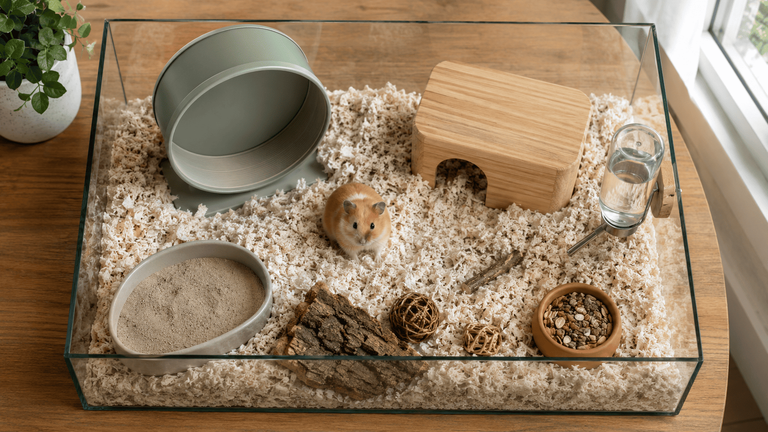
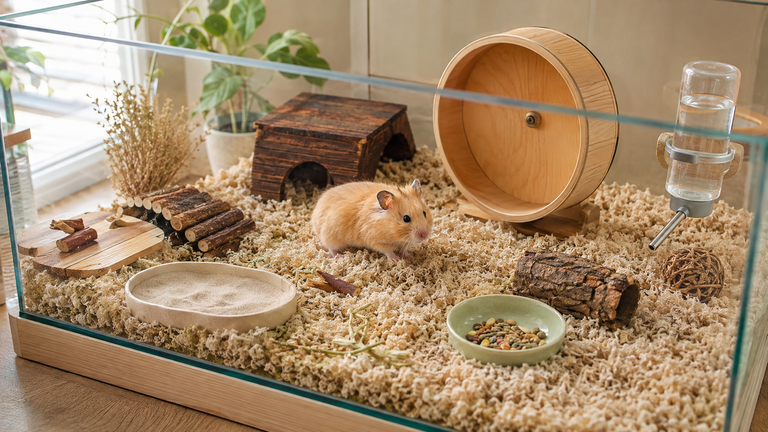



[…] For the full species-by-species discussion, see our hamster wheel size guide. […]
[…] our hamster wheel size guide and wheel types guide for more […]
[…] sized and safely positioned, but it should not replace a suitable upright wheel.See the hamster wheel size guide for species-specific fitting […]