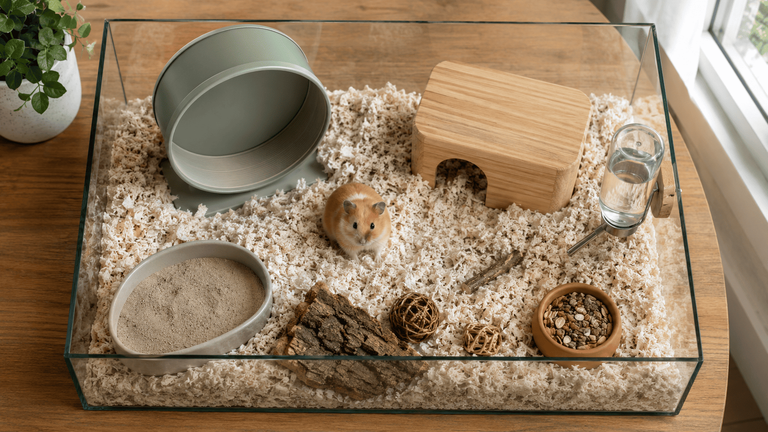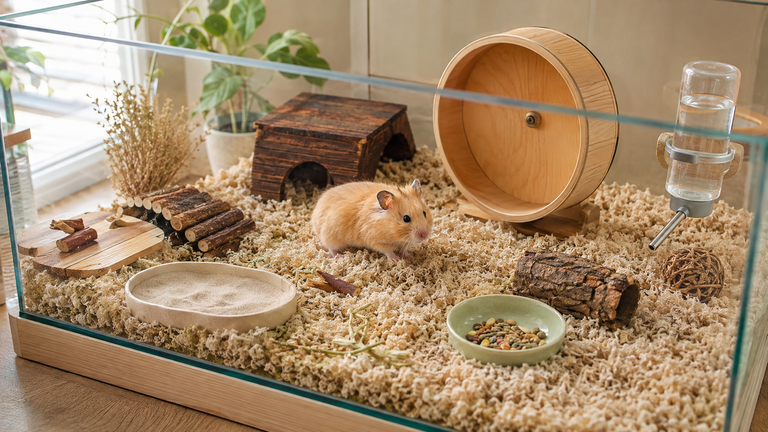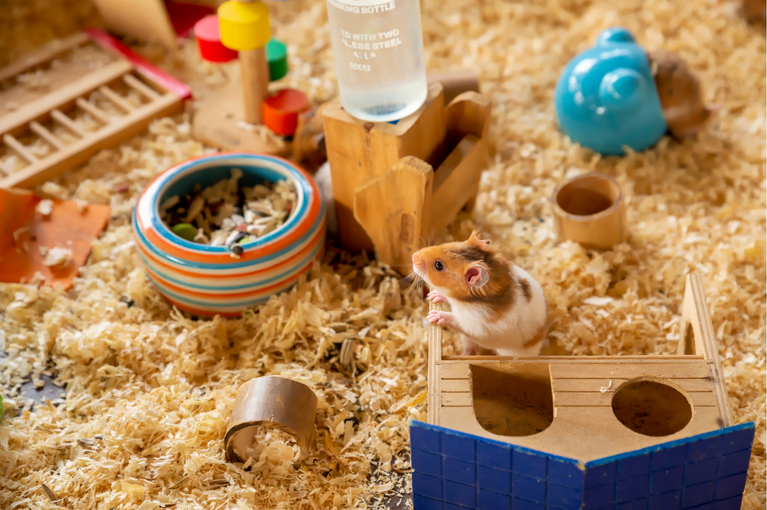
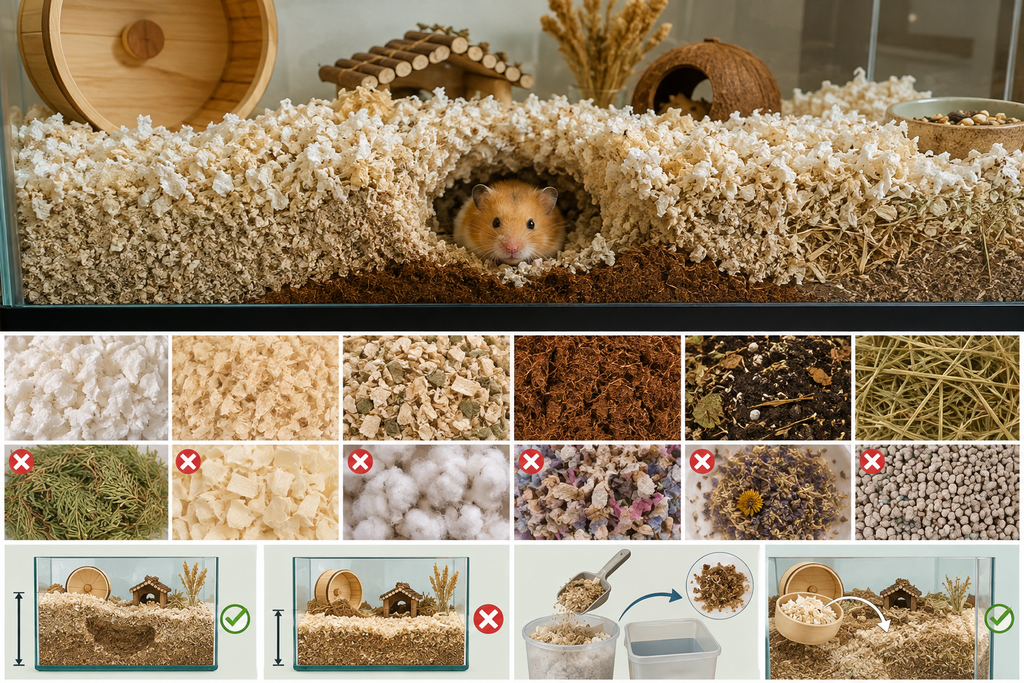
For most hamster setups, unscented paper-based bedding is the easiest first choice because it is widely recommended, relatively low in dust, and good at supporting burrows. Aspen and hemp are also supported options, but they may work better mixed with paper bedding when you want deeper tunnels to hold their shape.
There is no single bedding material that every authoritative source ranks as “the best.” What matters most is that the bedding is safe, low in dust, unscented, deep enough for burrowing, and capable of staying dry.
Coco fibre and suitable soil can add useful digging textures, but they are better treated as enrichment substrates rather than automatically replacing the main bedding.
What makes a good hamster bedding?
A useful hamster bedding needs to do more than absorb urine.
Hamsters naturally dig, build nests, store food underground, and create burrows. Good bedding should therefore allow those behaviors while remaining safe for the respiratory system and skin.
The Merck Veterinary Manual recommends bedding that is:
- clean
- nontoxic
- absorbent
- as dust-free as possible
- easy to change
Merck specifically identifies shredded paper and commercial paper-based bedding as suitable hamster substrates.
Blue Cross recommends dust-extracted bedding and lists paper-based bedding, wood pulp, and hemp as suitable options. Aspen can also be used.
Woodgreen recommends several materials that can be mixed for absorbency and structure, including soft paper bedding, aspen, hemp, cardboard-based bedding, and hay.
So the practical goal is not to find one magical substrate. It is to create a deep, stable, low-dust bedding layer that your hamster can actually use.
Paper-based bedding
Paper-based bedding is the simplest recommendation for most owners.
Merck, Blue Cross, Woodgreen, and PDSA all support paper-based bedding for hamsters.
Its biggest advantage is not that every paper product is automatically safe or “dust free.” It is that good-quality paper bedding combines several useful properties:
- relatively low dust
- softness
- absorbency
- good burrow stability
- easy availability
Woodgreen specifically identifies soft paper bedding as one of the materials that holds deep burrows well.
PDSA also says paper bedding can be used alone or mixed with other substrates.
That makes paper especially useful if your hamster likes constructing tunnels rather than simply digging shallow holes.
Choose an unscented product intended for small animals. If a particular bag is unusually dusty when poured or disturbed, I would choose another product rather than assuming the label makes it suitable.
Aspen bedding
Aspen is one of the better-supported wood-based options.
Blue Cross specifically says aspen shavings can be used for hamsters. Woodgreen also lists aspen among its base bedding options, while PDSA includes aspen in its safe bedding guidance.
The original article called kiln-dried aspen the only safe wood shaving. That is too absolute.
PDSA, for example, also lists dust-free spruce as a suitable option. So it is more accurate to say aspen has relatively clear support from several hamster-care sources, rather than claiming it is the only acceptable wood bedding.
One disadvantage is burrow stability.
PDSA notes that aspen, spruce, and hemp do not support burrows as effectively as paper bedding and suggests mixing them with paper to provide more structure.
So if you like aspen for absorbency or price, combining it with paper bedding can make more sense than trying to build a deep enclosure using loose aspen alone.
Hemp bedding
Hemp is another well-supported option.
Blue Cross, Woodgreen, and PDSA all include hemp among suitable hamster bedding materials.
It can work particularly well as part of a mixed substrate, with paper bedding providing more structural support for burrows.
I would remove claims such as:
“hemp has natural odor-control properties”
or
“hemp lets you clean the cage less often”
unless a specific product or hamster study supports them.
A bedding material being absorbent does not create an evidence-based cleaning schedule.
Hemp is simply another suitable bedding choice. Availability and price vary by location.
What about spruce bedding?
PDSA currently lists dust-free spruce alongside aspen and hemp as suitable hamster bedding.
That is worth mentioning because it shows why the internet rule “aspen is the only safe wood” is too simple.
However, other welfare sources are more cautious about wood shavings generally.
Blue Cross recommends avoiding most wood shavings and sawdust while specifically making an exception for aspen. Woodgreen also warns broadly about wood shavings and sawdust while separately listing a specific aspen bedding among its recommended options.
Because the guidance is not completely uniform, I would still make paper, aspen, or hemp the simpler recommendations rather than telling owners to buy any product labeled spruce.
Are pine shavings safe for hamsters?
This question needs more nuance than “all pine is toxic.”
Merck’s hamster guidance specifically says to avoid cedar chips and fresh pine materials because of possible toxicity and respiratory irritation from wood oils.
Broader laboratory-rodent guidance distinguishes untreated softwoods from heat-treated materials, which reduces some of the volatile compounds that created the original concern.
But hamster-care organizations are not consistent enough for me to turn that nuance into a recommendation to use commercial pine bedding.
Blue Cross advises avoiding most wood shavings, and PDSA advises against ordinary wood shavings and sawdust.
So the practical Hamster Corner recommendation is:
Do not use cedar or fresh, untreated pine. If you are choosing new bedding, there is little reason to navigate the pine debate when paper, aspen, and hemp have clearer hamster-care support.
That is more accurate than claiming every possible kiln-dried pine product has been proven dangerous to hamsters.
Cedar bedding
I would avoid cedar.
Merck specifically advises against cedar chips for hamsters because of possible toxicity associated with the oils in the wood.
There is no benefit to choosing cedar when several better-supported bedding materials are readily available.
Coco coir and coco fibre
Coco fibre can be useful hamster enrichment, but the original article gave it a much bigger role than the evidence supports.
Woodgreen recommends a dig box or tray filled with coco coir or coco fibre.
That supports using it as a separate digging texture.
It does not establish that the main hamster enclosure should contain a homemade mix such as:
“60 to 70% coco coir or topsoil at the base.”
I could not find authoritative hamster guidance supporting that percentage.
I would therefore use coco fibre in a dig box rather than treating it as the default structural base of the entire enclosure.
See hamster enrichment for other ways to add digging and foraging opportunities.
Can hamsters have soil?
PDSA says suitable soil can be used to add a natural texture to a hamster enclosure, provided it is organic, free from fertilizer and chemicals, and marked as pet-safe.
Again, that does not mean ordinary garden soil is automatically appropriate.
Avoid soil containing:
- fertilizer
- pesticides
- moisture-retaining chemicals
- unidentified additives
- plant treatments
A separate dig area is the simpler way to use it.
How deep should hamster bedding be?
This is one area where reputable sources give different numbers.
PDSA recommends no less than 25 cm (10 inches) of bedding.
Woodgreen recommends at least 15 cm (6 inches) across most of the enclosure, with a deeper section of approximately 25 to 30 cm (10 to 12 inches) for larger burrows and nests.
The Merck Veterinary Manual’s 2026 professional hamster guidance goes further for Syrian hamsters, saying that enclosures with 40 to 80 cm of bedding enhance Syrian hamster welfare.
That recommendation is consistent with a controlled study of 45 male Golden Syrian hamsters.
The study compared bedding depths of 10, 40, and 80 cm. Hamsters kept on 10 cm showed significantly more wire gnawing than the deeper-bedding groups, while all hamsters given 40 or 80 cm constructed and occupied burrows.
You can read the study in Applied Animal Behaviour Science.
The study does not prove that 40 cm is a universal minimum for every pet hamster species.
What it does show is that deeper bedding can produce meaningful behavioral differences in Syrian hamsters.
A practical approach
For a normal pet setup, aim to provide a genuinely deep burrowing area rather than a thin decorative layer.
Around 25 cm or more is a strong practical target when the enclosure allows it, particularly because it aligns with current PDSA guidance.
For Syrians, providing substantially deeper areas when possible has direct behavioral research behind it.
If your enclosure cannot hold adequate bedding, the long-term solution may be an enclosure that can.
For a deeper look at the evidence and different recommendations, see our hamster bedding depth guide.
Can you mix hamster bedding?
Yes.
In fact, mixing can solve one of the main weaknesses of certain substrates.
Blue Cross says mixing different bedding types can help maintain the structure of hamster burrows. Woodgreen similarly recommends combining suitable bedding options for stability and absorbency.
A simple setup might combine:
- paper bedding for structure
- aspen or hemp as another suitable substrate
- some soft hay to help support tunnels
You do not need a complicated recipe or exact percentages.
Watch the bedding itself. If your hamster digs and the walls immediately collapse, increasing the proportion of a more structurally stable paper bedding may help.
What hamster bedding should you avoid?
Some products have much clearer safety concerns.
Fluffy cotton-style bedding
Avoid cotton wool, hamster wool, kapok, seed-pod fluff, and similar products that separate into long fibers.
Blue Cross warns that fluffy bedding can wrap around limbs and cause problems if eaten.
PDSA also warns that fluffy bedding can become wrapped around the legs and may cause life-threatening gastrointestinal obstruction if swallowed.
Woodgreen similarly warns about entanglement and pouch or intestinal problems.
There is no reason to use it when shredded paper or tissue provides safer nesting material.
Scented bedding
Avoid scented bedding.
PDSA specifically notes that scented bedding can irritate hamster airways.
A hamster does not need lavender, lemon, deodorizing perfume, or another added fragrance in its nest.
Dusty sawdust and unsuitable wood shavings
Very dusty substrates are poor choices for an animal that spends significant time digging through and sleeping inside the bedding.
PDSA advises against dusty sawdust and ordinary wood shavings, while Blue Cross recommends dust-extracted bedding.
Cedar and fresh pine
Merck specifically advises avoiding cedar and fresh pine materials.
Cat litter
Do not substitute clumping or clay cat litter for the main hamster bedding.
Hamster bedding needs to support burrowing and nesting, not merely absorb urine.
Is corn cob bedding unsafe?
I would not put corn cob in a blanket “toxic bedding” list.
RSPCA guidance actually describes dust-free granulated corn cob without preservatives or other chemicals as a possible substrate.
That means calling every corn-cob product unsafe would conflict with an established welfare source.
However, paper bedding has clearer support for building stable burrows, so corn cob would not be my first choice for a modern deep-bedding setup.
This is a good example of the difference between not clearly toxic and best suited to the behavior we are trying to support.
For materials with clearer reasons to avoid them, see hamster bedding to avoid.
How often should hamster bedding be changed?
There is no universal three-to-four-week full-change rule.
Cleaning frequency depends on:
- enclosure size
- bedding volume
- where the hamster urinates
- whether the sand bath is used as a toilet
- how much bedding is actually soiled
Blue Cross says a deeper cage clean is usually needed once or twice a month, with soiled bedding removed every few days.
Woodgreen uses a two-to-three-week refresh clean as a general schedule but recommends keeping as much clean used bedding as possible.
RSPCA also emphasizes balancing cleanliness with avoiding unnecessary disturbance.
So the better routine is:
Spot-clean contaminated areas regularly, remove wet bedding and spoiled fresh food, and refresh larger areas when they actually need it.
Do not throw away a huge amount of clean bedding simply because a calendar says four weeks have passed.
Should old bedding be put back after cleaning?
Yes, as long as it is clean and dry.
Blue Cross recommends keeping some unsoiled used bedding and returning it after cleaning because familiar smells help hamsters feel secure.
Woodgreen goes further and recommends retaining as much clean used bedding as possible during a refresh.
Do not put urine-soaked, moldy, or spoiled bedding back into the enclosure just to preserve scent.
The goal is to keep clean familiar material, not dirt.
Bedding comparison
| Bedding | Suitable as main bedding? | Burrow support | Notes |
|---|---|---|---|
| Paper-based bedding | Yes | Very good | Easiest first choice for many setups |
| Aspen | Yes | Moderate | Often works better mixed with paper |
| Hemp | Yes | Moderate | Supported by several welfare sources |
| Spruce | Some guidance supports it | Moderate | PDSA supports dust-free spruce, but guidance on wood shavings varies |
| Coco fibre | Better as dig enrichment | Different use | Woodgreen recommends it for dig boxes |
| Pet-safe soil | Better as enrichment area | Different use | Must be chemical and fertilizer free |
| Cedar | No | Irrelevant | Merck advises avoiding it |
| Fresh or untreated pine | Avoid | Irrelevant | Merck advises against fresh pine |
| Fluffy cotton bedding | No | Poor | Entanglement and ingestion concern |
| Scented bedding | Avoid | Varies | Can irritate airways |
What bedding would I choose?
For a straightforward setup, I would start with a deep layer of unscented paper-based bedding.
If you want to change the texture, reduce cost, or make a mixed substrate, add a supported material such as aspen or hemp while keeping enough paper bedding for stable burrows.
Then use separate enrichment substrates such as coco fibre or suitable soil in dig boxes rather than trying to turn the entire enclosure into a complicated homemade soil mix.
More ingredients do not automatically make bedding better.
Depth, structure, safety, and your hamster’s ability to burrow matter more.
For the rest of the habitat, see hamster cage setup.
The bottom line
There is no single universally “best” hamster bedding, but paper-based bedding has some of the clearest support and is an excellent default.
Aspen and hemp are also suitable and can be mixed with paper for better burrow stability. PDSA additionally supports dust-free spruce, which is why claims that aspen is the only safe wood bedding are too absolute.
Avoid fluffy cotton-style materials, scented bedding, cedar, fresh untreated pine, and excessively dusty substrates.
Do not use coco fibre as the default base of the whole enclosure simply because naturalistic setups online do it. Woodgreen supports coco fibre as a dig-box substrate, which is a more evidence-based role.
Most importantly, provide enough suitable material for real burrowing. Current welfare recommendations generally support substantial bedding depth, and direct Syrian hamster research shows clear behavioral benefits when deeper bedding is available.
Sources
Merck Veterinary Manual: Providing a home for a hamster
Woodgreen: Caring for hamsters
RSPCA: Creating a good home for hamsters
Applied Animal Behaviour Science: The influence of bedding depth on behaviour in golden hamsters