
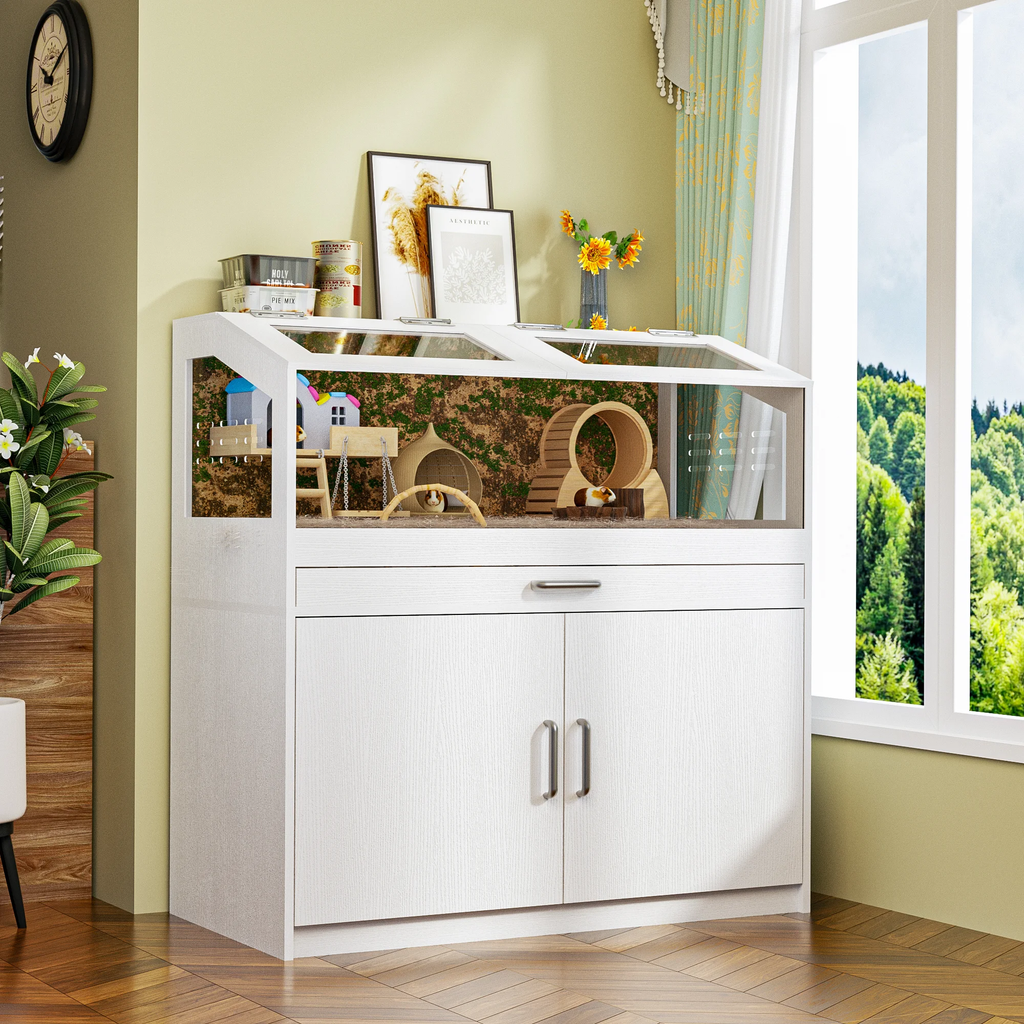
A good practical minimum for a hamster enclosure is 100 × 50 cm (about 39 × 20 inches) of main floor space. Blue Cross and Woodgreen currently recommend this footprint for pet hamsters, while PDSA also cites 100 × 50 cm as a minimum but notes that research has not established one exact scientifically proven cage size. Treat 100 × 50 cm as a starting point, not a target you should avoid exceeding.
Floor space matters more than adding shelves or tubes because hamsters are primarily ground-dwelling burrowers. Height still matters, though, because the enclosure needs enough room for deep bedding, an appropriate wheel and safe enrichment.
What is the minimum hamster cage size?
Three major UK welfare organizations currently point owners toward roughly the same footprint.
Blue Cross recommends housing no smaller than 100 cm long × 50 cm wide × 50 cm tall.
Woodgreen recommends:
- Syrian and Chinese hamsters: 100 × 50 × 50 cm
- Dwarf and Roborovski hamsters: 100 × 50 cm floor space with at least 40 cm height
PDSA also recommends a large enclosure and cites the German Veterinary Association for Animal Welfare’s 100 × 50 cm minimum.
However, PDSA adds an important qualification: there is not much evidence establishing exactly how large a hamster cage must be.
That distinction is worth preserving.
100 × 50 cm is a strong current welfare recommendation, not a biological threshold where 99 × 49 cm is suddenly unsafe and 100 × 50 cm is automatically ideal.
Is 100 × 50 cm enough, or should you go bigger?
If you can provide more usable space, that can be worthwhile.
Blue Cross and PDSA both explicitly encourage owners to go larger than the minimum.
There is also some experimental evidence supporting that direction. A study of 60 individually housed female Syrian hamsters compared cages with floor areas of 1,800, 2,500, 5,000 and 10,000 cm².
The researchers found stereotypic wire gnawing in all cage sizes, but hamsters in smaller cages did it more frequently and for longer. They concluded that welfare appeared improved in the 10,000 cm² cages compared with the smaller cages.
That does not mean every pet hamster now requires exactly 10,000 cm². The study involved female Syrian hamsters under controlled conditions and cannot establish one universal pet-hamster minimum.
It does show why 5,000 cm², which is what a 100 × 50 cm enclosure provides, should be viewed as a practical minimum rather than an evidence-backed optimum.
Do dwarf hamsters need less cage space?
Current Blue Cross and Woodgreen recommendations do not reduce the basic 100 × 50 cm footprint for dwarf hamsters.
Woodgreen uses the same floor dimensions for Syrian, Chinese, dwarf and Roborovski hamsters, although its height recommendation is slightly lower for dwarf and Roborovski species.
So choosing a smaller hamster should not be treated as a way to buy a tiny cage.
Dwarfs may require smaller wheels and different bar spacing, but they still spend substantial time running, digging, foraging and exploring.
The practical recommendation is therefore:
| Hamster | Practical minimum floor footprint |
|---|---|
| Syrian | 100 × 50 cm |
| Chinese | 100 × 50 cm |
| Campbell’s / hybrid dwarf | 100 × 50 cm |
| Winter White | 100 × 50 cm |
| Roborovski | 100 × 50 cm |
These numbers reflect current welfare guidance rather than a species-by-species experimental threshold.
Does floor space matter more than height?
Yes, but height is not irrelevant.
PDSA specifically says that single-level larger cages tend to be preferable to tall multi-level cages. Hamsters have relatively poor eyesight and can be injured by falls.
That means several small platforms stacked above one another should not be used to turn a small base into a supposedly large enclosure.
When comparing two cages, prioritize:
- the size of the main usable base
- enough height for deep bedding
- enough clearance for an appropriate upright wheel
- safe access to hides, sand and enrichment
- secure ventilation and escape prevention
A shelf can be useful for supporting a wheel, water bowl or sand bath. It just does not replace the main floor footprint.
How much bedding should the enclosure hold?
Cage dimensions only matter if the enclosure can also support normal burrowing behavior.
Current recommendations vary somewhat.
Blue Cross recommends at least 20 cm of digging bedding.
PDSA recommends the enclosure be capable of holding at least 25 cm.
Woodgreen recommends substantial bedding throughout the enclosure with a deeper area of around 25–30 cm for larger burrows and nests.
So a cage can technically have a 100 × 50 cm footprint and still be a poor choice if its base is so shallow that you cannot provide meaningful digging depth.
For the full evidence and setup options, see our hamster bedding depth guide.
How should you measure a hamster cage?
Do not rely only on the product name or advertised volume.
Measure the area your hamster can actually use.
Measure the main base
For a rectangular enclosure:
length × width = floor area
A 100 × 50 cm base provides 5,000 cm².
Measure the internal usable dimensions where possible rather than assuming the manufacturer’s outer dimensions equal the hamster’s living space.
Frames, sloping sides and thick walls can reduce the usable footprint.
Do not add shelves to the minimum
If the main base measures 80 × 40 cm and the cage has a second shelf, it does not become equivalent to a 100 × 50 cm enclosure.
Platforms are enrichment and furniture space, not substitutes for a sufficiently large continuous base.
Be careful with tapered storage bins
Large storage bins can look enormous at the rim but narrow considerably toward the bottom.
Check the internal dimensions around the level where the hamster will actually live rather than using only the widest measurements printed on the lid.
Is a 40-gallon breeder tank big enough?
This is one recommendation I would remove from the old article.
A standard 40-gallon breeder aquarium does not necessarily meet a 100 × 50 cm footprint.
For example, Aqueon’s current 40 Breeder is listed at approximately 36.25 × 18.25 inches internally, or roughly 92 × 46 cm.
That falls short of 100 × 50 cm despite being commonly described online as a large hamster tank.
Aquarium sizes are product categories, not welfare measurements.
So instead of asking:
“Is 40 gallons enough?”
ask:
“What are the actual internal length and width?”
Larger tanks can make excellent hamster enclosures when their dimensions, ventilation and lid are appropriate.
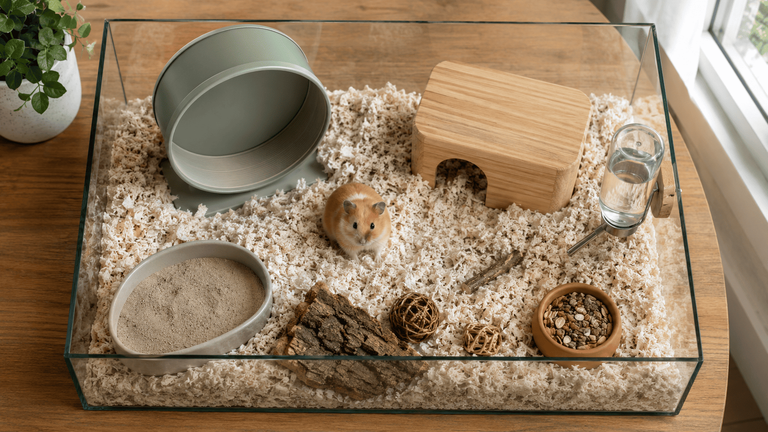
Are glass tanks good hamster enclosures?
They can be.
Blue Cross specifically describes tanks and aquariums as useful because they can hold deep bedding and reduce escape risk through bars.
A suitable glass enclosure needs:
- enough floor space
- a secure mesh or otherwise well-ventilated lid
- enough height for bedding and the wheel
- appropriate temperature management
- safe access for cleaning and handling
Volume in gallons alone tells you very little about whether the shape is appropriate.
A tall narrow aquarium can hold more gallons than a shorter enclosure while providing less useful hamster floor space.
See our hamster tank vs cage guide for the full comparison.
What about DIY bin cages?
A bin enclosure can work if the finished enclosure genuinely provides enough usable space and ventilation.
The problem is that storage-bin labels can be misleading for exactly the same reason as aquarium gallons.
A large-capacity bin may:
- taper sharply toward the bottom
- lose internal space because of molded handles or wheels
- have insufficient height after deep bedding is added
- need substantial ventilation added safely
Measure the finished enclosure rather than assuming a particular liter or gallon capacity makes it suitable.
Any modified mesh also needs to be installed securely with no sharp exposed edges.
Are most pet-shop hamster cages too small?
Many are.
PDSA specifically warns that most hamster cages sold in shops are not large enough to meet a hamster’s basic needs and recommends extra-large cages, tanks or suitable homemade enclosures instead.
That does not mean every commercially manufactured hamster cage is unsuitable.
The useful lesson is to ignore the word “hamster” on the box and check the actual measurements.
A product being marketed for hamsters does not tell you whether it meets current welfare recommendations.
Does a small cage cause bar biting?
Cage size can contribute, but bar biting is not a cage-size diagnostic test.
The Syrian hamster cage-size study mentioned earlier found that hamsters in smaller cages performed stereotypic wire gnawing significantly more often and for longer.
However, wire gnawing still occurred in the largest cages tested.
So this statement is too strong:
“Bar biting means the cage is too small.”
A better interpretation is:
repetitive bar biting can indicate that the housing or enrichment needs improvement, and enclosure size is one important factor to review.
Other repetitive behaviors also need context. Pacing, climbing bars or repeated escape attempts should prompt you to review the whole setup, including:
- available floor space
- bedding depth
- wheel suitability
- hides and cover
- opportunities to forage and dig
- disturbance and handling
- whether the behavior is new or accompanied by signs of illness
Upgrading an undersized cage can be an important part of fixing the environment, but no single behavior proves one cause.
Can a hamster cage be too big?
There is no evidence-based upper cage-size limit for normal pet housing.
A larger enclosure still needs to be well furnished.
Simply placing a hamster in a huge empty box does not provide good welfare. The hamster needs cover, deep bedding, hides, a suitable wheel, foraging opportunities and other enrichment so it can use the space normally.
For a nervous hamster, the solution to a large enclosure is more cover and hides, not deliberately reducing the floor space below current welfare recommendations.
How to upgrade from a cage that is too small
If your current enclosure falls short, focus on the finished setup rather than buying the first product advertised as an “XL hamster cage.”
Check:
- internal floor dimensions
- available bedding depth
- total height after bedding is added
- wheel clearance
- ventilation
- secure doors or lid
- ease of placing heavy furniture on stable platforms
When moving your hamster, set the new enclosure up first.
Transfer familiar clean hides and some clean, used bedding where practical. That preserves familiar scent while still giving your hamster the improved environment.
Avoid replacing every object and every piece of bedding at the same time unless there is a hygiene or medical reason to do so.
For the complete layout, see our hamster cage setup guide.
Floor space or enclosure volume: which number matters?
For shopping, dimensions are much more useful than liters or gallons.
Two enclosures can have similar total volume while having very different footprints.
A hamster needs room for:
- a burrow system
- a correctly sized wheel
- several hides
- a sand area
- food and water
- digging and foraging zones
Those features compete mainly for horizontal space.
Use volume only as a secondary specification. Judge the enclosure first by its usable length, width and ability to accommodate deep bedding safely.
The bottom line
For current pet-hamster care, 100 × 50 cm is a sensible practical minimum floor footprint for all commonly kept hamster species. Blue Cross and Woodgreen directly recommend it, and PDSA cites the same minimum while acknowledging that research has not established one exact cage-size threshold.
That nuance matters.
Do not treat 100 × 50 cm as proof that a hamster needs no more space. Research in female Syrian hamsters found better welfare indicators in substantially larger cages, reinforcing the value of going beyond the minimum where practical.
Prioritize the main usable floor footprint over shelves and tube systems. Make sure the enclosure can also hold around 20–25 cm or more of bedding, an appropriate wheel and enough enrichment.
And measure the actual enclosure rather than relying on labels such as “large hamster cage” or “40-gallon breeder.” A standard 40 breeder can still fall short of the 100 × 50 cm footprint.
Keep reading: Hamster cage setup | Hamster bedding depth | Hamster tank vs cage
External sources: Blue Cross hamster care | Woodgreen hamster care | PDSA hamster care | Fischer et al., hamster cage-size study
Hamster Corner provides general educational information about hamster care. If your hamster shows a sudden or significant change in behavior or health, contact a hamster-experienced veterinarian.


[…] our hamster cage size guide for a deeper look at enclosure […]
[…] our hamster cage size guide before replacing an […]
[…] our hamster cage size guide for the full […]
[…] For more detail, see hamster cage size. […]
[…] For the evidence and welfare recommendations behind the 100 × 50 cm figure, see our hamster cage size guide. […]
[…] same floor dimensions for the commonly kept species, with different minimum heights.Our guide to hamster cage size requirements explains how to measure usable floor space and why product labels such as “large hamster cage” […]
[…] main floor area simply because the hamster takes up less physical space.See the full explanation of hamster cage size requirements before buying an […]