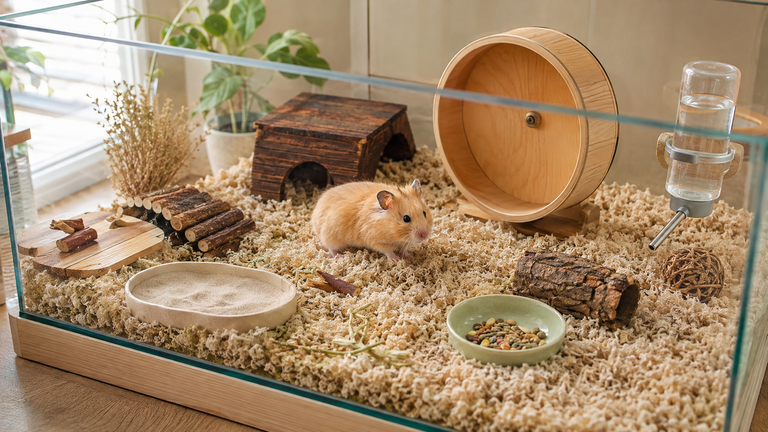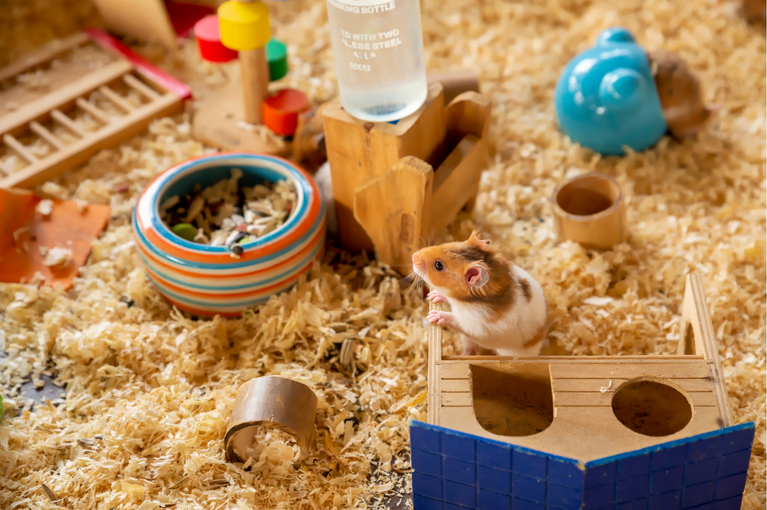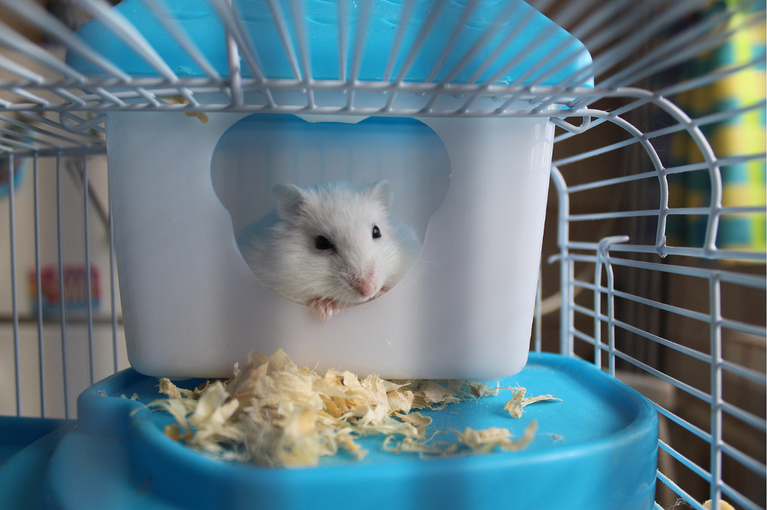
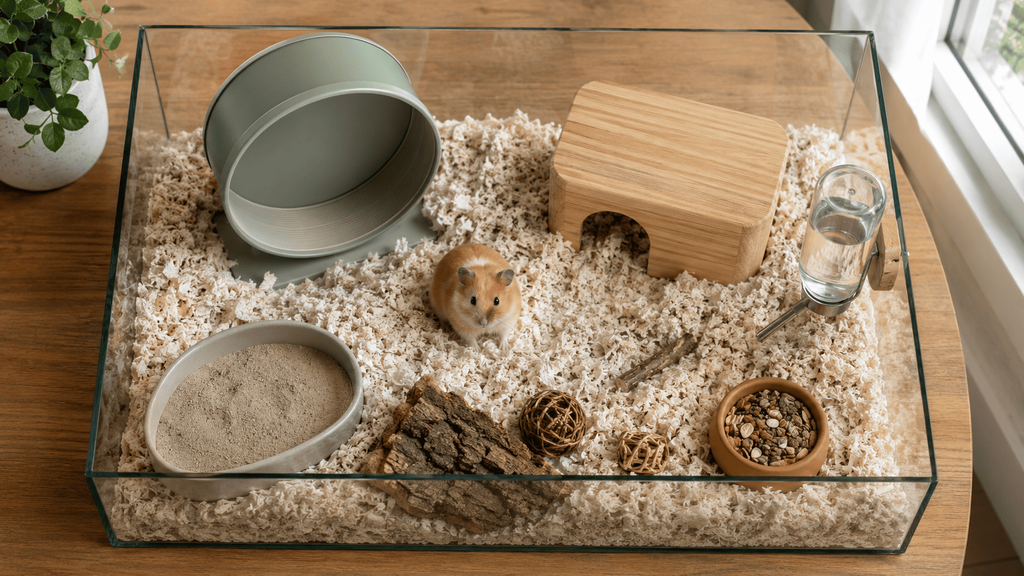
Most hamster starter kits include several accessories but miss the things that matter most: enough floor space, deep bedding and a wheel that does not bend the hamster’s back.
A hamster does not need a colorful cage packed with plastic accessories. It needs room to burrow, run, hide and forage. Many products marketed for hamsters are too small, unnecessary or unsafe, so the label alone cannot tell you what to buy.
This hamster cage essentials guide separates genuine must-haves from useful extras and products you can leave on the shelf.
1. Complete hamster cage essentials checklist
Use this checklist before bringing the hamster home. The enclosure should be assembled, filled and tested before the animal arrives.
| Priority | Supplies |
| Must-have | Large enclosure, secure lid, supportive bedding, solid upright wheel, dark hide, balanced food, fresh water, platform, safe nesting material and travel carrier |
| Strongly recommended | Sand bath, multichamber hide, additional cover, cork tunnel, chew materials, foraging items, dig box and digital scale |
| Optional | Food bowl, low platforms, safe branches, extra dig boxes, night camera, playpen and nonhazardous decoration |
| Avoid | Hamster ball, fluffy nesting material, wire wheel, bathing dust, scented bedding, tiny modular cage, narrow tubes, fabric items and high climbing structures |
1.1 Must-have before the hamster arrives
- Enclosure with at least 100 × 50 cm of continuous floor space
- Secure mesh lid or locking doors
- Safe bedding that can hold a burrow
- Correctly sized solid upright wheel
- At least one dark sleeping hide
- Balanced commercial hamster food
- Water bottle or stable water bowl
- Stable platforms for heavy equipment
- Soft, safe nesting material
- Secure travel carrier
1.2 Strongly recommended
- Sand bath
- Multichamber hide
- Cork log or wide tunnel
- Safe chew materials
- Sprays or other foraging items
- One or two additional hides
- Dig box with a different substrate
- Digital scale for weight monitoring
1.3 Optional items
A food bowl is optional if most dry food is scatter-fed. Low platforms, additional digging areas, safe branches, a night camera and a supervised playpen can all be useful, but none compensates for inadequate space, bedding or wheel size.
Decoration is optional. Add it only when it does not reduce usable space, block the wheel or create a chewing, trapping or falling hazard.
1.4 Supplies to avoid
Do not add:
- Hamster exercise balls
- Cotton wool, kapok or bamboo fluff
- Wire or mesh wheels
- Undersized wheels
- Chinchilla dust or other fine bathing powder
- Wire flooring
- Scented bedding
- Tiny modular cages
- Narrow, poorly ventilated plastic tubes
- High platforms without fall protection
- Fabric hammocks, rope or yarn
- Heavy ceramic accessories placed on unsupported bedding
2. Start with the right hamster enclosure
The enclosure is the most important purchase. No combination of toys can correct a habitat that is fundamentally too small.
2.1 Minimum hamster cage size
All commonly kept pet hamsters should have at least 100 cm long × 50 cm wide of uninterrupted floor space. That is approximately 39 × 20 inches or 775 square inches.
| Hamster | Minimum floor space | Suggested height | Bar spacing |
| Syrian hamster | 100 × 50 cm | Around 50 cm or more | About 1 cm or less |
| Chinese hamster | 100 × 50 cm | Around 50 cm or more | About 1 cm or less |
| Dwarf hamster | 100 × 50 cm | At least around 40 cm | About 7 mm or less |
| Roborovski hamster | 100 × 50 cm | At least around 40 cm | About 7 mm or less |
These dimensions are a practical welfare baseline, not a luxury target. Some female Syrians are particularly active and may benefit from substantially more space and enrichment.
Dwarf hamsters are smaller, but that does not remove their need to run, forage and build burrows. Do not reduce the main floor area simply because the hamster takes up less physical space.
See the full explanation of hamster cage size requirements before buying an enclosure.
2.2 Measure the inside base
Measure the usable interior floor rather than relying on:
- Product names such as “large”
- The number of levels
- Liter or gallon capacity
- External measurements
- Dimensions taken across the top of a storage bin
Storage bins often taper toward the bottom, making the base smaller than the upper rim. Measure the internal length and width where the hamster will actually live.
Do not subtract the area occupied by the wheel, hide or sand bath from your measurement. Those items are part of the habitat, but the enclosure still needs the full baseline footprint.
2.3 Choose an enclosure type
| Type | Best feature | What to check |
| Glass tank | Holds deep bedding and provides clear visibility | Weight, ventilation and a secure mesh lid |
| Acrylic enclosure | Good visibility and bedding retention | Joints, airflow and chewable edges |
| Large barred cage | Strong ventilation | Base depth, bar spacing and bedding scatter |
| DIY bin cage | Affordable large setup | Interior base size, plastic strength, lid and mesh ventilation |
| Wooden enclosure | Can provide generous dimensions | Must be professionally sealed and easy to keep dry; RSPCA advises against unsuitable wooden cages |
| Modular tube cage | Visually appealing | Usually unsuitable as a main enclosure |
A tank is not automatically better than a barred cage. The material matters less than usable space, bedding capacity, ventilation, security and safe equipment clearance. The RSPCA advises against unsuitable wooden cages, so any wooden build must be sealed, dry and safe to clean.
2.4 Ventilation and escape prevention
A solid-sided enclosure needs a large mesh lid or another substantial ventilation area. A few small drilled holes are not adequate ventilation for a large bin cage.
Use metal mesh rather than plastic mesh. Secure the lid with clips or reliable locks and check every gap around doors, corners, bottle mounts and panel joints.
Place the enclosure away from direct sunlight, drafts, heat sources, loud appliances and household pets. Blue Cross recommends at least 100 × 50 cm of floor space and identifies tanks or aquariums as useful options when they provide suitable ventilation and security. See its hamster care guidance.
3. Choose safe bedding that supports burrowing
3.1 How deep should hamster bedding be?
Provide at least 8 inches or 20 cm of compressed bedding. A better target is 10 to 12 inches or 25 to 30 cm or more in a substantial deep section.
PDSA advises housing that can accommodate at least 25 cm of bedding, while Blue Cross gives 20 cm as a minimum. These recommendations point in the same direction: a thin layer across the floor is not enough.
The depth should be measured after pressing the bedding down. Provide deep bedding over most of the enclosure where possible rather than limiting it to a small digging box.
3.2 Best bedding options
Unscented paper bedding is the most straightforward beginner choice because it is generally soft, absorbent and capable of holding burrows when compressed.
Other supported options include:
- Low-dust aspen
- Unscented hemp
- Plain shredded paper or cardboard
- Small amounts of clean, soft hay for structure
Aspen or hemp can be used alone if the selected product remains low in dust and supports tunnels. If it collapses too easily, mix it with paper bedding.
Read the guide to safe hamster bedding before choosing a product based on fragrance, color or marketing claims.
3.3 Bedding and nesting materials to avoid
Avoid:
- Scented bedding
- Cedar shavings
- Fine sawdust
- Excessively dusty substrate
- Damp or moldy material
- Cotton wool
- Kapok
- Bamboo fluff
- Long-fiber nesting material
- Fabric and yarn
The RSPCA warns that cotton wool and similar fluffy materials can separate into thin strands, become tangled around limbs or cause harm if eaten. Use soft paper-based nesting material that tears apart easily.
3.4 Pack bedding correctly
Add bedding in layers:
- Pour in the first layer.
- Press it down firmly with your hands.
- Add another layer.
- Compress it again.
- Continue until the bedding reaches the intended depth.
- Make a small test hole.
If the hole collapses immediately, the bedding needs more compression or a more supportive mixture.
A partially buried cardboard tunnel or cork log can serve as a burrow starter. Our guide to natural burrowing behavior explains how to build stable tunnels and support accessories safely.
4. Choose the correct hamster wheel
4.1 Hamster wheel size guide
Use the following as starting points:
| Hamster | Starting wheel size |
| Syrian hamster | About 11 to 12 inches / 28 to 30 cm |
| Chinese hamster | About 10 to 11 inches / 25 to 27 cm |
| Campbell’s or Winter White dwarf | About 9 to 10 inches / 22 to 25 cm |
| Roborovski hamster | About 8 to 9 inches / 20 to 22 cm |
Woodgreen recommends a 12-inch solid upright wheel for Syrian and Chinese hamsters and an 8-inch wheel for smaller species. Blue Cross gives more detailed size ranges by species.
The hamster’s posture is the final test. Its back should remain relatively straight while running. If the spine arches upward or the hamster raises its head unnaturally, use a larger wheel.
4.2 What makes a wheel safe?
Choose an upright wheel with:
- A solid running track
- No wire, mesh, rungs or open spokes
- Stable rotation
- Enough track width
- A strong stand
- A surface that can be cleaned
- Enough clearance from the lid and bedding
A wheel should not wobble, tip or slide while the hamster runs.
4.3 Size and safety matter more than silence
A quiet wheel is helpful in a bedroom, but “silent” is not the first selection criterion.
Choose in this order:
- Correct diameter
- Solid running surface
- Stability
- Ease of cleaning
- Noise level
A silent wheel that bends the hamster’s back is still the wrong wheel.
See how to choose the correct hamster wheel size before buying based on brand or product photos.
4.4 Place the wheel on a platform
A hamster may burrow beneath equipment. A wheel placed directly on deep bedding can tilt, sink or stop turning.
Use a platform or stand with legs that reach the enclosure base. Leave enough clearance for the wheel to rotate without hitting bedding, a wall, the lid or nearby decoration.
5. Provide a dark hide and nesting area
5.1 At least one secure hide is essential
The main sleeping hide should be:
- Dark and enclosed
- Large enough for the hamster to turn around
- Wide enough at the entrance for full cheek pouches
- Free from sharp edges
- Stable on or within the bedding
- Positioned away from a leak-prone water bottle
A hide does not replace deep bedding. The hamster should be able to use both.
5.2 A multichamber hide is strongly recommended
A multichamber hide gives the hamster several enclosed areas that may be used for sleeping, food storage or toileting.
A floorless model can connect directly to the bedding. A removable roof helps with necessary inspections, although it should not be lifted repeatedly simply to look at the hamster.
A multichamber hide is useful rather than universally mandatory. A hamster with a secure nesting box, deep bedding and other dark cover can still have an appropriate setup.
5.3 Safe budget hideouts
Budget alternatives include:
- Plain cardboard boxes
- Tissue boxes with the plastic film removed
- Stable ceramic mugs placed on their sides
- Safe terracotta pots
- DIY cardboard multichamber houses
- Natural cork tunnels
Remove staples, tape, plastic windows and questionable coatings. Smooth any cut edges and make each entrance wide enough to prevent trapping.
6. Add a sand bath
6.1 Why hamsters need sand
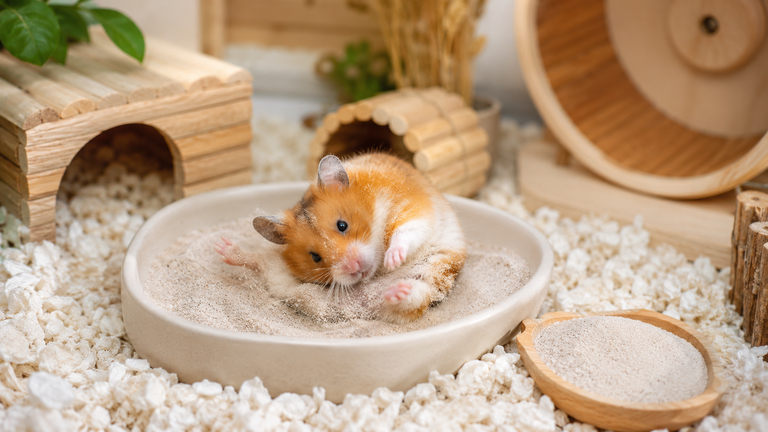
Sand helps hamsters maintain their coats and provides another substrate for digging and exploration. Many hamsters also choose it as a toilet area.
A sand bath is strongly recommended for every commonly kept hamster species. RSPCA guidance includes sand as part of a suitable hamster environment. Roborovski hamsters often make especially frequent use of a larger sand area.
6.2 Choose safe sand
Look for sand that is:
- Low in dust or dust-extracted
- Unscented
- Uncolored
- Nonclumping
- Free from added calcium
- Free from fragrance and other additives
Some chinchilla bathing sands can be suitable when they are genuinely sand rather than powder. Avoid chinchilla dust, talc-like bathing powder, calcium sand, clumping litter and scented sand.
The safest approach is to assess the texture and labeling carefully rather than assuming every product with “chinchilla” or “hamster” on the bag is identical. See the guide to choosing safe hamster sand.
6.3 Choose a stable container
The container should be:
- Large enough for the hamster to turn and dig
- Easy to enter
- Deep enough to hold a useful layer of sand
- Heavy enough not to tip
- Easy to spot-clean
Place it on a platform rather than directly over an unsupported burrow.
7. Food and water essentials
7.1 Balanced hamster food
Buy a commercial food formulated specifically for hamsters before the hamster comes home. Keep it dry, sealed and protected from insects.
If the hamster has been eating a different product, transition gradually rather than changing the entire diet on the first day.
This article focuses on supplies rather than nutrition. Use the complete guide to a balanced hamster diet for staple foods, fresh additions and foods to avoid.
7.2 Is a food bowl essential?
Food is essential. A bowl is not.
Scatter feeding dry food encourages foraging and gives the hamster more to do. A shallow bowl can still be helpful for:
- Fresh foods
- Monitoring a new hamster’s intake
- Older or less mobile hamsters
- Feeding directed by a veterinarian
If you use one, choose a stable, shallow ceramic bowl.
7.3 Water bottle or water bowl?
| Option | Advantages | What to monitor |
| Water bottle | Less likely to collect bedding or food | Blocked nozzle, leakage and mounting height |
| Water bowl | Easy to inspect and allows a natural drinking position | Tipping, contamination and buried bedding |
Either system can work if the hamster can reach it easily and the water remains clean.
Use a heavy bowl on a platform. Check bottle flow every day. During the first few days, offering both can help ensure a new hamster locates a water source.
8. Platforms are a safety essential
Platforms are not merely decoration when they support heavy equipment.
Use them beneath:
- Wheels
- Sand baths
- Ceramic hides
- Water bowls
- Heavy wooden houses
- Rocks
- Large dig boxes
A suitable platform should have legs that reach the enclosure base, remain stable under pressure and contain no sharp edges or trapping gaps.
Place heavy equipment and platforms before adding deep bedding. The hamster can then burrow around the supports without causing the object above to sink into the tunnel.
9. Add chews, tunnels and enrichment
9.1 Chew materials
Suitable options include:
- Plain cardboard
- Natural cork
- Hamster-safe untreated wood
- Appropriately prepared safe branches
- Purpose-made wooden chews
Chewing is natural and provides activity. However, chew toys do not guarantee that every dental problem will be prevented. Overgrown or misaligned teeth require veterinary assessment.
9.2 Tunnels and covered routes
Use:
- Cork logs
- Wide cardboard tubes
- Low wooden bridges with safe gaps
- Cardboard boxes
- Appropriately sized wooden tunnels
- Clearly identified safe sprays for cover
Every tunnel must be wide enough for the hamster to pass through with full cheek pouches. Avoid long, narrow plastic tube systems with poor airflow.
Covered routes help a prey animal cross the enclosure without feeling completely exposed. They should not block the main running path or wheel.
9.3 Foraging enrichment
Low-cost options include:
- Scatter feeding
- Food hidden in plain cardboard
- Seed sprays with identified ingredients
- Safe dried herbs
- Paper bags
- Dig boxes
- Multiple substrate textures
The best enrichment supports an activity. A brightly colored object that the hamster cannot dig through, hide under, chew or investigate may be decoration rather than enrichment.
See these hamster enrichment ideas after the basic setup is complete.
10. Hamsterscaping for beginners
Hamsterscaping means arranging an enclosure around natural behaviors such as burrowing, hiding, foraging, running and sand bathing. It is not simply decorating a cage.
10.1 Divide the enclosure into functional zones
| Zone | What to include |
| Deep bedding zone | Burrowing area, nest and floorless hide |
| Wheel zone | Wheel on a stable platform |
| Sand zone | Sand bath supported from the base |
| Foraging zone | Sprays, herbs and scatter-fed food |
| Covered route | Cork logs, tunnels and low hides |
| Water zone | Accessible bottle or bowl away from the burrow |
The zones do not need rigid borders. Their purpose is to prevent equipment from competing for the same unstable space.
10.2 Balance cover with movement
A completely empty enclosure can feel exposed, but overcrowding creates its own problems.
Leave clear paths between the nest, water, wheel and sand bath. Use low cover around those routes rather than building tall climbing structures.
The hamster should be able to move freely, access every resource and use the wheel without bumping into nearby objects.
10.3 Adjust the setup by species
| Feature | Syrian hamster | Dwarf or Roborovski hamster |
| Entrances and tunnels | Larger openings for the body and full cheek pouches | Smaller openings can work, but must not trap the hamster |
| Wheel | Usually 11 to 12 inches | Usually 8 to 10 inches depending on species and posture |
| Bar spacing | Around 1 cm or less | Around 7 mm or less |
| Sand area | Useful permanent bath | Roborovski hamsters often benefit from a larger sand section |
| Equipment | Larger, heavier accessories need strong platforms | Lighter equipment still needs stable support |
11. How to build a safe DIY hamster bin cage
11.1 When a bin cage makes sense
A bin cage can be a practical budget option when:
- The internal base measures at least 100 × 50 cm
- The bin is tall enough for deep bedding and the wheel
- The plastic is strong and undamaged
- A large metal-mesh ventilation panel can be installed
- The lid closes securely
Do not use a bin simply because its capacity sounds large. Liters, gallons and quarts do not tell you the internal floor dimensions.
A tapered bin may be wide at the top but much too narrow at the base.
11.2 Essential materials
A safer build requires:
- Large, strong storage bin
- Secure lid
- Appropriately spaced metal mesh
- Bolts, washers and nuts or another strong fastening method
- Suitable cutting tools
- File or edge protection
- Drill
- Measuring tape
Do not use plastic mesh. Avoid exposed tape, sharp wire ends or fasteners the hamster can chew. Any fastening tails or edges should remain outside the enclosure or be securely shielded.
11.3 Safety principles
- Measure the internal bottom before buying
- Create a large mesh ventilation panel
- Preserve enough solid wall height for deep bedding
- Smooth every cut edge
- Secure the mesh so it cannot shift
- Test the lid before use
- Check wheel clearance
- Inspect the plastic regularly for cracks and chew damage
- Keep the bin away from direct sunlight
Do not join several small bins and add their floor areas together. A tube connection does not turn separate boxes into one continuous enclosure.
The full guide explains how to build a safe hamster bin cage and what to test before adding bedding.
12. Budget hamster cage setup ideas
Some items are easy to replace with safe household alternatives.
| Item | Budget alternative |
| Sleeping hide | Plain cardboard or tissue box without plastic film |
| Tunnel | Wide cardboard tube, cut lengthwise if trapping is possible |
| Multichamber hide | DIY plain cardboard structure |
| Foraging toy | Paper bag, egg carton or toilet paper roll |
| Dig box | Stable food-safe container or ceramic dish |
| Water bowl | Small heavy ceramic dish |
| Platform | Stable untreated wood platform |
| Enclosure | Properly sized and ventilated bin cage |
Do not choose the cheapest possible version of:
- The enclosure
- Wheel
- Main bedding
- Lid and mesh
- Support platforms
- Staple food
A good budget order is:
- Enclosure
- Bedding
- Wheel
- Hide and platforms
- Food and water
- Sand bath
- Enrichment
- Decoration
Cardboard enrichment can be replaced cheaply. An undersized enclosure or wheel is more expensive to correct later.
13. Items marketed for hamsters that you do not need
13.1 Hamster ball
A hamster cannot leave a ball voluntarily or access water, food and cover. Collisions, trapped feet and poor ventilation are additional concerns. Blue Cross advises against hamster exercise balls. Use a secure playpen instead.
13.2 Cotton or fluffy nesting material
Long fibers can tangle around limbs or cause harm if swallowed. Use unscented paper nesting material.
13.3 Tiny plastic houses
A hide must accommodate the hamster’s body and full cheek pouches. Many small plastic houses are unsuitable for Syrians despite being labeled for hamsters.
13.4 Mineral and salt licks
Do not assume every hamster needs supplementation. A balanced staple diet is the priority, and additional supplements should not be introduced without a specific reason or veterinary guidance.
13.5 Harnesses and leashes
Hamsters are too small and fragile for conventional walking equipment. A harness can cause injury or prevent normal escape behavior.
13.6 Wire climbing toys and high ladders
Hamsters have poor eyesight and are not built for high-level climbing. Use low, stable structures and reduce fall distances.
13.7 Decorative fabric
Fabric, yarn and rope can be chewed, swallowed or tangled around the limbs. Choose cardboard, cork and safe solid materials instead.
13.8 Elaborate feeding stations
A single hamster does not need multiple bowls and feeding platforms. Scatter feeding is simpler and provides better foraging value for dry food.
Frequently asked questions
What are the essentials for a hamster cage?
A hamster needs a spacious, secure enclosure, deep supportive bedding, a correctly sized solid wheel, dark sleeping hide, sand bath, balanced food, fresh water, stable platforms and safe enrichment. Prepare and test all of these before bringing the hamster home.
What size cage does a hamster need?
Provide at least 100 × 50 cm, or approximately 39 × 20 inches, of continuous internal floor space. Platforms, shelves and connected tubes do not replace the main floor. The enclosure must also be tall enough for deep bedding and a suitable wheel.
How deep should bedding be in a hamster cage?
Provide at least 8 inches or 20 cm of compressed bedding. A deep section of 10 to 12 inches or 25 to 30 cm or more gives the hamster more room to build burrows. The material must remain stable after compression.
What size wheel does a Syrian hamster need?
Most Syrian hamsters need a solid upright wheel around 11 to 12 inches or 28 to 30 cm. Check the hamster while it runs. If the back arches or the head lifts unnaturally, use a larger wheel.
What size wheel does a dwarf hamster need?
The smallest Roborovski hamsters may use an 8 to 9 inch wheel, while Campbell’s and Winter White hamsters often need 9 to 10 inches. The wheel can be larger when it remains lightweight, stable and easy for the hamster to turn.
Does a hamster need a sand bath?
A sand bath is strongly recommended for every pet hamster. It supports grooming and provides another digging texture. Use clean, low-dust, nonclumping sand rather than chinchilla dust, calcium sand or scented bathing powder.
Does a hamster need a food bowl?
No. The food itself is essential, but dry food can be scatter-fed to encourage foraging. A shallow ceramic bowl remains useful for fresh foods, monitoring intake or accommodating an older or unwell hamster.
Is a water bowl or bottle better for a hamster?
Both can work. A bottle is less likely to collect bedding but may block or leak. A bowl is easy to inspect but can tip or become buried. Choose a stable setup and check the water supply every day.
Are DIY bin cages safe for hamsters?
A bin cage can be safe when the internal base is large enough, the plastic is strong, the lid locks and a substantial metal-mesh ventilation panel is installed. A few drilled holes are not enough, and gallon capacity does not prove adequate floor space.
What can I use for cheap hamster hides?
Plain cardboard boxes, tissue boxes without plastic film, stable ceramic mugs, safe terracotta pots and DIY cardboard chambers can all work. Remove tape, staples, plastic windows and sharp edges, and make the entrance wide enough for the hamster’s body and cheek pouches.
Spend your budget on space, bedding depth and wheel size before decorative accessories. Once those foundations are right, add hides, sand, cover and foraging opportunities while keeping heavy objects stable. A simple setup that supports natural behavior is safer than a crowded cage filled with products merely marketed for hamsters.