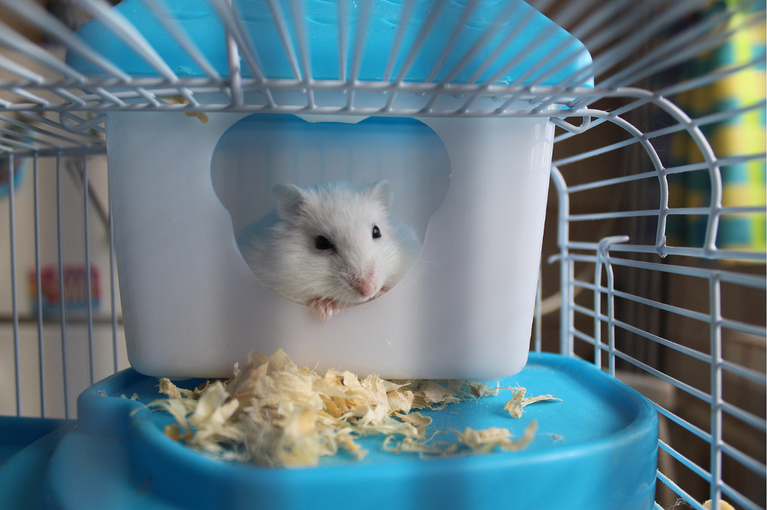

When you bring a new hamster home, the priority is a finished enclosure, a calm transfer and time to settle before handling. Blue Cross recommends leaving a new hamster largely undisturbed, apart from essential feeding and water care, for the first two or three days. Woodgreen gives similar advice and suggests avoiding handling for a day or two. Treat that as a settling period rather than a 48-hour stopwatch.
Your job during those first days is simple: make sure the hamster has everything it needs, keep disruption low, monitor for signs of illness and let it become familiar with its new surroundings before you begin taming.
Set up the enclosure before bringing your hamster home
Do not bring the hamster home first and build the enclosure around it afterward.
Blue Cross specifically recommends preparing the cage before a hamster arrives. That way, the hamster can move directly from the transport carrier into a complete home without another major rearrangement.
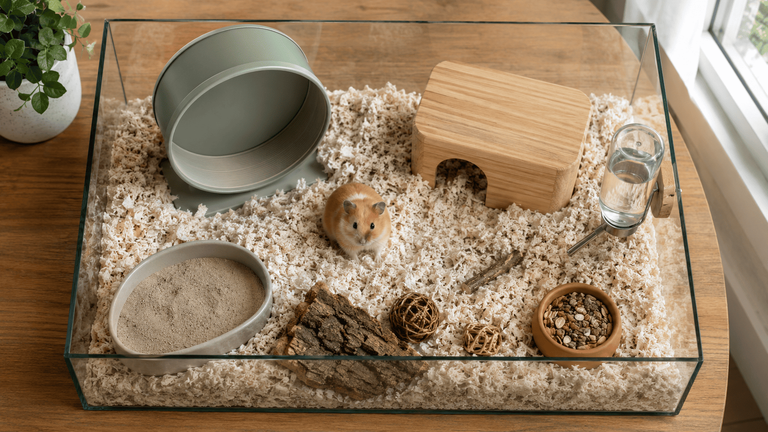
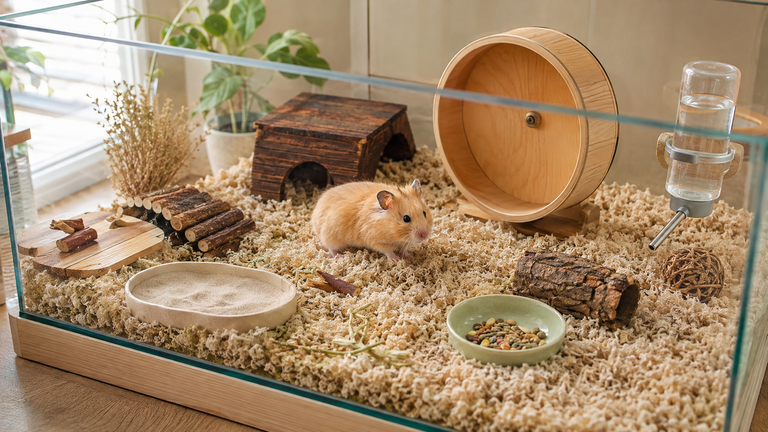
Before collection, make sure the enclosure already has:
- suitable deep bedding
- at least one secure hide
- an appropriately sized solid upright wheel
- fresh water
- the hamster’s normal staple food
- safe nesting material
- enrichment such as tunnels and places to forage
- a secure lid or doors
A sand bath can also be part of the finished setup where appropriate.
For the full layout, see our hamster cage setup guide.
How deep should the bedding be?
There is some variation between welfare organizations, so there is no reason to pretend one exact number is universally agreed upon.
Blue Cross recommends at least 20 cm of digging bedding.
PDSA recommends at least 25 cm.
Woodgreen recommends at least six inches across most of the enclosure plus a deeper area of 25–30 cm for larger burrows and nests.
The useful takeaway is not whether 20 or 25 cm wins.
Give the hamster enough suitable bedding to create real burrows, and provide a deeper digging zone if the enclosure allows it.
For more detail, see our hamster bedding depth guide.
Put the enclosure somewhere quiet and temperature-stable
Where the enclosure sits matters.
PDSA recommends keeping a hamster in a quiet, calm location, away from noisy appliances, draughts and direct sunlight, with a steady temperature around 18–21°C (64–70°F).
That is a better target than the broad 65–75°F range in the old article.
Avoid putting the enclosure:
- beside a television or loud speaker
- next to a washing machine
- in direct sunlight
- beside a cold window or draught
- where dogs or cats can constantly approach it
- in a busy walkway where the hamster is repeatedly disturbed while sleeping
Try to choose the long-term location before the hamster arrives so you do not need to move the entire setup again immediately.
The journey home
Transport itself can be stressful, so keep it straightforward.
RSPCA transport guidance recommends:
- a secure carrier
- suitable bedding
- some clean, familiar used nesting material where available
- ventilation
- covering the carrier enough to make it darker without blocking airflow
- keeping the journey quiet
- avoiding unnecessary travel time
- maintaining a comfortable temperature
Woodgreen also recommends bedding in the carrier, together with a hide or tunnel and some food.
You do not need a rule that says journeys longer than exactly 30 or 45 minutes require a particular intervention. Journey conditions, temperature and access to necessities matter more than an arbitrary cutoff.
Do not repeatedly open the carrier during a routine journey just to check or pet the hamster. Make sure it is secure before leaving and concentrate on getting home safely and calmly.
How to move your hamster into the enclosure
Once home, avoid turning the transfer into the hamster’s first handling session.
If practical, place the secure carrier at the enclosure entrance or inside a large enough enclosure and let the hamster come out without being chased.
Some hamsters will leave quickly. Others may hesitate.
There is no need to tip, shake or grab the hamster simply because it does not exit immediately.
If the carrier cannot safely be placed inside the enclosure, use the calmest transfer method available. A tunnel or small hide can also be useful for moving a nervous hamster without trying to catch it in your hands.
Once the hamster is safely inside, secure the enclosure and give it space.
How long should you leave a new hamster alone?
Think roughly one to three days, not exactly 48 hours.
Woodgreen recommends avoiding handling for a day or two after arrival.
Blue Cross is slightly more conservative and recommends leaving a hamster undisturbed, apart from feeding, for the first two or three days.
Those recommendations are close enough to give us a practical approach:
Do essential care, but postpone unnecessary handling and enclosure changes while the hamster settles.
Essential care still includes:
- checking that fresh water is available
- providing the normal food
- making sure the wheel and other equipment are functioning safely
- addressing an obvious escape or safety hazard
- responding if the hamster appears unwell
“Leave the hamster alone” does not mean ignore a medical problem for three days.
What should you expect during the first few days?
A new hamster may spend a lot of time hidden.
Hamsters normally sleep for much of the day and tend to be more active later in the day and overnight. A nervous new hamster may be especially reluctant to emerge while people are nearby.
You may notice evidence of activity rather than actually seeing it:
- food has been moved or hoarded
- bedding has been rearranged
- tunnels have appeared
- the water level has changed
- the hamster has used its wheel
- droppings appear in different areas
These can show that the hamster is moving around when the room is quiet.
However, wheel use by itself does not prove that a hamster is happy, and hiding by itself does not prove something is wrong.
Look at the overall pattern.
Should you sit and watch your new hamster?
You do not need to disappear from the room entirely.
The useful goal is low disturbance, not a ban on looking at the enclosure.
Normal quiet activity in the room is different from repeatedly tapping the glass, opening the enclosure, moving hides or hovering over the hamster whenever it emerges.
Give it opportunities to explore when it feels safe.
If you want to monitor a shy hamster without disturbing it, checking the food and water or using a camera at night can be more informative than repeatedly waking it during the day.
When can you start taming?
Do not automatically begin because the calendar says “day three.”
After the initial settling period, start when the hamster is:
- naturally awake
- exploring the enclosure
- eating and drinking normally
- no longer immediately retreating whenever you are nearby
Begin slowly.
You might first sit near the enclosure and speak quietly. Later, let the hamster investigate your hand without immediately trying to pick it up.
Blue Cross recommends starting by allowing the hamster to sniff the hand before progressing to gentle touch and eventually two-handed pickup.
Woodgreen similarly recommends gradual handling and letting nervous hamsters approach in their own time.
For the full process, see how to tame a hamster.
A particularly nervous hamster may need longer than three days, and that is fine.
Do not completely clean the enclosure during the settling period
A full clean immediately after arrival is unnecessary unless there is an actual hygiene or safety problem.
Hamsters rely heavily on scent information, and repeatedly changing the layout during the first days adds another environmental change on top of transport and relocation.
You can remove obviously spoiled fresh food and deal with wet or contaminated areas when necessary.
But there is no reason to empty all of the bedding, scrub the enclosure or rearrange every hide because the hamster has chosen a toilet corner.
Once the hamster has settled, use normal spot-cleaning and partial-cleaning practices rather than treating the enclosure as something that needs to be completely sterilized on a schedule.
What if your hamster does not come out?
Hiding during daylight hours is usually not surprising.
What matters more is whether there is evidence the hamster is eating, drinking and moving when it would normally be active.
Do not use “wait 48 hours” as a medical rule.
If you genuinely believe your hamster is not eating or drinking, or it appears weak or abnormal when awake, contact a veterinarian rather than waiting for the settling period to finish.
The RSPCA lists not eating or drinking, significant lethargy during normal active periods, labored breathing, diarrhea, discharge and difficulty walking among signs requiring veterinary attention.
See signs of a sick hamster for a broader checklist.
What health problems should you watch for after bringing a hamster home?
Stress and a change of environment can coincide with illness, particularly in young hamsters, so do not dismiss every abnormal sign as “settling in.”
Contact a hamster-experienced veterinarian promptly if you notice:
- not eating or drinking
- significant lethargy during the hamster’s normal active period
- labored or difficult breathing
- persistent sneezing or respiratory discharge
- diarrhea or a soiled rear
- obvious injury
- difficulty walking
- marked weakness
- another significant change from normal behavior
Blue Cross notes that diarrhoea associated with stress, often called wet tail, is particularly important in newly weaned hamsters and specifically recommends minimizing disturbance during the first two or three days.
A wet or dirty rear is not something to wait out at home.
See our hamster wet tail guide for what to do next.
Should you change the hamster’s food immediately?
Avoid an abrupt diet change simply because the hamster has moved home.
If possible, find out what staple food the hamster was already eating and use that during the transition.
RSPCA hamster feeding guidance advises avoiding sudden dietary changes because they can upset a hamster’s digestive system.
If you intend to switch to a different appropriate staple, transition gradually rather than changing everything on the first night.
The first days already contain enough change without simultaneously replacing the entire diet.
What about familiar bedding from the previous home?
A small amount of clean, unsoiled familiar bedding or nesting material can be useful during transport.
RSPCA specifically recommends used, unsoiled nesting material in a transport carrier.
You do not need to transfer dirty bedding or large amounts of soiled substrate into the new enclosure.
If the breeder, rescue or previous home provides a little clean familiar material, it can simply be placed with the new bedding and left for the hamster to investigate.
A simple first-days timeline
| Time | What to do |
|---|---|
| Before pickup | Complete the enclosure, food, water, wheel, hides and bedding |
| Journey home | Use a secure, ventilated carrier with bedding; keep transport calm |
| Arrival | Transfer calmly and avoid turning it into a handling session |
| First 1–3 days | Essential food/water checks only; minimize handling and rearranging |
| After settling | Begin quiet, gradual taming when the hamster is awake and comfortable |
| Any time | Contact a vet promptly if significant illness signs appear |
This is a guide, not a countdown.
A confident hamster may begin approaching you relatively quickly. A very nervous hamster may take considerably longer.
The bottom line
Prepare the enclosure before your hamster arrives, make the journey home calm, transfer the hamster without unnecessary handling and then give it a quiet settling period.
There is good welfare support for leaving a new hamster largely undisturbed for roughly the first one to three days, with Blue Cross recommending two to three days and Woodgreen advising a day or two.
That is more useful than treating 48 hours as an exact rule.
Keep providing food and water, deal with genuine safety issues, and monitor health without constantly disturbing the enclosure. Start taming only after the hamster is naturally awake, eating, drinking and beginning to explore comfortably.
Most importantly, do not confuse “give it space” with “ignore signs of illness.” A hamster that is not eating or drinking, has diarrhea, difficulty breathing, weakness or another significant health change needs veterinary attention even if it arrived only a few hours ago.
Keep reading: Hamster cage setup | Hamster bedding depth | How to tame a hamster | Signs of a sick hamster
Hamster Corner provides general educational information about hamster care. It is not a substitute for professional veterinary advice. If your new hamster shows significant signs of illness, contact a hamster-experienced veterinarian promptly.