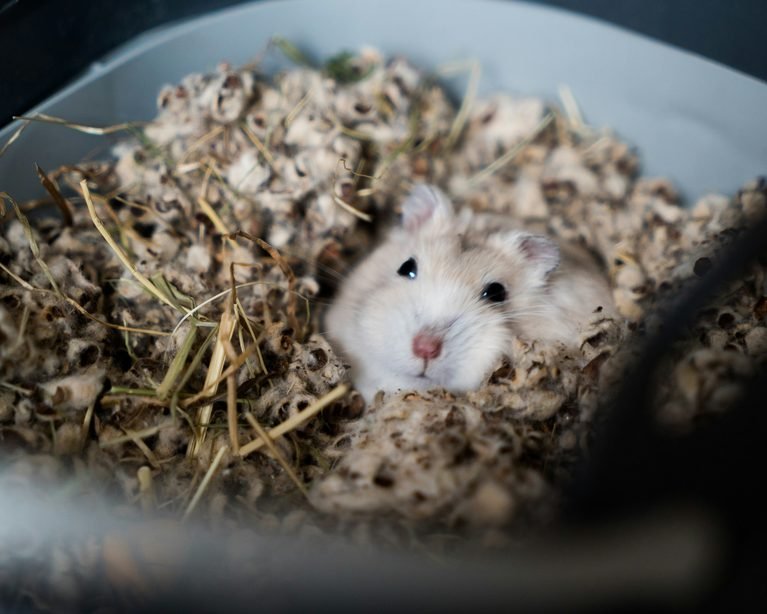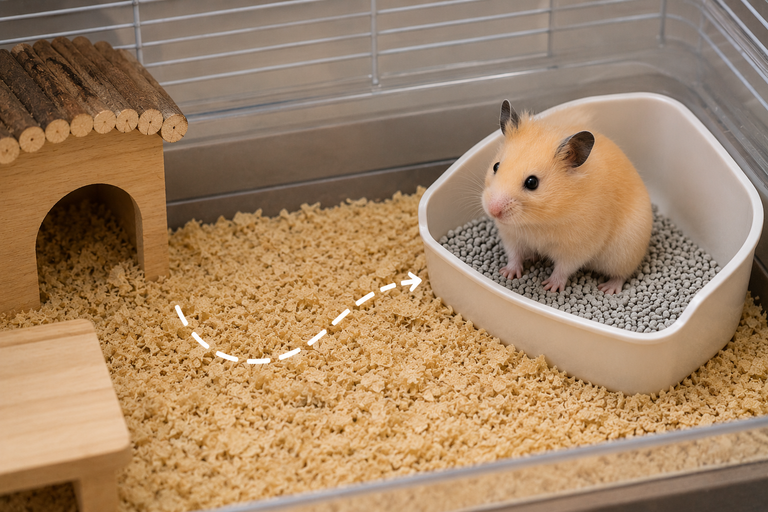
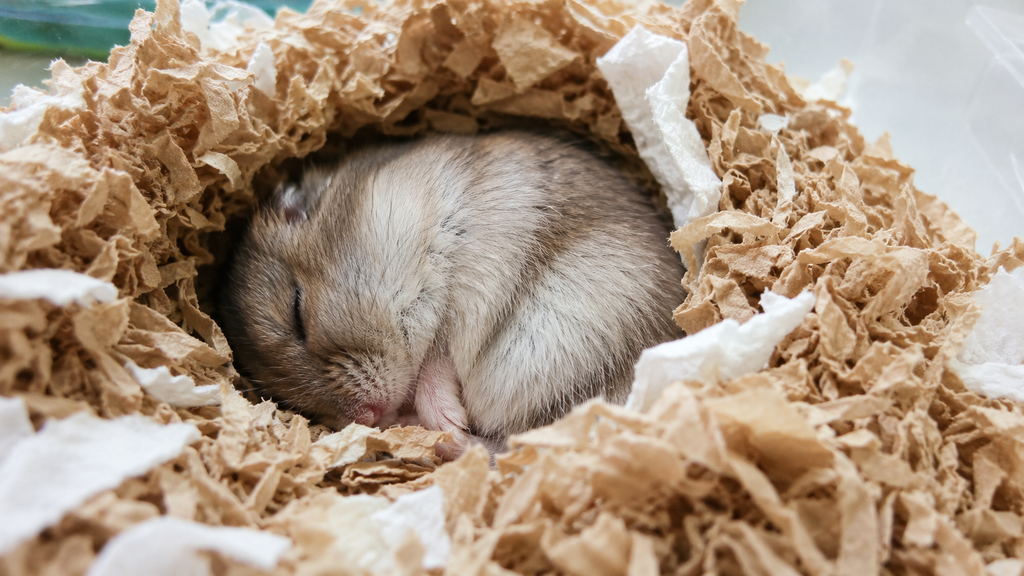
A cold, motionless hamster may be in torpor rather than dead, especially after exposure to a cold environment. Torpor can make breathing extremely slow and the body cool and unresponsive, so do not assume a hamster has died based on appearance alone. Move the hamster gradually to a warm room, look carefully for signs of breathing, and contact a hamster-experienced vet as soon as possible if you suspect torpor or are unsure.
The important point is not to prove torpor at home before asking for help. Severe illness, hypothermia, torpor and death can look similar in a small animal.
Do hamsters hibernate?
The answer depends on what we mean by “hibernate” and which hamster we are talking about.
Some wild hamster species are true hibernators. Syrian hamsters are also capable of deep hibernation under sufficiently cold experimental or natural conditions.
Pet-care sources often use the term torpor for the dangerous, hibernation-like state seen when a pet hamster becomes too cold or faces other unfavorable conditions.
PetMD describes torpor as a state in which heart rate, breathing, activity and body temperature fall dramatically. It may last from hours to days.
PDSA similarly says Syrian hamsters may enter short-term torpor when exposed to low temperatures.
The terminology is less important than the practical point:
A pet hamster becoming cold and barely responsive is not normal sleep and should be taken seriously.
What causes torpor in pet hamsters?
Cold is an important trigger, but there is no single household temperature below which every hamster will suddenly enter torpor.
PetMD lists exposure to temperatures below 41°F (5°C), reduced daylight and food restriction among possible triggers.
However, welfare organizations recommend acting long before a room becomes that cold.
PDSA recommends keeping a hamster’s environment at a steady 18–21°C (64–70°F). Woodgreen gives the same approximate 18–21°C range, while PetMD recommends around 65–80°F for normal housing.
So I would not use 5°C as the practical threshold for owners.
A cold room, significant temperature drop, draught or inadequate access to food can all be relevant context if a hamster suddenly becomes unusually inactive.
How can you tell torpor from death?
You cannot always be certain at home.
A hamster in deep torpor may look lifeless because breathing and other body functions have slowed dramatically.
Woodgreen recommends checking for several signs:
- Breathing: watch the chest very carefully for several minutes. Breaths may be extremely slow and shallow.
- Small responses: gently stroking the hamster may produce a tiny whisker movement.
- Body flexibility: a torpid hamster is often limp or flexible rather than rigid.
- Temperature: a torpid hamster will feel unusually cool.
Woodgreen notes that breathing during torpor can be as infrequent as roughly one breath every two minutes, which is why looking for only a few seconds is not enough.
However, none of these checks gives you a perfect home diagnosis.
Rigor mortis can make a hamster that has died stiff after death, but stiffness later changes again. Likewise, the absence of an obvious whisker twitch does not prove death.
If you are unsure, treat the situation cautiously and contact a vet.
Do not pull on the hamster’s paws to test it
The old advice to gently pull a paw and look for a stretch response is unnecessary.
PDSA and Woodgreen suggest watching for breathing and very subtle responses such as whisker movement. There is no need to manipulate the limbs to “test” whether the hamster is alive.
Handle the hamster gently and as little as necessary while you move it somewhere warmer.
How should you warm a hamster that may be in torpor?
Warm the hamster gradually.
A conservative first response is:
- Move the hamster into a comfortably warm room.
- Hold it gently in cupped hands or close to your body so your body heat provides gradual warmth.
- Keep watching carefully for breathing or small movements.
- Contact a hamster-experienced veterinarian for advice as soon as possible.
PetMD specifically recommends body heat and a slightly warm cloth and cautions against external heating devices that can raise body temperature too rapidly.
Woodgreen also describes carefully used warm pads or wrapped warm-water bottles as possible options. Because the guidance differs slightly, the simplest low-risk approach at home is warm room + body heat, without placing the hamster directly on a heating pad, radiator, hot-water bottle or other strong heat source.
Never put a cold hamster into hot or warm water.
Should you wait to see whether the hamster wakes before calling a vet?
No.
Woodgreen recommends taking a hamster suspected of torpor to a vet as soon as possible, and Blue Cross also advises seeking veterinary advice if you are concerned that a hamster has entered torpor.
That is safer than:
“Warm the hamster for an hour, then call the vet if it does not wake.”
You can begin gentle warming while arranging veterinary advice.
This matters because an unresponsive hamster might be hypothermic or seriously ill rather than simply torpid.
How long does it take a hamster to come out of torpor?
There is no reliable countdown that tells you whether the hamster is safe.
PetMD says torpor may last hours or days and that warming may help a hamster begin to arouse.
Woodgreen notes that small movements may appear during gradual warming, but it still recommends veterinary involvement.
So do not use “one hour” or “two hours” as a deadline after which you decide whether your hamster is alive or dead.
A veterinarian is the appropriate person to confirm the situation when there is uncertainty.
Torpor versus normal sleep
Normal sleep should not make a healthy hamster markedly cold and almost completely unresponsive.
A sleeping hamster may be deeply asleep during the day because hamsters normally rest during daylight hours. It should still be in a normal warm environment and should not have the profound reduction in responsiveness associated with torpor.
Do not routinely wake sleeping hamsters just to check them.
But if a hamster feels unusually cold, appears limp and barely responsive, or you have reason to think the room became very cold, this is different from ordinary daytime sleep.
Do all hamster species enter torpor in the same way?
No.
PetMD notes that Syrian hamsters are known to hibernate under certain environmental conditions, while dwarf hamster species generally do not undergo true hibernation in the same way but may show torpor or related reductions in body temperature.
Research also demonstrates that Roborovski hamsters can show reversible torpor-like reductions in body temperature during food restriction under certain experimental conditions.
So it is better not to write one universal physiological rule for every hamster species.
For a pet owner, however, the practical response remains the same: a cold, profoundly unresponsive hamster needs careful warming and veterinary advice regardless of species.
What signs can appear before severe torpor?
Woodgreen describes possible earlier signs including:
- unusual lethargy
- sleeping more than normal
- shivering or shaking
- increasing inactivity
These signs are not specific to torpor. Illness can produce similar changes.
So if your hamster suddenly becomes unusually lethargic even though the room is warm, do not assume it is simply getting ready to hibernate. Contact a vet.
For other warning signs, see signs of a sick hamster.
How can you prevent torpor?
The main goal is a stable, appropriate environment.
PDSA recommends keeping the enclosure at about 18–21°C (64–70°F) and away from draughts and direct sunlight.
Woodgreen gives a similar temperature recommendation and advises providing plenty of bedding and soft nesting material.
Practical prevention includes:
- keep the room temperature stable
- keep the enclosure away from cold windows and draughts
- provide deep suitable bedding and nesting material
- make sure the hamster has reliable access to its normal food and fresh water
- check the hamster regularly so unusual inactivity is noticed quickly
See our hamster cage setup guide for the broader enclosure setup.
Can torpor kill a hamster?
Torpor in a pet hamster should not be treated as harmless sleep.
PetMD warns that prolonged torpor can result in death from problems such as dehydration or hypothermia. Woodgreen also describes torpor as dangerous and potentially fatal.
That is another reason to contact a vet promptly rather than leaving the hamster in the enclosure and waiting for it to wake naturally.
How do you know for certain that a hamster has died?
If you are uncertain, let a veterinarian confirm it.
Very slow breathing during torpor can be difficult to detect, and a cold torpid hamster can appear lifeless.
Woodgreen recommends watching carefully for breathing over several minutes and considering body flexibility and the environmental circumstances, but those clues are not a substitute for veterinary confirmation.
I would not use a home rule such as:
“No response after one hour of warming means the hamster has died.”
There is no reliable evidence supporting that threshold.
If there is any doubt, especially after cold exposure, contact a vet before assuming the hamster has passed away.
The bottom line
A cold, apparently lifeless hamster may be in torpor, but you should not try to distinguish torpor, severe illness and death using one temperature or a short home checklist.
Look carefully for very slow breathing and subtle movement, move the hamster gradually into a warm environment, and use gentle body heat rather than intense direct heat.
Most importantly, contact a hamster-experienced veterinarian as soon as possible if your hamster is cold and unresponsive or you are uncertain whether it is alive.
The familiar 41°F (5°C) figure appears in veterinary guidance and hibernation research, but it should not be treated as the temperature at which owners first need to worry. PDSA and Woodgreen recommend keeping pet hamsters around 18–21°C so they never reach conditions where torpor becomes a realistic concern.
Keep reading: Signs of a sick hamster | How long do hamsters live? | Hamster cage setup
Hamster Corner provides general educational information about hamster care. It is not a substitute for veterinary diagnosis or emergency advice. If your hamster is cold, severely lethargic or unresponsive, contact a hamster-experienced veterinarian promptly.