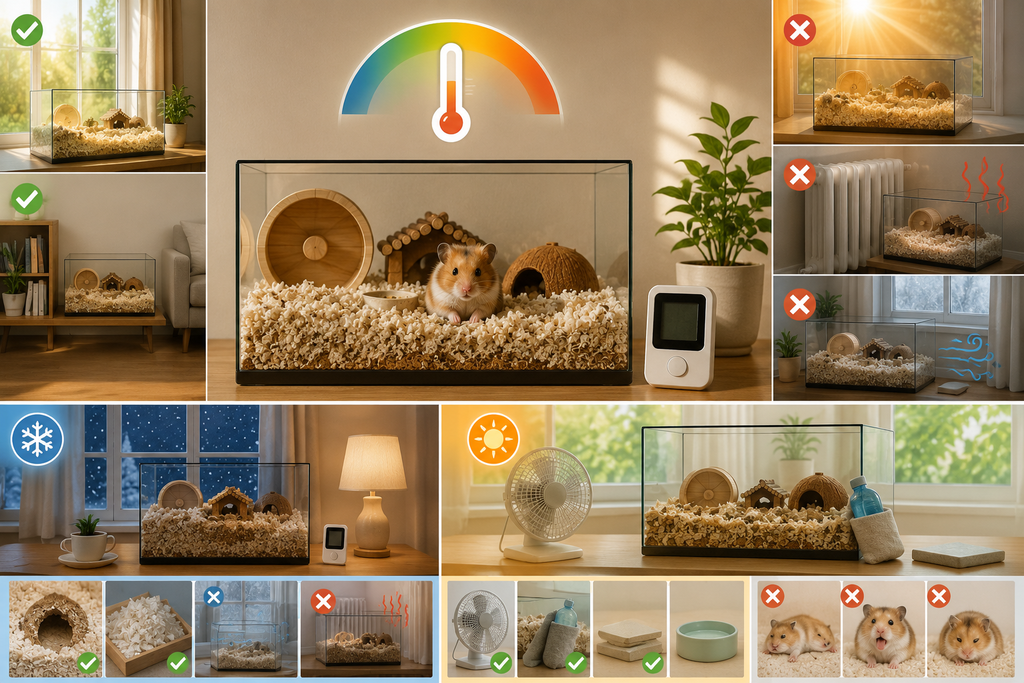
Keep a hamster indoors in a stable, moderate-temperature room, away from draughts, direct sunlight, radiators, and other strong heat sources.
For a practical target, both PDSA and Woodgreen currently recommend around 18 to 21°C (64 to 70°F). That is a useful care range, but it should not be treated as a sharp biological threshold where one degree suddenly causes torpor or heatstroke.
Cold conditions can trigger torpor, while excessive heat can cause dangerous overheating. The safest approach is to keep the room stable, use a thermometer near the enclosure, and respond to the hamster’s condition rather than relying on internet temperature cut-offs.
What temperature should a hamster room be?
PDSA recommends keeping a hamster’s enclosure at a steady 18 to 21°C and away from draughts and direct sunlight.
Woodgreen gives the same approximate range, recommending a room temperature of around 18 to 21°C throughout the year to reduce the risk of cold-induced torpor.
So for most homes:
Aim for roughly 18 to 21°C (64 to 70°F), with as little sudden fluctuation as practical.
That is narrower than the commonly repeated 65 to 75°F range, but it has clearer support from current hamster-care organizations.
A room being briefly a little warmer than 21°C does not automatically mean a hamster is in danger. Likewise, dropping just below 18°C does not prove that torpor will occur.
Temperature guidance works better as a target than as a countdown to an emergency.
Is 65°F too cold for a hamster?
Not automatically.
The original version of this article said that temperatures below about 65°F could cause torpor. That is too precise.
Torpor is a controlled reduction in metabolism and body temperature that can be influenced by environmental temperature, food availability, seasonal light cycles, and species.
Research on Syrian hamsters has even documented torpor under controlled seasonal conditions across ambient temperatures ranging from approximately 8 to 22°C.
That does not mean a pet Syrian should be kept at 8°C or that 22°C is dangerous. Laboratory torpor research is studying physiology under carefully controlled conditions, not establishing pet-room temperature limits.
For pet care, the better message is much simpler:
Keep the room around the recommended 18 to 21°C range and do not intentionally expose a hamster to cold conditions.
What is torpor?
Torpor is a temporary state in which metabolic activity, heart rate, and body temperature fall substantially.
A hamster in deep torpor may:
- feel unusually cool
- be limp or minimally responsive
- breathe extremely slowly
- remain curled in its nest
- show only tiny movements
Woodgreen warns that cold-induced torpor in pet hamsters can put them at risk of hypothermia and may be fatal.
PDSA also warns that a hamster kept too cold may enter this dangerous survival state.
Pet hamster torpor should therefore not be treated as healthy winter hibernation.
Is there a specific temperature that causes torpor?
There is no single useful household number that guarantees torpor.
This is one area where even care sources use different wording.
PDSA recommends keeping hamsters at 18 to 21°C and says that if you suspect torpor, check whether the room has fallen below 20°C.
Woodgreen also recommends 18 to 21°C to help prevent torpor.
Blue Cross explains that hamsters can enter torpor when they become too cold but does not use a single current pet-care cut-off on its main hamster guide.
Scientific research makes the picture even less suitable for a simple threshold because torpor is affected by more than ambient temperature alone.
So I would remove claims such as:
- below 65°F causes torpor
- 41°F is the point where torpor becomes serious
- keeping a room above 65°F guarantees prevention
Those numbers create more certainty than the evidence supports.
What should you do if you think your hamster is in torpor?
A cold, motionless hamster can be difficult to distinguish from a hamster that is severely ill or has died.
Do not assume torpor based only on the room temperature.
Woodgreen recommends moving a suspected torpid hamster to a warmer room, warming it gradually, and contacting a veterinarian as soon as possible.
Do not:
- place the hamster directly on a hot radiator
- immerse it in hot water
- apply intense direct heat
- rapidly overheat the enclosure
Gentle body warmth or a wrapped warm heat source may help while veterinary advice is being arranged.
If you find your hamster cold and unresponsive, see hamster hibernation or dead? for a more detailed guide.
How hot is too hot for a hamster?
There is good support that hamsters are vulnerable to excessive heat, but I would remove the claim that 80°F (27°C) is a universal heatstroke threshold.
VCA notes that hamsters do not tolerate heat well and should be kept in a cool area during hot weather.
PDSA also warns that hamsters and other small pets are sensitive to heatwaves and may have difficulty regulating their body temperature.
However, the current veterinary and welfare guidance I found does not establish one exact room temperature at which every hamster develops heatstroke.
Risk depends on more than the thermometer alone, including:
- direct sunlight
- ventilation
- enclosure design
- humidity
- duration of heat exposure
- access to water
- the hamster’s health and age
So avoid thinking:
26°C = safe, 27°C = heatstroke.
Instead, prevent the enclosure from becoming hot and watch closely during warm weather.
Signs a hamster may be overheating
PDSA lists heat-related warning signs in small pets including:
- drooling
- low energy
- eating less or refusing food
- short, rapid breaths
- lying stretched out or flat
- marked lethargy
- loss of consciousness
- seizures
A hamster showing signs consistent with heatstroke needs immediate veterinary attention.
Do not assume lying stretched out by itself proves heatstroke. A hamster may change sleeping position for many reasons.
The concern is a combination of hot environmental conditions and abnormal behavior or physical signs.
For a general illness checklist, see signs of a sick hamster.
Direct sunlight is a bigger problem than it looks
Never place a hamster enclosure in direct or constant sunlight.
PDSA warns that small-pet enclosures can overheat quickly in sunlight.
Woodgreen likewise recommends positioning hamster housing away from direct or constant sunlight.
The room can still have a normal natural day-night cycle. The problem is having strong sunlight falling directly onto the enclosure.
This matters particularly with enclosures that have solid sides because heat can build up when ventilation is limited.
Keep the enclosure away from draughts and radiators
Cold airflow and direct heating are both poor ways to regulate a hamster enclosure.
Woodgreen recommends positioning hamster housing:
- away from windows and draughts
- away from radiators and other heat sources
- away from direct sunlight
RSPCA similarly says hamsters should not be exposed to draughty or damp conditions.
Do not place the cage directly beside a heater in winter to “make sure the hamster is warm.” That can create a highly uneven environment and may overheat one side of the enclosure.
Warm the room, not the hamster.
How to keep a hamster cool in summer
The first priority is controlling the room temperature rather than repeatedly placing freezing objects inside the cage.
During hot weather:
- move the enclosure away from sunlight
- close curtains or blinds on the sunny side of the room
- keep the room cool and ventilated
- provide fresh water at all times
- check water bottles or bowls more frequently
- monitor the hamster for changes in appetite, breathing, or activity
PDSA says a fan can help keep air moving, but the enclosure should not sit directly in a continuous draught.
Can you use a frozen water bottle?
Yes, with an important placement detail.
PDSA suggests freezing a partially filled water bottle and placing it outside the enclosure so the animal can rest near the cooler area.
That is better than putting a frozen bottle directly into the cage, where the hamster could become too cold or chew the bottle.
Ceramic or china tiles and cups can also provide cool resting surfaces as long as they are stable, free of sharp edges, and cannot fall onto the hamster.
Should you spray or bathe a hot hamster?
Do not cool a hamster by putting it into cold water.
PDSA specifically warns against bathing small pets to cool them because the sudden temperature change can make them too cold.
Likewise, do not mist or soak a hamster simply because the weather is warm.
Control the room, provide water and suitable cool resting areas, and seek veterinary help if the hamster is showing signs of heat illness.
Does deep bedding help with temperature?
Deep bedding is important because it allows a hamster to build a proper burrow and nest.
Woodgreen recommends plenty of bedding and soft nesting material when discussing prevention of cold-related torpor.
That makes deep bedding a useful part of an appropriate winter setup, but it should not become an excuse for allowing the room itself to become too cold.
Bedding cannot replace a safe ambient temperature.
For current bedding-depth recommendations, see hamster bedding depth.
How to keep a hamster comfortable in winter
Focus on room stability rather than adding direct heat to the cage.
Useful steps include:
- keep the room within the recommended temperature range
- move the enclosure away from cold windows and exterior doors
- prevent direct draughts
- provide deep bedding and nesting material
- monitor the room with a thermometer
- check that overnight heating changes do not create very cold conditions
If the normal room cannot stay around the recommended temperature, Woodgreen advises moving the hamster to a warmer part of the home.
I would not recommend heat lamps as routine hamster equipment.
A direct heat source can create dangerously uneven temperatures, and a normal appropriately heated room is the simpler way to regulate the environment.
Do hamsters need a heating pad?
Usually not for routine husbandry.
A healthy hamster kept in an appropriately heated room with suitable bedding should not need a heating pad under its enclosure.
Heat pads or warm water bottles may have a role when carefully warming a suspected torpid hamster, and Woodgreen specifically discusses them in that context.
That is very different from leaving a permanent heater under one part of the enclosure.
If a veterinarian recommends supplemental heat because a hamster is sick or recovering, follow the specific instructions they give you.
Where should the hamster enclosure go?
Choose a position that is:
- indoors
- away from direct sunlight
- away from windows and cold draughts
- away from radiators and heaters
- away from air-conditioning airflow
- in a room where the temperature remains relatively stable
A simple digital thermometer placed near the enclosure is useful because the temperature beside a sunny window or exterior wall can differ from another part of the room.
For the rest of the habitat, see hamster cage setup.
The bottom line
For routine pet care, around 18 to 21°C (64 to 70°F) is the clearest current recommendation from PDSA and Woodgreen.
Do not turn that range into fake emergency thresholds. A hamster does not automatically enter torpor at 17.9°C, and there is no strong hamster-care evidence showing that 80°F is the universal point where heatstroke begins.
Instead, keep the temperature stable, avoid deliberate cold exposure, direct sunlight, draughts, and direct heat sources, and pay attention during unusually hot or cold weather.
A cold, unresponsive hamster may be in torpor but can also be seriously ill, so warm it gradually and contact a veterinarian. A hamster showing drooling, rapid breathing, marked lethargy, collapse, or other signs of heatstroke needs urgent veterinary care.
Sources
Woodgreen: Hamster hibernation and torpor
Woodgreen: Caring for hamsters
RSPCA: Creating a good home for hamsters