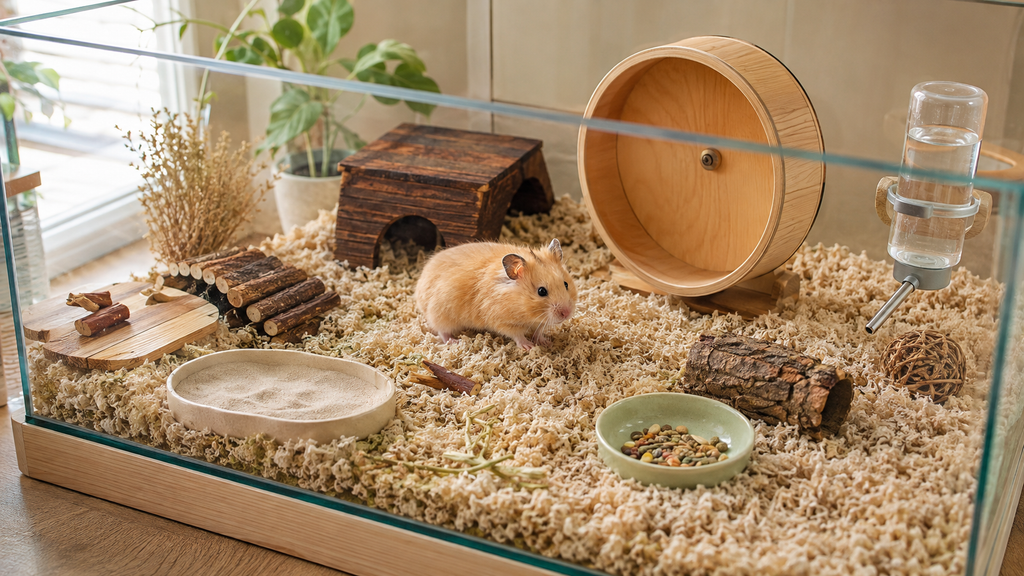
Hamsters are often sold as easy pets that need little more than a small cage, food bowl and wheel. That picture is misleading. A hamster is small, but it still needs room to run, deep bedding for burrowing and an environment where it can behave like a hamster.
The setup takes the most work. Once the enclosure, wheel, bedding and feeding routine are right, daily care is much easier to manage. This hamster care guide covers what to prepare, what to feed, how to build trust and which health changes should not wait.
1. Is a hamster the right pet for you?
1.1 Hamsters are small, but they are not low-maintenance decorations
A hamster does not need walking or constant attention, but that does not make it disposable or maintenance-free.
The enclosure may take up more space than expected, and the initial setup can cost considerably more than the hamster itself. You will need deep bedding, an appropriately sized wheel, hides, a sand bath, enrichment and access to a veterinarian who treats hamsters.
The animal also needs to be observed every day. A hamster that does not enjoy handling still depends on its owner to notice changes in eating, movement, droppings, breathing and body condition.
1.2 Hamsters are most active in the evening and at night
Most pet hamsters sleep during much of the day and become active in the evening or at night. This schedule may not suit someone who wants an animal to play with in the morning or afternoon.
Waking a hamster for interaction can frighten it and increase the chance of defensive biting. The wheel, chewing and digging may also create noise during the night, so think carefully before placing the enclosure in a bedroom.
1.3 Most pet hamsters should live alone
Syrian and Chinese hamsters must be housed individually. They are territorial and can seriously injure one another.
Guidance for dwarf hamsters is not completely uniform. The RSPCA notes that some established dwarf pairs or groups may coexist, but they do not need companions and may begin fighting later. PDSA advises housing domesticated Russian dwarf hamsters separately.
For a beginner, one hamster per enclosure is the safest choice. Do not mix species or sexes, and do not buy a second hamster because the first appears “lonely.” Read more about whether hamsters should live together.
1.4 How long do hamsters live?

Hamsters usually live for approximately two to three years, according to PDSA hamster care guidance, although species, genetics, health and care can affect lifespan.
Their short lifespan does not reduce the responsibility involved. You still need to plan for veterinary care, daily observation and possible age-related changes throughout the hamster’s life.
1.5 Children need adult supervision
Hamsters are small, fast and easily injured if dropped. They may bite when frightened, awakened or restrained too tightly.
An adult should remain responsible for feeding, cleaning, health checks and veterinary decisions. A hamster should not be treated as a child’s practice pet or left entirely in a young child’s care.
2. Which type of hamster should you get?
The commonly kept hamsters are different species, not simply color variations of one animal.
| Type | What beginners should know | Housing note |
| Syrian hamster | The largest common pet hamster and physically easier to hold once tame | Must live alone and needs room for a large wheel |
| Campbell’s or Winter White dwarf | Small and quick; pet store hamsters may be hybrids rather than one clearly identified species | Individual housing is safest, with narrow bar spacing |
| Roborovski hamster | Very small and fast, often better suited to observation than frequent handling | Needs an exceptionally secure enclosure and benefits from a larger sand area |
| Chinese hamster | Longer-bodied, agile and capable of climbing | Must live alone and needs an escape-resistant enclosure |
A Syrian is often easier for a new owner to handle because of its size, but no species is guaranteed to be friendly. Personality, previous experiences and the taming process all matter.
Use the full guide to common pet hamster species before choosing one based only on appearance.
3. What do you need before bringing a hamster home?
Prepare and test the entire enclosure before the hamster arrives.
Essential supplies
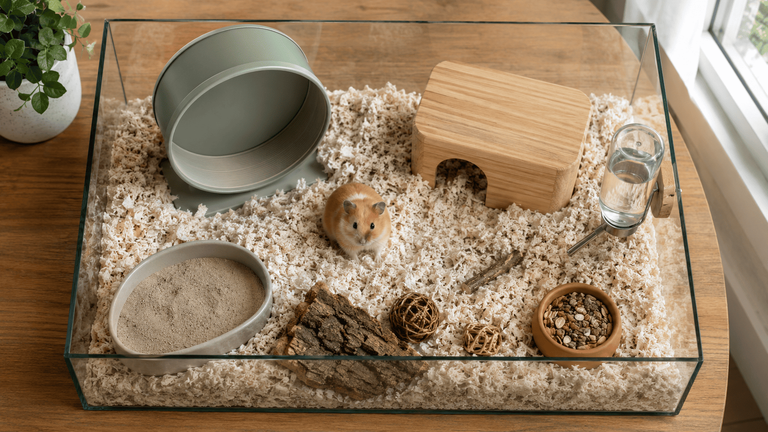
- Enclosure with at least 100 × 50 cm of floor space
- Secure mesh lid or properly locking doors
- Deep, safe bedding
- Correctly sized solid upright wheel
- Dark nesting box or multichamber hide
- Additional hides and tunnels
- Sand bath with hamster-safe sand
- Balanced commercial hamster food
- Water bottle or stable water bowl
- Safe chew materials
- Platforms for the wheel and heavy accessories
- Secure carrier
- Small digital scale
- Contact details for a veterinarian who treats hamsters
Optional but useful
- Cork logs
- Clearly identified seed sprays sold for small-animal foraging
- Dig boxes
- Suitable branches or grapevine
- Foraging toys
- Secure playpen
- Night camera
Do not add a hamster ball or cotton-style nesting fluff to the list. Neither is necessary for good care.
Test the wheel, water bottle, doors and lid before bringing the hamster home. Finding a blocked bottle or escape gap after the animal arrives is much harder to manage.
4. Hamster cage size requirements

4.1 How large should a hamster cage be?
Provide at least 100 cm long × 50 cm wide, or approximately 39 × 20 inches, of continuous floor space. This is about 775 square inches.
Syrian and Chinese hamsters should have an enclosure around 50 cm high. Dwarf and Roborovski hamsters need at least approximately 40 cm of height, although additional height makes it easier to combine deep bedding with a safe wheel.
These dimensions are a practical starting point, not an upper limit. More space is useful when it is furnished with bedding, hides, cover and enrichment.
Current Blue Cross hamster care guidance recommends housing no smaller than 100 × 50 × 50 cm. Woodgreen’s hamster housing guidance uses the same floor dimensions for the commonly kept species, with different minimum heights.
Our guide to hamster cage size requirements explains how to measure usable floor space and why product labels such as “large hamster cage” are unreliable.
4.2 Floor space matters more than levels
Shelves can provide extra surfaces, but they do not replace a large base.
Hamsters are ground-dwelling burrowers. They need horizontal room for a nest, wheel, sand area, foraging and underground tunnels. Tall cages with several narrow levels may provide less useful space and create fall risks.
Measure the main uninterrupted floor. Do not add shelf areas together to make an undersized base appear adequate.
4.3 Tank, barred cage or plastic enclosure?
| Enclosure type | Advantages | Limitations |
| Glass tank or aquarium-style enclosure | Holds deep bedding, easy to observe, no bars to bite | Heavy and requires a secure mesh lid with good ventilation |
| Large barred cage | Strong airflow and convenient attachment points | Base trays may be shallow, bedding can scatter and bars allow climbing or gnawing |
| Large plastic or acrylic enclosure | Lighter than glass and often holds bedding well | Ventilation, chewable edges and door security require careful checking |
| Modular tube cage | Colorful and visually appealing | Usually too small, difficult to clean and unable to replace continuous floor space |
The best enclosure is the one that provides enough usable floor area, ventilation, security and bedding depth while fitting a suitable wheel.
4.4 Bar spacing and escape prevention
Woodgreen recommends bar spacing of approximately:
- 1 cm or less for Syrian and Chinese hamsters
- 7 mm or less for dwarf and Roborovski hamsters
Check the areas around doors, corners, lid clips and bottle openings. A hamster may fit through a gap that looks impossibly small.
A mesh lid must be secured. Do not rely on the lid’s weight alone, especially if accessories give the hamster a route to the top.
5. How much bedding does a hamster need?
5.1 Hamster bedding depth
Provide at least 20 cm or 8 inches of compressed bedding. Where the enclosure allows, aim for 25 cm or more, with substantial bedding across most of the base.
Blue Cross gives 20 cm as a minimum, while PDSA recommends no less than 25 cm. Woodgreen advises at least six inches through most of the enclosure with a 10 to 12 inch digging area.
Treat 20 cm as a practical starting point, not an ideal maximum.
Measure after pressing the bedding down. A fluffy layer can lose considerable depth once the hamster walks on it.
5.2 Safe bedding for hamsters
Unscented paper-based bedding is the simplest option for most beginners because it is usually soft, absorbent and capable of holding tunnels when compressed.
Other supported materials include:
- Low-dust aspen
- Unscented hemp
- Shredded plain paper or cardboard as supplementary nesting and enrichment material
- Small amounts of soft, clean hay for additional structure
Not every product within a category is equally good. Avoid a bag that is unusually dusty, damp, moldy or strongly scented.
Read the detailed guide to safe hamster bedding before choosing a substrate based only on price or packaging.
5.3 Unsafe bedding and nesting materials
Avoid:
- Cotton wool
- Kapok
- Bamboo fluff
- Long-fiber “fluffy nesting material”
- Scented bedding
- Fine sawdust
- Excessively dusty substrate
- Cedar shavings
- Damp or moldy material
- Fabric, yarn and other difficult-to-break fibers
Long fibers can become tangled around the body or limbs and may cause harm if swallowed. Dusty or aromatic material may irritate the respiratory system.
The RSPCA warns specifically against cotton wool and similar fluffy products, even when they are marketed as nesting material.
5.4 How to make bedding hold burrows
Add bedding in layers and press each layer down firmly before adding the next. Do not compress it into a solid block, but make it stable enough that a small test hole does not immediately collapse.
A little soft hay between layers can add structure. A partially buried cork log, cardboard tube or floorless hide can provide an entrance that encourages digging.
Place wheels, sand baths and ceramic hides on platforms that transfer their weight to the enclosure base. A hamster may burrow beneath an unsupported object and cause it to sink.
Our guide to natural hamster burrowing behavior covers tunnel construction and collapse risks in more detail.
6. What should be inside a hamster cage?

6.1 A correctly sized wheel
A wheel should have:
- A solid running surface
- No mesh, rungs or open spokes
- A stable stand
- Enough width for comfortable movement
- A diameter that lets the hamster run without arching its back
Use these sizes as starting points rather than guarantees:
| Hamster | Practical starting size |
| Syrian hamster | About 11 to 12 inches / 28 to 30 cm |
| Chinese hamster | About 10 to 11 inches / 25 to 27 cm |
| Campbell’s or Winter White dwarf | About 9 to 10 inches / 22 to 25 cm |
| Roborovski hamster | About 8 to 9 inches / 20 to 22 cm |
These ranges align with current Blue Cross hamster wheel guidance. The hamster’s posture is the final test. If its back curves while running, size up.
A flying saucer can be additional enrichment when appropriately sized and safely positioned, but it should not replace a suitable upright wheel.
See the hamster wheel size guide for species-specific fitting advice.
6.2 Hides and a nesting area
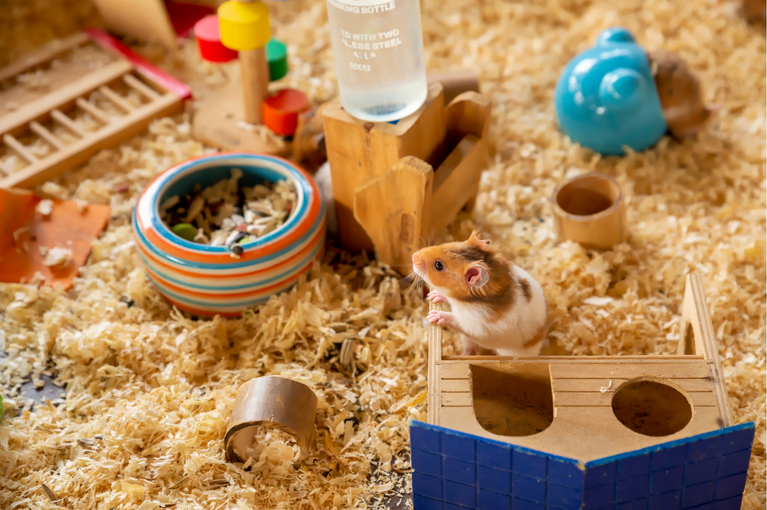
Every hamster needs a dark, enclosed sleeping space. A multichamber hide can provide separate areas for nesting and storing food, but a roomy single nesting box can also work.
Additional hides, cork logs and covered routes help the hamster move without crossing large exposed areas. A floorless hide can connect directly to the bedding below.
Check that entrances are wide enough for the hamster to pass through while carrying food in full cheek pouches. The hide should be stable and free from sharp or damaged edges.
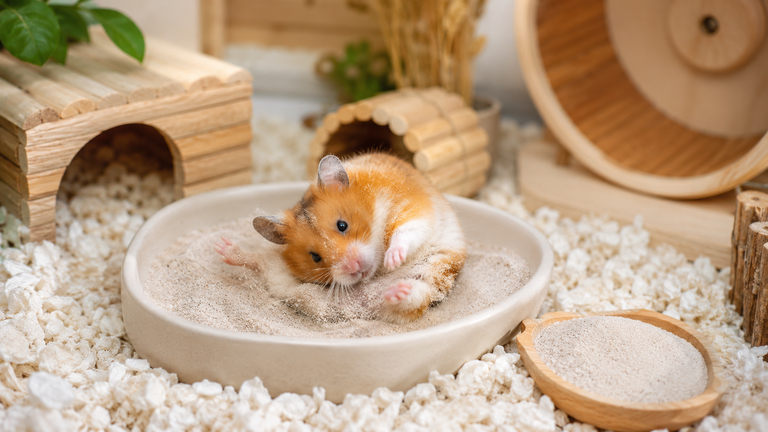
6.3 A sand bath
Hamsters use sand for grooming, digging and sometimes toileting.
Choose hamster-safe sand that is low in dust. Do not use fine chinchilla dust or bathing powder, which can create airborne particles.
The container should be large enough for the hamster to turn and dig. Roborovski hamsters often benefit from a larger sand area, but sand cannot replace deep main bedding.
6.4 Safe materials to chew
Suitable chewing options include:
- Plain cardboard
- Natural cork
- Hamster-safe untreated wood
- Appropriately prepared safe branches
- Purpose-made chew items without paint, string or small detachable parts
Chewing helps support natural tooth wear, but a toy cannot correct already overgrown or misaligned teeth. The Merck Veterinary Manual advises veterinary treatment when normal gnawing no longer keeps the incisors worn properly.
6.5 Enrichment and foraging
Useful enrichment creates opportunities to dig, search, chew and explore. Options include:
- Scatter feeding
- Cork tunnels
- Cardboard boxes and tubes
- Dig boxes with a different safe substrate
- Clearly identified seed sprays
- Safe herbs
- Foraging toys
- Additional covered routes
Do not replace every object at once. A hamster relies on familiar scents and territory. Rotate a small number of items while keeping the nest and core layout stable.
Explore these hamster enrichment ideas after the basic enclosure, bedding and wheel are correct.
7. What do hamsters eat?
7.1 Balanced hamster food should be the staple
Choose a commercial food formulated specifically for hamsters. The product should provide a balanced staple rather than function only as a colorful treat mix.
Pellets or uniform pieces can reduce selective eating. A well-formulated seed mix can offer variety and foraging value, but the overall formula still matters.
Follow the feeding directions for the specific product and adjust with veterinary guidance if the hamster is underweight, overweight, growing, pregnant or ill. Do not apply one universal tablespoon measurement to every food and species.
7.2 Hamsters are omnivores
Hamsters eat both plant and animal material. Small additions to an appropriate staple may include:
- Safe vegetables
- Plain culinary herbs
- Occasional fruit
- A small amount of cooked egg or an appropriate insect protein
- Extra high-fat seeds or nuts outside the staple diet as controlled treats
These foods should add variety, not replace the staple diet. Consult the complete guide to what hamsters can safely eat before offering unfamiliar food.
7.3 Fresh water must always be available
Replace or refresh water daily. Check a bottle nozzle for blockage and leakage rather than assuming it is working.
A stable bowl is also an option when the hamster can reach it safely. Use a heavy bowl and place it on a platform so it cannot tip or become buried in bedding.
Whichever system you choose, keep it clean and confirm that the hamster is actually drinking from it.
7.4 Scatter feeding supports natural behavior
Instead of placing all dry food in a bowl, scatter some through the enclosure or hide small portions in cardboard and foraging toys.
This encourages searching and food collection. It also helps turn feeding into an activity rather than a few seconds at a bowl.
Continue monitoring the total amount provided. An empty dish does not always mean the hamster ate everything. It may have moved the food into an underground hoard.
7.5 Introduce new foods gradually
Sudden dietary changes can cause digestive upset. Introduce one new fresh food at a time in a small amount.
Remove damp leftovers before they spoil. During spot-cleaning, inspect food stores without destroying the whole nest. Leave dry, safe staple food in place and remove anything moldy, wet or perishable.
7.6 Foods to avoid
Never offer:
- Chocolate
- Caffeine
- Alcohol
- Rhubarb
- Moldy or spoiled food
- Highly salted or seasoned human food
- Candy and very sugary processed food
- Sticky foods that may lodge in the cheek pouches
- Any plant or food whose safety has not been established
The wider list of foods hamsters should never eat explains specific hazards and what to do after a possible exposure.
8. Understanding normal hamster behavior

8.1 Burrowing
Hamsters dig to sleep, hide, store food and create secure routes. A hamster that spends much of the day underground is not necessarily unhappy.
Do not dismantle the burrow simply because you want to see the hamster more often. Observe during its natural active hours and monitor food, water and droppings.
8.2 Food hoarding
Carrying food in the cheek pouches and storing it is normal. A bowl that empties quickly may indicate that the hamster moved its food rather than ate it all.
Remove stored food only when it is wet, moldy or perishable. Repeatedly taking away a safe dry hoard may encourage more frantic storing.
8.3 Sleeping during the day
Most hamsters rest during daylight hours. Do not wake one for play or taming.
Some hamsters appear only after the room is dark and quiet. A night camera, tracks in the sand bath and changes in scattered food can help confirm activity.
8.4 Chewing and digging
Chewing cardboard, moving bedding and digging are natural behaviors. Persistent bar biting or scratching one bare corner for long periods is different and may suggest that the environment is not meeting the hamster’s needs.
Use our guide to signs your hamster may be stressed when a behavior becomes repetitive or changes suddenly.
8.5 Scent marking
Hamsters use scent to recognize their environment. A complete removal of every familiar smell can be disruptive.
Avoid scented bedding and heavily fragranced cleaners. Preserve some clean old bedding when cleaning or moving the hamster into a new enclosure.
9. How to tame and handle a hamster
9.1 Let a new hamster settle
Have the enclosure ready before arrival. During the initial adjustment period, limit interaction to food, water and necessary safety checks.
There is no universal number of days after which every hamster is ready to be handled. Watch the individual. A hamster that eats and explores around you is showing more readiness than one that freezes or flees whenever you approach.
9.2 Build trust gradually
Try this sequence:
- Sit near the enclosure and speak softly.
- Offer a small treat near the entrance.
- Rest your hand still inside the enclosure.
- Let the hamster approach and step onto your palm.
- Lift your hand only slightly once the hamster remains relaxed.
- Move to short sessions in a secure playpen.
Do not chase the hamster around the enclosure or drag it from its nest. The detailed guide to taming a hamster gradually covers each stage.
9.3 Pick up a hamster safely
Use both hands to form a cup and support the hamster’s whole body. Keep your hands low over the floor, your lap or another stable surface.
For an untamed hamster, let it walk into a mug, tunnel or small container and move the container carefully.
Do not lift a hamster by its legs, tail or loose skin. Avoid grabbing from above.
9.4 Respect warning signals
Stop the interaction if the hamster:
- Freezes for an extended period
- Flees repeatedly
- Chatters its teeth
- Screams or squeaks unusually
- Lunges
- Tries to jump from your hand
A hamster that prefers limited handling can still have a good quality of life. Taming should build trust, not force physical contact.
9.5 Avoid hamster balls
Hamster balls restrict access to food, water and hiding places. The hamster cannot choose to leave, and its ability to investigate through scent and touch is limited. Collisions, trapped feet and poor ventilation are additional concerns.
Blue Cross states that hamster exercise balls should not be used. A secure playpen or hamster-proofed area with supervision is a better option.
10. How to clean a hamster cage without causing unnecessary stress
10.1 Daily checks
Each day:
- Refresh or check the water
- Confirm the bottle or bowl works
- Remove spoiled fresh food
- Check for wet bedding
- Observe droppings and activity
- Make sure the wheel and doors remain secure
10.2 Spot-clean as needed
Every few days, or whenever you find a soiled area:
- Remove urine-soaked bedding
- Clean dirty sections of the sand bath
- Remove spoiled food
- Check for bottle leaks
- Leave dry burrows and nesting material in place
Do not discard a safe dry food hoard just because it looks untidy.
10.3 Deep-clean according to the enclosure
A large enclosure that is spot-cleaned well often does not need every piece of bedding replaced weekly.
Cleaning frequency depends on enclosure size, bedding volume, moisture and the hamster’s toileting habits. The RSPCA notes that a deeper clean once or twice a month may be sufficient in many cases.
When more extensive cleaning is needed:
- Wait until the hamster is awake.
- Move it into a secure carrier with familiar bedding.
- Remove wet, moldy and heavily soiled material.
- Clean accessories with a suitable pet-safe product.
- Rinse and dry everything completely.
- Return some clean old bedding and nesting material.
- Rebuild the familiar areas without changing the entire layout unnecessarily.
11. How to keep your hamster healthy
11.1 Learn the normal baseline
Observe your hamster often enough to know its usual:
- Active hours
- Appetite
- Water intake
- Droppings and urine
- Weight
- Grooming
- Wheel use
- Walking and balance
- Response to interaction
A change from that baseline can be more useful than a generic symptom list.
11.2 Perform regular health checks
When the hamster is awake and comfortable, check:
- Eyes and nose for discharge
- Front teeth for unusual length or misalignment
- Mouth area for drooling
- Cheek pouches for persistent swelling
- Skin and coat
- Feet and nails
- Abdomen for visible lumps or swelling without pressing or squeezing it
- Hindquarters for staining
- Breathing
- Body condition and weight
Do not cut hamster teeth at home. Dental trimming and examination should be performed by a veterinarian.
11.3 Signs of a sick hamster
Merck Veterinary Manual lists inactivity, appetite or weight loss, discharge, a hunched posture, an abnormal walk, coat changes, diarrhea and breathing trouble as warning signs. Contact a hamster-experienced veterinarian if you notice:
- Loss of appetite
- Weight loss
- Lethargy during normal active hours
- Hunched posture
- Rough or unkempt coat
- Hair loss with skin changes
- Diarrhea or a wet rear
- Discharge from the eyes, nose, ears or genital area
- Rapid, noisy or labored breathing
- Abnormal walking, circling or loss of balance
- A wound, lump or swelling
- Drooling
- A clear change in urine or feces
Hamsters can conceal illness and deteriorate quickly. Do not wait several days when the hamster is not eating, has diarrhea, struggles to breathe or cannot balance.
Read the full guide to signs your hamster may be sick.
11.4 Wet tail requires prompt veterinary care
“Wet tail” does not simply mean that water touched the fur.
Watery diarrhea, a wet or heavily soiled rear, lethargy, hunching and loss of appetite can indicate a serious intestinal illness. Merck notes that proliferative ileitis can progress rapidly and may be fatal. Contact a veterinarian promptly rather than attempting home treatment.
Do not give human medicine, leftover antibiotics or an over-the-counter pet store remedy without veterinary direction. Learn more about wet tail in hamsters.
11.5 Find a veterinarian before an emergency
Not every veterinary clinic regularly treats hamsters. Call nearby clinics and confirm that a specific veterinarian sees them.
Save:
- Clinic name and phone number
- Regular opening hours
- Same-day appointment policy
- After-hours emergency option
- Directions and travel time
Keep a secure carrier ready with ventilation and enough space for familiar bedding and a hide.
12. A practical hamster care routine
| Frequency | Tasks |
| Every day | Check or replace water, provide the appropriate food amount, remove spoiled fresh food and observe activity and droppings |
| Every few days | Spot-clean wet bedding, inspect the sand bath, check food stores and look for bottle leaks |
| Every week | Perform a brief health check, inspect the wheel and enclosure and record weight when the hamster tolerates it |
| Every few weeks or as needed | Complete a partial or deeper clean while preserving clean familiar bedding |
| Regularly | Replace worn chew items, rotate some enrichment and check for damaged accessories or escape gaps |
| Immediately when needed | Contact a veterinarian for appetite loss, breathing difficulty, diarrhea, loss of balance, injury or sudden physical decline |
Use this hamster care guide routine as a starting point, not a fixed schedule that forces you to disturb the nest. Hygiene and health should determine when deeper cleaning is necessary.
13. Common beginner hamster care mistakes

Mistake 1: Buying a small starter cage
Many products marketed for hamsters do not provide 100 × 50 cm of usable floor space or enough height for deep bedding and a suitable wheel.
Mistake 2: Providing only a thin bedding layer
Bedding is not just a liner for absorbing urine. Hamsters need enough depth to construct a burrow.
Mistake 3: Using the wheel included with the cage
Starter-kit wheels are frequently too small, particularly for Syrian hamsters. Judge the wheel by the hamster’s running posture, not the species label on the packaging.
Mistake 4: Housing two hamsters together
A second hamster is not a cure for loneliness. Syrian and Chinese hamsters must live alone, and individual housing is the safest option for beginners with dwarf hamsters.
Mistake 5: Using fluffy cotton nesting material
The word “natural” does not make a long-fiber product safe. Use soft paper-based nesting material instead.
Mistake 6: Waking the hamster for handling
Wait until the hamster wakes naturally. Startling a sleeping hamster damages trust and increases the chance of biting.
Mistake 7: Replacing every piece of bedding each week
Unnecessary full cleaning destroys the nest, burrow and familiar scent map. Spot-clean and preserve safe old bedding.
Mistake 8: Treating a hamster ball as exercise
Provide a correctly sized wheel and supervised playpen instead.
Mistake 9: Feeding too many treats
Fruit, nuts, seeds and commercial treats should not replace a balanced hamster food.
Mistake 10: Waiting when the hamster looks sick
Enclosure changes cannot treat diarrhea, breathing difficulty, dental disease or injury. Contact a veterinarian when physical symptoms appear.
Frequently asked questions
Are hamsters easy to take care of?
Daily care is manageable once the habitat is correct, but hamsters are not maintenance-free pets. They need a large enclosure, deep bedding, enrichment, balanced food, health monitoring and access to a veterinarian who treats hamsters. The initial setup usually requires more space and money than pet store starter kits suggest.
What does a hamster need in its cage?
A hamster needs a spacious enclosure, deep bedding, solid upright wheel, dark nesting hide, sand bath, covered routes, chew materials, enrichment, balanced food and fresh water. Wheels, sand baths and heavy ceramic items should stand on secure platforms rather than unsupported deep bedding.
What size cage does a hamster need?
Provide at least 100 × 50 cm, or approximately 39 × 20 inches, of continuous floor space. The enclosure must also be tall enough for deep bedding and a species-appropriate wheel. Shelves and narrow levels do not replace an adequately sized main floor.
How much bedding does a hamster need?
Provide at least 20 cm or 8 inches of compressed bedding, although PDSA recommends no less than 25 cm or 10 inches. Use a safe material that can support tunnels, such as unscented paper bedding, and place heavy accessories on platforms.
What size wheel does a hamster need?
Syrian hamsters commonly need an 11 to 12 inch upright wheel. Many dwarf hamsters need approximately 9 to 10 inches, while a small Roborovski may fit an 8 to 9 inch wheel. The hamster must be able to run without arching its back.
What do hamsters eat every day?
A balanced commercial hamster food should form the daily foundation. Small amounts of suitable vegetables, herbs or other extras can add variety. Treats should remain limited, and fresh water must always be available. Follow the feeding instructions for the specific staple food rather than using one amount for every formula.
Do hamsters need a friend?
No. Syrian and Chinese hamsters must live alone. Although some welfare guidance acknowledges that established dwarf groups may sometimes coexist, PDSA advises housing domesticated Russian dwarf hamsters separately. They do not require companions and can begin fighting unexpectedly, so individual housing is the safest approach.
How often should you clean a hamster cage?
Spot-clean wet bedding and remove spoiled food regularly. More extensive cleaning depends on enclosure size, bedding volume and toilet habits. A large, well-maintained habitat often does not need every piece of bedding replaced weekly. Preserve some clean familiar bedding during deeper cleans.
How long should you leave a new hamster alone?
There is no single timeline for every hamster. During the initial adjustment period, keep the environment quiet and limit interaction to necessary care. Increase contact only when the hamster is awake, eating normally and willing to approach without freezing or repeatedly fleeing.
How do you know if a hamster is sick?
Warning signs include not eating, weight loss, lethargy, hunched posture, rough fur, diarrhea, a wet rear, labored breathing, discharge, abnormal walking and changes in urine or feces. Because hamsters can decline quickly, contact a veterinarian rather than waiting when significant symptoms appear.
Good hamster care starts with the parts that cannot be replaced by extra toys: enough floor space, deep bedding, a suitable wheel and a balanced diet. Use this hamster care guide to set those up before bringing your hamster home, then build trust at its pace and learn what its normal behavior looks like. That baseline will help you notice health problems earlier and make better decisions throughout its life.